
ExamQuark
Getting things ready
Your next step is almost ready.
Your progress
0
Correct
0
Wrong
0%
Accuracy
0 s
Time spent
—
Percentile
Questions by year
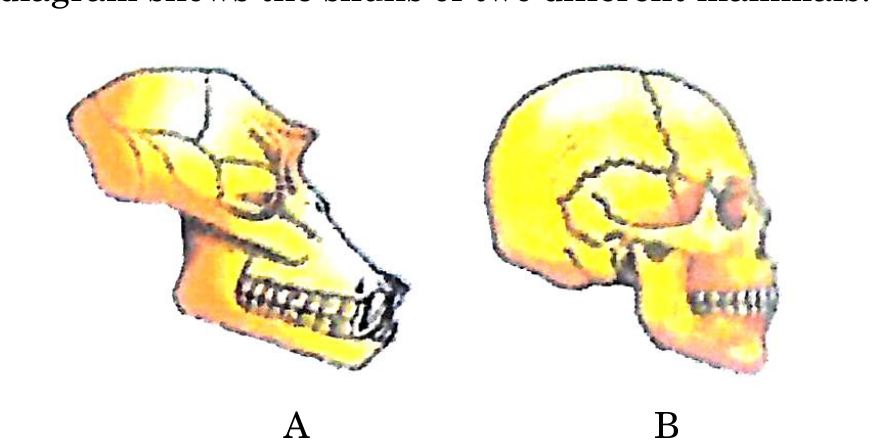 The given diagram shows the skulls of two different mammals.
Which of the following options accurately describes the differences between these skulls ?CBSE 12th Biology 2026 Set 57/4/1MCQ›17Explain the three different ways in which natural selection operates. Explain with the help of graphs.CBSE 12th Biology 2026 Set 57/4/13 marks · Notebook›18(a) (i) Rearrange the following in correct order of their appearance on Earth between 2 million years and 40,000 years ago :
Homo Neanderthalensis, Australopithecus, Homo erectus, Homo habilis
(ii) Which one of the above :
(I) had the largest brain size ?
(II) ate fruits ?
OR
(b) (i) What is natural selection ?
(ii) Explain the type of natural selection that promotes evolutionary change. Give an example.CBSE 12th Biology 2026 Set 57/3/32 marks · Notebook›19Assertion (A) : Hardy-Weinberg principle says that allele frequencies in a population are stable.
Reason (R) : Hardy-Weinberg principle is applicable only when genetic drift does not occur.CBSE 12th Biology 2026 Set 57/3/2MCQ›20Appearance of antibiotic-resistant bacteria is an example of evolution due to :CBSE 12th Biology 2026 Set 57/3/1MCQ›21Identify the statements that correctly describe Darwin's Theory of Evolution.
(i) Overproduction of organisms leads to competition.
(ii) Variation is inherited and causes evolution.
(iii) Acquired characters are inherited.
(iv) Survival depends on favourable traits.
(v) New species arise due to accumulation of favourable variations.
Choose the correct option.CBSE 12th Biology 2026 Set 57/3/1MCQ›22(a) (i) Mention any two characteristics of Neanderthal man that lived near East and Central Asia.
(ii) Identify the following hominids with respect to human evolution :
(I) Brain capacity 900 cc, probably ate meat.
(II) First human-like with brain capacity 650 – 800 cc.
OR
(b) The allele for brown eyes (B) is dominant over blue eyes (b). In a population, 36% of individuals have blue eyes.
Assuming Hardy-Weinberg equilibrium, calculate :
(i) Frequency of allele B
(ii) Percentage of heterozygous individuals
(iii) Percentage of individuals that are homozygous dominant
(Working to be shown)CBSE 12th Biology 2026 Set 57/3/12 marks · Notebook›23Assertion (A) : Under a particular set of selection pressure, organisms evolve towards the most efficient reproductive strategy.
Reason (R) : Populations evolve to maximise their reproductive fitness in the habitat where they live.CBSE 12th Biology 2026 Set 57/2/3MCQ›24(a) Compare homologous and analogous organs by giving any one point of difference.
(b) Mention the type of evolution each represents and give one example of each from plants and animals.CBSE 12th Biology 2026 Set 57/2/33 marks · Notebook›25Which one of the following evidences does not support Darwin’s theory of natural selection ?CBSE 12th Biology 2026 Set 57/1/3MCQ›26Assertion (A) : Fossils provide direct evidence for evolution.
Reason (R) : Fossils help to trace evolutionary relationships among organisms over time.CBSE 12th Biology 2026 Set 57/1/3MCQ›27Assertion (A) : When we see stars, we are apparently peeping into the past.
Reason (R) : What we see today is an object whose emitted light started its journey millions of years back reaching our eyes now.CBSE 12th Biology 2026 Set 57/1/2MCQ›
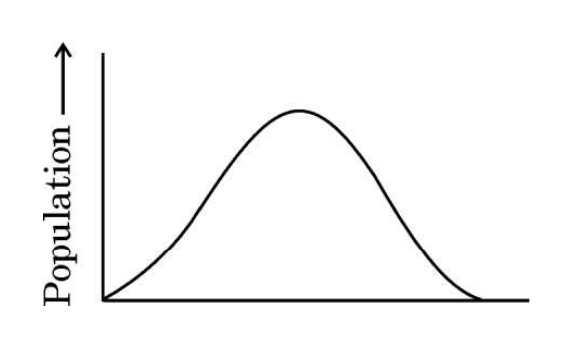 The given graph shows the range of variation among population members, for a trait determined by multiple genes. If this population is subjected to disruptive selection for several generations, which of the following distributions is most likely to result ?
Choose the correct option :CBSE 12th Biology 2025 Set 57/7/1MCQ›41A few stages and their respective time period in the evolutionary history of human beings are mentioned in the flowchart given below :
15 mya – Primates walking like gorillas and chimpanzees existed. (a)
↓
3 – 4 mya – Man-like primates walked in Eastern Africa. Fossils of their bones were discovered. (b)
↓
2 mya – This ancestor lived in the East African grasslands and ate fruits. (c)
↓
1.5 mya – This hominid had a brain size of 900 cc and probably ate meat. (d)
Based on the above information, answer the following questions :
(a) Name one primate about 15 mya.
(b) Name one place where fossils of primates were discovered in Eastern Africa.
(c) Name the ancestor that lived in the East African grasslands about 2 mya.
(d) Name the hominid that was found around 1.5 mya.CBSE 12th Biology 2025 Set 57/7/12 marks · Notebook›42(a) “The process of evolution of different species in a given geographical area starts from a point and literally radiates to other geographical areas.” Explain it with an example.
(b) Cite an example where more than one adaptive radiation has occurred in an isolated geographical area. Name the type of evolution your example depicts.CBSE 12th Biology 2025 Set 57/7/13 marks · Notebook›43Which of the following combinations is a correct example of convergent evolution in Australian marsupials and Placental mammals ?
Each option below gives: Australian Marsupials – Placental Mammals.CBSE 12th Biology 2025 Set 57/5/1MCQ›44Highly conserved proteins such as Haemoglobin and Cytochrome-C provide the best biochemical evidences to trace evolutionary relationships between different groups. Cytochrome-C is formed of 104 amino acids. Cytochrome-C is the respiratory pigment present in all eukaryotic cells. It has evolved at a constant rate during evolution. In chimpanzees and humans, Cytochrome-C genes are identical. The given data shows the evolution of the Cytochrome-C gene in different mammals from kangaroos, cows, rodents to humans :
Groups Nucleotide substitution in the gene of Cytochrome-C Millions of years ago
Human/Kangaroo 100 125 mya
Human/Cow 75 120 mya
Human/Rodent 60 75 mya
(a) Select the correct option for the time of separation of two groups and the number of nucleotide substitutions in the gene of Cytochrome-C :
Options Time of separation of two groups during evolution Number of nucleotide substitutions
(i) Lesser Greater
(ii) Greater Lesser
(iii) Greater Greater
(b) What do you infer about the type of evolution (convergent or divergent) for the given pair of groups and why ?
(i) Human and Kangaroo
(ii) Human and Rodent
(c) (i) Define convergent evolution.
OR
(c) (ii) Define divergent evolution.CBSE 12th Biology 2025 Set 57/5/14 marks · Notebook›45Evolution of modern man involves the following man-like primates. Choose the correct series of human evolution.CBSE 12th Biology 2025 Set 57/1/1MCQ›46Compare and contrast convergent and divergent evolution.CBSE 12th Biology 2025 Set 57/1/13 marks · Notebook›47The first human-like homonid evolved during human evolution is supposed to be :CBSE 12th Biology 2025 Set 57/4/3MCQ›48About 15 mya during human evolution, the primates which used to walk like gorillas and chimpanzees were :CBSE 12th Biology 2025 Set 57/4/1MCQ›49Read the following passage and answer the questions that follow.
The most convincing evidence to trace evolutionary relationships between humans and different groups of animals come from the basic similarities seen at the molecular level. Study the table given below that depicts the number of amino acid differences between the haemoglobin polypeptide of few animals with that of humans and answer the questions that follow.
S.No. Animal No. of amino acid differences in haemoglobin with that of humans
1. Macaque 08
2. Dog 32
3. Bird 45
4. Frog 67
5. Lamprey 125
(a) To which category of evolution (Divergent or Convergent) do the following evolutionary relationships belong to :
(i) Humans and Macaque
(ii) Humans and Frog
(b) What do the biochemical similarities in haemoglobin suggest about the evolutionary relationship between humans, frog and lamprey ?
(c) (i) Which one of the two – lampreys’ or macaques’ evolution is more closely related to humans and why ?
OR
(c) (ii) Which one of the two – frogs’ or dogs’ evolution is more closely related to humans and why ?CBSE 12th Biology 2025 Set 57/4/14 marks · Notebook›50Which one of the following options shows the correct evolutionary order of the plants mentioned below ?
(i) Ferns
(ii) Ginkgo
(iii) Zosterophyllum
(iv) Gnetales
Choose the correct option.CBSE 12th Biology 2025 Set 57/2/1MCQ›51Assertion (A) : The number of white winged moths decreased after industrialisation in England.
Reason (R) : Effects of industrialisation were more marked in rural areas of England.CBSE 12th Biology 2025 Set 57/2/1MCQ›52How does the process of Natural Selection affect Hardy-Weinberg equilibrium ? Explain with the help of graphs.CBSE 12th Biology 2025 Set 57/2/13 marks · Notebook›53The primates that probably lived in East Africa grasslands about two mya were :CBSE 12th Biology 2025 Set 57/4/2MCQ›54If a natural population with 50 individuals is in Hardy-Weinberg equilibrium for a gene with two alleles A and a, with the gene frequency of allele A of 0.6, the genotype frequency of Aa will be :CBSE 12th Biology 2025 Set 57/6/1MCQ›55In his observations of small black birds in the Galapagos Islands, Darwin found that all the finches arose from the original ancestor :CBSE 12th Biology 2025 Set 57/6/1MCQ›56Read the following passage and answer the questions that follow.
According to evolutionary theory, every evolutionary change involves the substitution of a new gene for the old one and the new allele arises from the old one. Continuous accumulation of changes in the DNA coding for proteins leads to evolutionary differences. The chemical composition of DNA is basically the same in all living beings, except for differences in the sequence of nitrogenous bases. Given below are percentage relative similarities between human DNA and DNA of other vertebrates :
S.No. Vertebrates Percentage similarities
1. Chimpanzee 100
2. Gibbon 94
3. Rhesus Monkey 88
4. Lemur 47
5. Treeshrew 28
6. Mouse 21
7. Hedgehog 19
8. Chicken 10
(a) What is the term used for the substitution of a new gene for the old one and the new allele arising from the old one during evolutionary process ?
(b) Which one of the following holds true for the data provided in the above table ?
(A) Greater the evolutionary distance, greater are the differences in the nitrogenous bases.
(B) Lesser the evolutionary distance, greater are the differences in the nitrogenous bases.
(C) Greater the evolutionary distance, lesser are the differences in the nitrogenous bases.
(D) Lesser the evolutionary distance, lesser are the differences in the nitrogenous bases.
(c) (i) To which category of evolution (divergent or convergent) does the following relationship belong to ? Justify your answer.
Human and Rhesus Monkey
OR
(c) (ii) Differentiate between Convergent and Divergent evolution.CBSE 12th Biology 2025 Set 57/6/14 marks · Notebook›
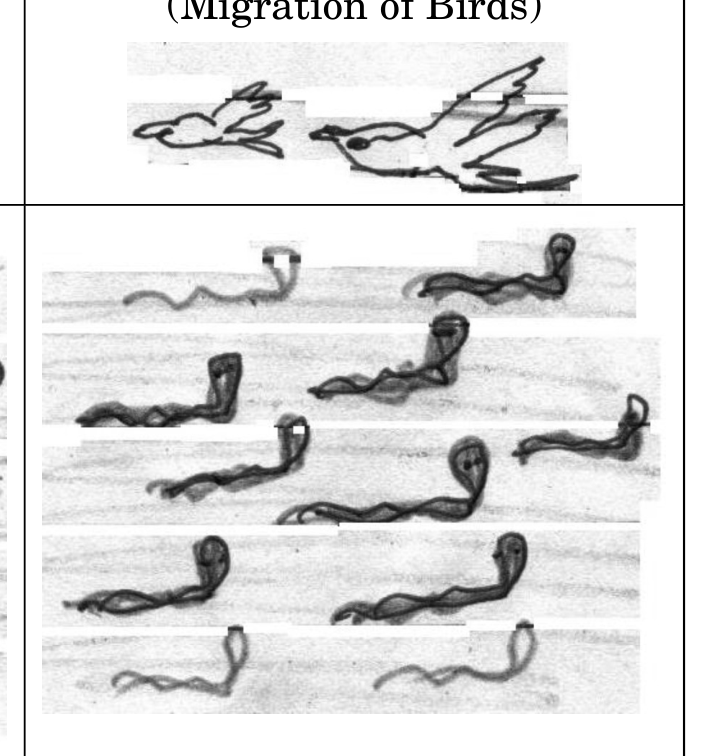 A population of snakes lived in a desert with brown sand. Study the drawings given below showing the change in the population from ‘one’ to ‘two’ over time and answer the question that follows. Brown snakes and Grey snakes are represented by alleles A/a (Dominant/recessive).
(a) If the frequency of the recessive trait is 9% in population-one, work out the frequency of homozygous dominant and heterozygous dominant snakes.
(b) Name the mechanism of evolution that must have operated so that population-two evolved from population-one.CBSE 12th Biology 2024 Set 57/3/13 marks · Notebook›62Louis Pasteur dismissed the theory of spontaneous generation by his experiments using pre-sterilised flasks and :CBSE 12th Biology 2024 Set 57/3/2MCQ›63After the 1850s in the post-industrialization era in England, the expected effect of natural selection on the number of white-winged moths as compared to the dark-winged moths was :CBSE 12th Biology 2024 Set 57/3/2MCQ›64The origin of life according to the early Greek philosophers was transfer of unit of life from outer space to the different planets in the form of :CBSE 12th Biology 2024 Set 57/3/3MCQ›65Who proposed the mutation theory in favour of organic evolution ?CBSE 12th Biology 2024 Set 57/4/1MCQ›66
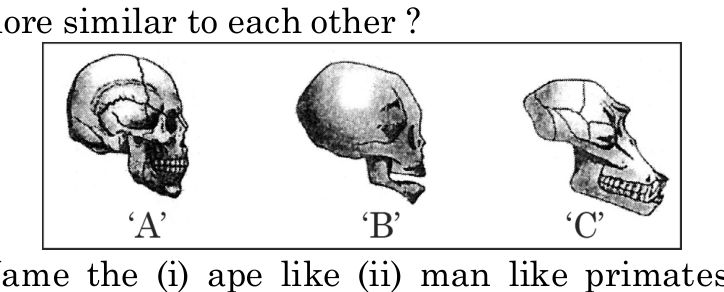 (a) Whose skulls ‘A’, ‘B’, and ‘C’ are shown below ? Which of the two are more similar to each other ?
(b) Name the (i) ape like (ii) man like primates that existed 1.5 million years ago.CBSE 12th Biology 2024 Set 57/4/13 marks · Notebook›67Homologous organs indicateCBSE 12th Biology 2024 Set 57/4/2MCQ›68Homologous organs indicate :CBSE 12th Biology 2024 Set 57/2/2MCQ›69(a) Natural selection operates in different ways in nature.
(i) Identify the type of natural selection depicted in the graph above.
(ii) In England after industrialisation, the population of dark winged moths were more favoured than white winged moth. Explain.
(iii) Anthropogenic action can enhance the rate of evolution. Explain with the help of an example.
OR
(b) (i) Why did Hershey and Chase use ‘ ^{35} S’ and ‘ ^{32} P’ in their experiment ? Explain.
(ii) State the importance of (1) blending and (2) centrifugation in their experiment.
(iii) Write the conclusion they arrived at the end of their experiment.CBSE 12th Biology 2024 Set 57/5/15 marks · Notebook›70Single step large mutation leading to speciation is also calledCBSE 12th Biology 2024 Set 57/5/2MCQ›71Which one of the following options gives the correct temperature condition and the mixture of the gaseous components that were used by S.L. Miller in 1953 to prove abiogenesis of life ?CBSE 12th Biology 2024 Compartment Set 57/S/1MCQ›72The most primitive ancestor of humans is :CBSE 12th Biology 2024 Compartment Set 57/S/1MCQ›73Differentiate between the explanations given by Darwin and de Vries respectively on the mechanism of evolution. Write any three differences.CBSE 12th Biology 2024 Compartment Set 57/S/13 marks · Notebook›74
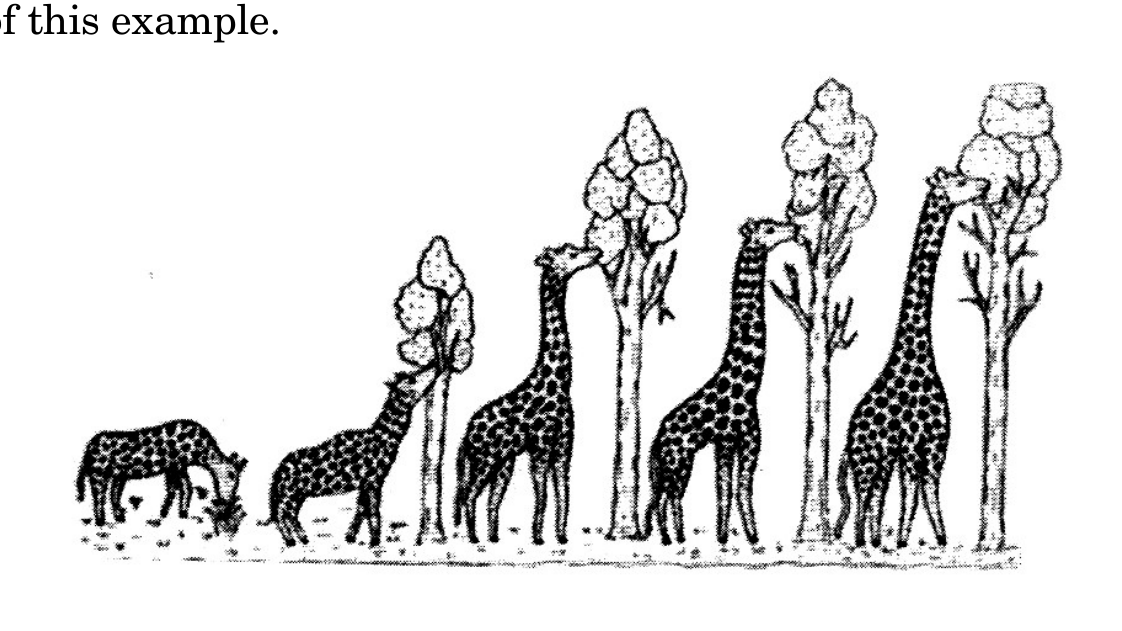 Observe the picture given below. Name the naturalist and write the explanation given by him that evolution of life forms had occurred on the basis of this example.CBSE 12th Biology 2024 Set 57/1/12 marks · Notebook›75(a) Explain the significance of the experiment carried out by S.L. Miller. Name the scientists whose hypothesis prompted him to carry out this experiment.
(b) How does meteorite analysis favour this hypothesis ?CBSE 12th Biology 2024 Set 57/1/13 marks · Notebook›76The scientist who proposed that “embryos of all vertebrates including humans develop a row of vestigial gill slits behind the head but it is a functional organ only in fish and replaced by lungs in all other vertebrates” is :CBSE 12th Biology 2024 Set 57/1/3MCQ›77Assertion (A) : Gene flow increases genetic variations.
Reason (R) : The random introduction of new alleles into a recipient population and their removal from donor population affects allele frequency.CBSE 12th Biology 2024 Set 57/1/3MCQ›78
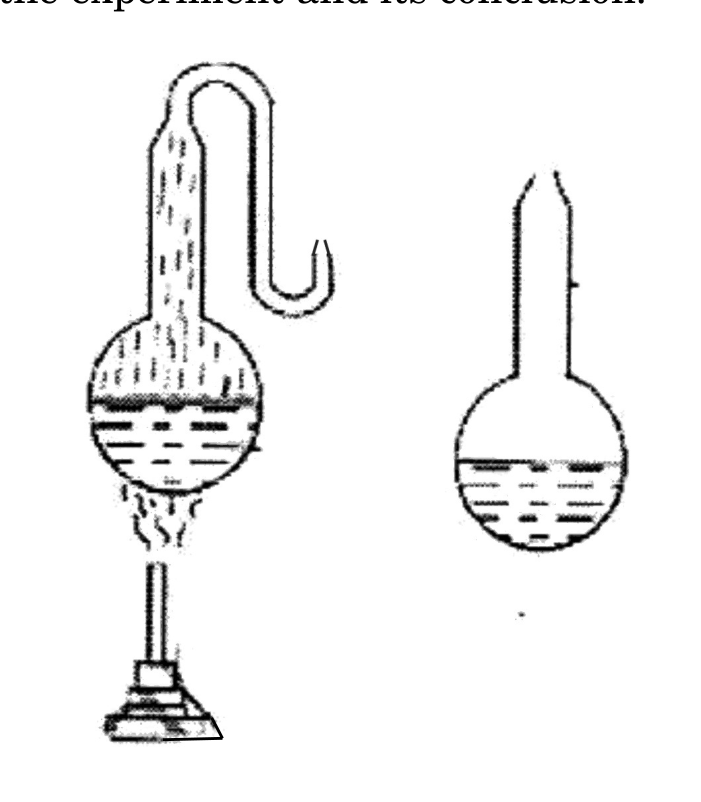 Given below is an illustration of the experiment performed by Louis Pasteur. Explain the experiment and its conclusion.CBSE 12th Biology 2024 Set 57/1/32 marks · Notebook›79Which one of the following statements is not true ?CBSE 12th Biology 2024 Set 57/2/1MCQ›80A population is in genetic equilibrium/Hardy-Weinberg equilibrium for a gene with 2 alleles (dominant allele is ‘A’ and recessive allele ‘a’). If the frequency of allele ‘A’ is 0.6, then the frequency of genotype ‘Aa’ is :CBSE 12th Biology 2024 Set 57/2/1MCQ›
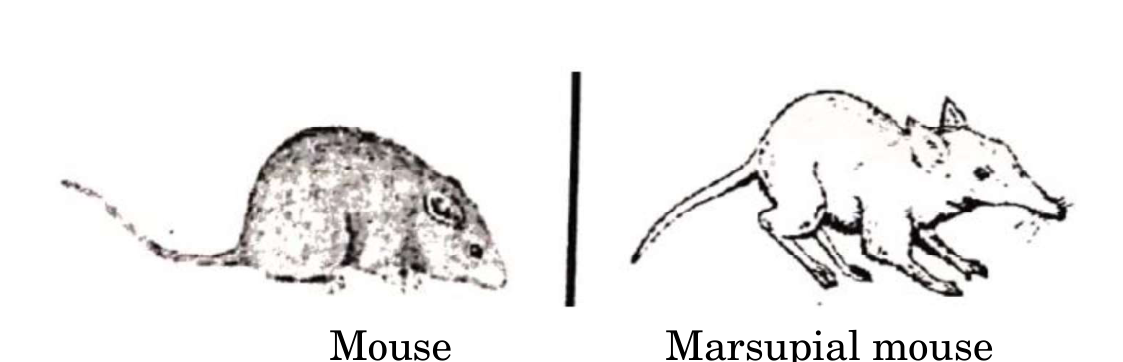 Identify the option that gives the correct type of evolution exhibited by the two animals shown, living in the same habitat in Australia.CBSE 12th Biology 2023 Set 57/3/1MCQ›89Assertion (A): The number of white winged moths decreased drastically after industrialisation in England.
Reason (R): Effects of industrialisation were more marked in rural areas of England.CBSE 12th Biology 2023 Set 57/3/1MCQ›90(a) Darwin’s theory of Natural Selection is widely accepted but some limitations have been identified by modern biologists. Mention the limitations identified.
(b) Name and state the most accepted theory of evolution in modern times.
(c) Mention any two ways the limitations identified in Darwin’s theory of evolution are explained in modern biology.CBSE 12th Biology 2023 Set 57/3/13 marks · Notebook›91(a) (i) Describe the phenomenon of adaptive radiation as explained by Darwin.
(ii) Is human evolution an example of adaptive radiation ? Give reason in support of your answer.
OR
(b) You are given a tall pea plant and asked to determine its genotype. Name and explain the cross that you will carry out to find the possible genotype of the given tall pea plant.CBSE 12th Biology 2023 Set 57/1/35 marks · Notebook›92
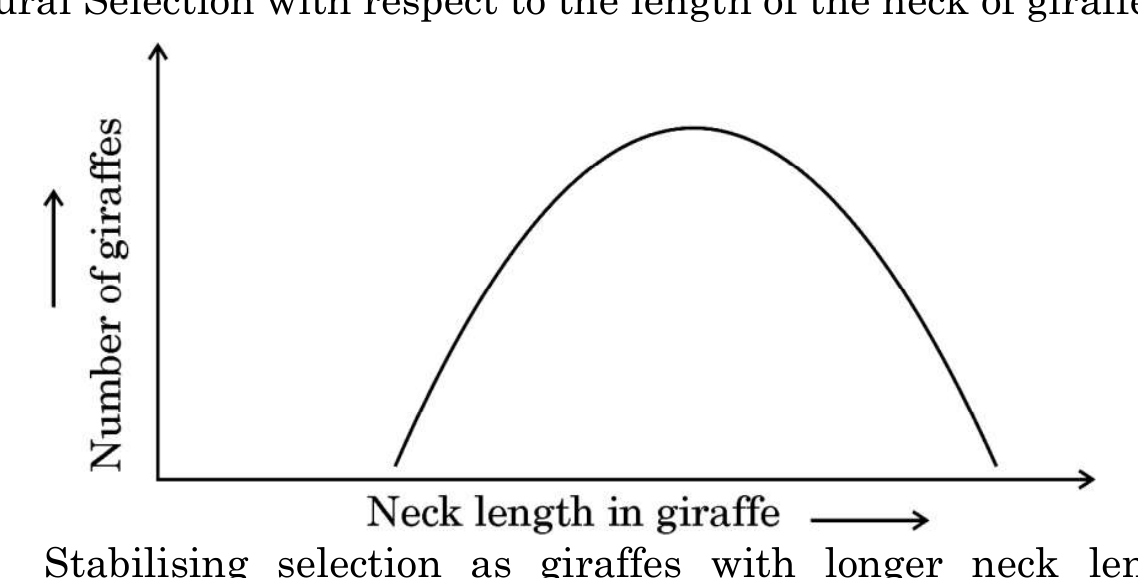 Select the option that gives the correct description of the process of Natural Selection with respect to the length of the neck of giraffe.CBSE 12th Biology 2023 Set 57/1/11 marks · Notebook›93(a) Name the two primate ancestors of the present day humans, who existed approximately about 15 million years ago.
(b) According to geological records, when and where did Australopithecines live ?
(c) Give two differences between Homo habilis and Homo erectus .CBSE 12th Biology 2023 Set 57/1/13 marks · Notebook›