
ExamQuark
Getting things ready
Your next step is almost ready.
Your progress
0
Correct
0
Wrong
0%
Accuracy
0 s
Time spent
—
Percentile
Questions by year
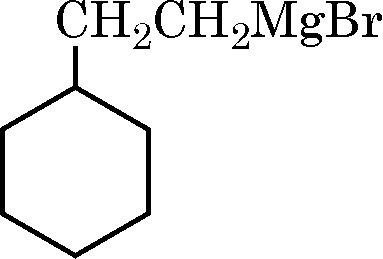 Which of the following Grignard Reagent will be used to prepare when treated with methanal ?CBSE 12th Chemistry 2026 Set 56/1/2MCQ›6$\left(\mathrm{CH}_3\right)_3 \mathrm{C}-\mathrm{OC}_2 \mathrm{H}_5$ on reaction with HI givesCBSE 12th Chemistry 2026 Set 56/1/2MCQ›7Assertion (A) : The presence of $-\mathrm{OH}$ group in phenols directs the incoming group to ortho and para positions.
Reason (R) : $-\mathrm{OH}$ group in phenols activates the aromatic ring towards electrophilic substitution reaction.CBSE 12th Chemistry 2026 Set 56/1/2MCQ›8At low temperature, phenol on reaction with $\mathrm{Br}_2$ in $\mathrm{CS}_2$ givesCBSE 12th Chemistry 2026 Set 56/1/3MCQ›9Assertion (A) : The presence of $-\mathrm{OH}$ group in phenols directs the incoming group at ortho- and para- positions.
Reason (R) : $-\mathrm{OH}$ group in phenols deactivates the aromatic ring.CBSE 12th Chemistry 2026 Set 56/1/3MCQ›10Identify the correct increasing order of boiling points of the given compounds :CBSE 12th Chemistry 2026 Set 56/2/1MCQ›11(A) An organic compound 'A', with molecular formula $\mathrm{C}_2 \mathrm{H}_6 \mathrm{O}$ reacts with active metals such as sodium to give compound 'B' and hydrogen gas. 'A on treatment with iodine and sodium hydroxide gives 'C' and in presence of $\mathrm{H}_2 \mathrm{SO}_4$ at 413 K gives 'D' $\left(\mathrm{C}_4 \mathrm{H}_{10} \mathrm{O}\right)$. 'D' on reaction with excess of HI gives 'E'. Identify 'A', 'B', 'C', 'D' and 'E' and write all the reactions involved.
OR
(B) (a) Write the reagents which are used in the given conversions :
(i) Phenol to 2, 4, 6 - tribromophenol
(ii) Propene to propan-1-ol
(iii) Butan-2-one to butan-2-ol
(b) Explain the mechanism of acid catalyzed hydration of alkene to form corresponding alcohol.CBSE 12th Chemistry 2026 Set 56/2/15 marks · Notebook›12The intermediate formed during the slowest step involved in the dehydration of alcohol is :CBSE 12th Chemistry 2026 Set 56/3/1MCQ›13Assertion (A) : Phenol is less acidic than 4-methylphenol.
Reason (R) : The presence of an electron releasing group in phenol makes it less acidic.CBSE 12th Chemistry 2026 Set 56/3/1MCQ›14Alcohols have higher boiling points than other compounds, namely hydrocarbons, ethers and haloalkanes of comparable molecular masses. On oxidation, primary alcohols yield aldehydes with mild oxidizing agents and carboxylic acids with strong oxidizing agents. Secondary alcohols yield ketones on oxidation while tertiary alcohols are resistant to oxidation. Ethers may be prepared by dehydration of alcohols and Williamson synthesis. The $\mathrm{C}-\mathrm{O}$ bond in ethers can be cleaved by hydrogen halides. The presence of $-\mathrm{OH}$ group in phenols activates the aromatic ring towards electrophilic substitution and directs the incoming group to ortho and para positions due to resonance effect. In presence of NaOH, phenol generates phenoxide ion which is even more reactive than phenol. Thus, in alkaline medium, phenol undergoes Kolbe's reaction.
(a) Name the reagents used in the following reactions :
(i) Oxidation of a primary alcohol to aldehyde
(ii) Oxidation of a primary alcohol to carboxylic acid
(b) Write the reaction involved in Kolbe's reaction.
(c) (i) Why are tertiary alcohols resistant to oxidation ?
OR
(c) (ii) Write the products of the following reaction :
$(\mathrm{CH}_3)_3 \mathrm{C}-\mathrm{O}-\mathrm{C}_2 \mathrm{H}_5 \xrightarrow{\mathrm{HI}}$CBSE 12th Chemistry 2026 Set 56/3/14 marks · Notebook›15The dehydration of $1^{\circ}$, $2^{\circ}$ and $3^{\circ}$ alcohols follows the order :CBSE 12th Chemistry 2026 Set 56/3/2MCQ›16Assertion (A) : Phenol is more acidic than 4-methylphenol.
Reason (R) : The presence of an electron releasing group in phenol makes it more acidic.CBSE 12th Chemistry 2026 Set 56/3/2MCQ›17Which of the following product is formed when salicylic acid is treated with $(\mathrm{CH}_3 \mathrm{CO})_2 \mathrm{O}$ in the presence of acid ?CBSE 12th Chemistry 2026 Set 56/3/3MCQ›18Assertion (A) : Ethers have lower boiling points than the boiling points of alcohols.
Reason (R) : This is due to the presence of hydrogen bonding in alcohols.CBSE 12th Chemistry 2026 Set 56/3/3MCQ›19Primary, secondary and tertiary alcohols can be distinguished by :CBSE 12th Chemistry 2026 Set 56/5/1MCQ›20Assertion (A) : p-nitrophenol is more acidic than phenol.
Reason (R) : Nitro group is an electron-withdrawing group, it stabilises phenoxide ion by dispersal of negative charge.CBSE 12th Chemistry 2026 Set 56/5/1MCQ›21
 Ethers are prepared by the dehydration of alcohols in presence of protic acids at $413 \mathrm{~K}$. Symmetrical and unsymmetrical ethers can also be prepared by Williamson synthesis. This reaction involves $\mathrm{S}_{\mathrm{N}} 2$ attack of an alkoxide ion on primary alkyl halide. If a tertiary alkyl halide is used, elimination reaction occurs and an alkene is formed, no ether is formed. $\mathrm{C}-\mathrm{O}$ bond in ethers are cleaved under drastic conditions with excess of HI. When unsymmetrical ethers react with HI, the alkyl halide is formed from smaller alkyl group. If one of the alkyl group is tertiary, the alkyl halide is formed from the tertiary alkyl group because tertiary alkyl carbocation is more stable than the primary carbocation. Cleavage of alkyl aryl ethers takes place at the alkyl-oxygen bond due to more stable aryl-oxygen bond. The order of reactivity of hydrogen halides is $\mathrm{HI}>\mathrm{HBr}>\mathrm{HCl}$. Aromatic ethers undergo electrophilic substitution reactions. The alkoxy group attached to the aromatic ring activates the ring towards electrophilic substitution and directs the incoming group to ortho- and para-positions.
Answer the following questions :
(a) Complete the following equations :
(i)
(ii)
(b) (i) Write the names of alkyl halide and sodium alkoxide used to prepare tert-butyl ethyl ether.
OR
(b) (ii) Anisole on reaction with HI gives phenol and $\mathrm{CH}_3-\mathrm{I}$ and not methanol and iodobenzene. Justify the statement.
(c) Why is $\mathrm{C}-\mathrm{O}-\mathrm{C}$ bond angle in ethers slightly greater than tetrahedral angle ?CBSE 12th Chemistry 2026 Set 56/5/14 marks · Notebook›22Dehydration of tertiary alcohols with Cu at 573 K gives :CBSE 12th Chemistry 2026 Set 56/4/3MCQ›23Assertion (A) : $\left(\mathrm{CH}_3\right)_3 \mathrm{C}-\mathrm{O}-\mathrm{CH}_3$ gives $\left(\mathrm{CH}_3\right)_3 \mathrm{C}-\mathrm{I}$ and $\mathrm{CH}_3 \mathrm{OH}$ on reaction with HI.
Reason (R) : The reaction occurs by $\mathrm{S}_{\mathrm{N}} 1$ mechanism.CBSE 12th Chemistry 2026 Set 56/4/3MCQ›24Lucas reagent produces cloudiness immediately with :CBSE 12th Chemistry 2026 Set 56/4/1MCQ›25Assertion (A) : Alcohols act as Bronsted bases as well as Bronsted acids.
Reason (R) : It is due to the presence of unshared electron pairs on oxygen atom and presence of polar $\mathrm{O}-\mathrm{H}$ bond.CBSE 12th Chemistry 2026 Set 56/4/1MCQ›26Alcohols and Phenols are acidic in nature. Electron withdrawing groups in phenol increase its acidic strength and electron releasing groups decrease it. Alcohols undergo nucleophilic substitution with hydrogen halides to yield alkyl halides. Dehydration of alcohols gives alkenes. On oxidation, primary alcohols yield aldehydes with mild oxidising agents and carboxylic acids with strong oxidising agents, while secondary alcohols yield ketones. Tertiary alcohols are resistant to oxidation. The presence of $-\mathrm{OH}$ group in phenols activates the aromatic ring towards electrophilic substitution and directs the incoming group to ortho and para positions due to resonance effect.
Answer the following questions :
(a) Write the mechanism of acid dehydration of ethanol to yield ethene.
(b) (i) Why are tertiary alcohols resistant to oxidation ?
OR
(b) (ii) Write the structure of the major product expected from the dinitration of 3-methylphenol.
(c) Why is ortho-nitrophenol more acidic than ortho-methoxyphenol ?CBSE 12th Chemistry 2026 Set 56/4/14 marks · Notebook›27Phenol, on heating with conc. $\mathrm{HNO}_3$, gives :CBSE 12th Chemistry 2026 Compartment Set 56/7/1MCQ›28
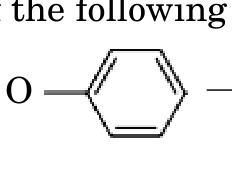 The products of the following reaction are :CBSE 12th Chemistry 2026 Compartment Set 56/7/1MCQ›29The correct order of reactivity of alcohols with Lucas reagent is :CBSE 12th Chemistry 2026 Compartment Set 56/7/1MCQ›30(a) Arrange the following compounds in the decreasing order of their acidic strength :
Phenol, 4-Nitrophenol, 2,4,6-Trinitrophenol
(b) Why are alcohols more soluble in water than hydrocarbons of comparable molecular masses ?
(c) Name the reagent used in the oxidation of a primary unsaturated alcohol to an aldehyde.CBSE 12th Chemistry 2026 Compartment Set 56/7/13 marks · Notebook›31Williamson synthesis is an example of :CBSE 12th Chemistry 2026 Set 56/4/2MCQ›32Assertion (A) : Alcohols act as Bronsted bases as well as Bronsted acids.
Reason (R) : Alcohols react as both nucleophiles and electrophiles.CBSE 12th Chemistry 2026 Set 56/4/2MCQ›
 Phenols undergo electrophilic substitution reactions readily due to the strong activating effect of OH group attached to the benzene ring. Since, the OH group increases the electron density more to o- and p- positions therefore OH group is ortho, para-directing. Reimer-Tiemann reaction is one of the examples of aldehyde group being introduced on the aromatic ring of phenol, ortho to the hydroxyl group. This is a general method used for the ortho-formylation of phenols.
Answer the following questions :
(a) What happens when phenol reacts with
(i) $\mathrm{Br}_2 / \mathrm{CS}_2$
(ii) Conc. $\mathrm{HNO}_3$
(b) Why phenol does not undergo protonation readily ?
(c) Which is a stronger acid - phenol or cresol ? Give reason.
OR
(c) Write the IUPAC name of the product formed in the Reimer-Tiemann reaction.CBSE 12th Chemistry Delhi Set 1 - 20254 marks · Notebook›36What will be formed after oxidation reaction of secondary alcohol with chromic anhydride ($\mathrm{CrO}_3$) ?CBSE 12th Chemistry Outside Delhi Set 3 - 2025MCQ›37The conversion of phenol to salicylic acid can be accomplished byCBSE 12th Chemistry Outside Delhi Set 3 - 2025MCQ›38(A) An organic compound 'A', molecular formula $\mathrm{C}_2 \mathrm{H}_6 \mathrm{O}$ oxidises with $\mathrm{CrO}_3$ to form a compound 'B'. Compound 'B' on warming with iodine and aqueous solution of NaOH gives a yellow precipitate of compound 'C'. When compound 'A' is heated with conc. $\mathrm{H}_2 \mathrm{SO}_4$ at 413 K gives a compound 'D', which on reaction with excess HI gives compound 'E'. Identify compounds 'A', 'B', 'C', 'D' and 'E' and write chemical equations involved.
OR
(B) (a) Write chemical equations of the following reactions :
(i) Phenol is treated with conc. $\mathrm{HNO}_3$
(ii) Propene is treated with $\mathrm{B}_2 \mathrm{H}_6$ followed by oxidation by $\mathrm{H}_2 \mathrm{O}_2 / \mathrm{OH}^{-}$.
(iii) Sodium t-butoxide is treated with $\mathrm{CH}_3 \mathrm{Cl}$.
(b) Give a simple chemical test to distinguish between butan-1-ol and butan-2-ol.
(c) Arrange the following in increasing order of acid strength : phenol, ethanol, waterCBSE 12th Chemistry Outside Delhi Set 3 - 20255 marks · Notebook›39Alkenes are formed by heating alcohols with conc. $\mathrm{H}_2 \mathrm{SO}_4$. The first step in the reaction is :CBSE 12th Chemistry 2025 Set 56/4/1MCQ›40
 Write the structures of the main products of the following reactions :
(a)
(b)CBSE 12th Chemistry 2025 Set 56/4/12 marks · Notebook›41(a) Can sodium ethoxide and t-butyl chloride be used for the preparation of t-butyl ethyl ether ? Give suitable explanation. Justify your answer by suggesting the appropriate starting material required for preparation of t-butyl ethyl ether.
(b) Give the IUPAC name of above mentioned ether.CBSE 12th Chemistry 2025 Set 56/4/13 marks · Notebook›42(a) Can sodium methoxide and t-butyl bromide be used for the preparation of t-butyl methyl ether. Give suitable reason. Justify your answer by suggesting the appropriate starting material if required for the preparation of t-butyl methyl ether.
(b) Give the IUPAC name of above mentioned ether.CBSE 12th Chemistry 2025 Set 56/4/23 marks · Notebook›43(a) Can sodium propoxide and t-butyl chloride be used for the preparation of t-butyl propyl ether ? Give suitable explanation. Justify your answer by suggesting the appropriate starting material required for the preparation of t-butyl propyl ether.
(b) Give the IUPAC name of the above mentioned ether.CBSE 12th Chemistry 2025 Set 56/4/33 marks · Notebook›44$\mathrm{CH}_3 \mathrm{CH}_2 \mathrm{OH}$ can be converted to $\mathrm{CH}_3 \mathrm{CHO}$ by :CBSE 12th Chemistry 2025 Set 56/5/1MCQ›45Explain the mechanism of acid catalysed hydration of ethene.CBSE 12th Chemistry 2025 Set 56/5/12 marks · Notebook›46(a) Arrange the following compounds in the increasing order of their acidic strength :
3,5-dinitrophenol, 4-methylphenol, phenol, 2,4,6-trinitrophenol
(b) What happens when : (write equations)
(i) Phenol is distilled with Zn dust ?
(ii) Anisole is treated with HBr ?CBSE 12th Chemistry 2025 Set 56/5/13 marks · Notebook›47Write the mechanism of dehydration of ethyl alcohol with conc. $\mathrm{H}_2 \mathrm{SO}_4$ at 413 K.CBSE 12th Chemistry 2025 Set 56/5/22 marks · Notebook›48(a) Write the chemical equation for Williamson's synthesis.
(b) Give a method to separate $o$-nitrophenol and $p$-nitrophenol. Explain the principle involved.CBSE 12th Chemistry 2025 Set 56/5/23 marks · Notebook›49Write the mechanism of dehydration of ethyl alcohol with conc. $\mathrm{H}_2 \mathrm{SO}_4$ at 443 K.CBSE 12th Chemistry 2025 Set 56/5/32 marks · Notebook›50(a) Write the chemical equation for the following :
(i) Preparation of phenol from cumene
(ii) Nitration of anisole
(b) Complete the following :
$\left(\mathrm{CH}_3\right)_3 \mathrm{C}-\mathrm{O}-\mathrm{CH}_3+\mathrm{HI} \rightarrow$CBSE 12th Chemistry 2025 Set 56/5/33 marks · Notebook›51Williamson synthesis of preparing unsymmetrical ether is :CBSE 12th Chemistry 2025 Set 56/6/1MCQ›52Assertion (A) : Phenol is strongly acidic as compared to ethanol.
Reason (R) : Phenoxide ion is more stable than ethoxide ion.CBSE 12th Chemistry 2025 Set 56/6/1MCQ›53Alcohols undergo a number of reactions involving the cleavage of C $-$ OH bond. However, phenols do not undergo reactions involving the cleavage of C $-$ OH bond. Alcohols are weaker acids than water. Alcohols react with halogen acids to form the corresponding haloalkanes. Phenols are stronger acids than alcohols. A characteristic feature of phenols is that they undergo electrophilic substitution reactions such as halogenation, nitration, etc. Since $-$ OH group is a strong activating group, phenol gives trisubstituted products during halogenation, nitration, etc.
(a) What happens when phenol is treated with the following ?
(i) $\mathrm{Br}_2$ water (ii) Conc. $\mathrm{HNO}_3$
(b) (i) Write the mechanism of alcohol reacting as nucleophile in a reaction with $\mathrm{CH}_3^{\oplus}$.
OR
(b) (ii) Why do phenols not undergo reactions involving cleavage of C $-$ OH bond ?
(c) How can you distinguish between Butan-1-ol and 2-Methylpropan-2-ol by using HCl in the presence of anhydrous $\mathrm{ZnCl}_2$ ?CBSE 12th Chemistry 2025 Set 56/6/14 marks · Notebook›54Which by-product is obtained in the manufacture of phenol from cumene ?CBSE 12th Chemistry 2025 Set 56/6/2MCQ›55Assertion (A) : Phenol is less acidic than alcohol.
Reason (R) : Phenoxide ion is more stable than alkoxide ion.CBSE 12th Chemistry 2025 Set 56/6/2MCQ›56During dehydration of alcohol to alkene by heating with conc. $\mathrm{H}_2 \mathrm{SO}_4$, the initiation step is :CBSE 12th Chemistry 2025 Set 56/6/3MCQ›57Assertion (A) : The bond angle $\mathrm{C}-\mathrm{O}-\mathrm{C}$ in ethers is slightly greater than tetrahedral angle.
Reason (R) : This is because of the repulsive interaction between the two bulky alkyl groups.CBSE 12th Chemistry 2025 Set 56/6/3MCQ›58When phenyl ethyl ether is heated with HI, it produces :CBSE 12th Chemistry 2025 Compartment Set 56/S/3MCQ›59Out of the following organic compounds, the one which will react with Lucas reagent at room temperature is :CBSE 12th Chemistry 2025 Compartment Set 56/S/1MCQ›60When phenyl methyl ether is heated with HI, it produces :CBSE 12th Chemistry 2025 Compartment Set 56/S/1MCQ›61Assertion (A) : p-methoxyphenol is a stronger acid than p-nitrophenol.
Reason (R) : Methoxy group is electron-donating group whereas nitro group is electron-withdrawing.CBSE 12th Chemistry 2025 Compartment Set 56/S/1MCQ›62Assertion (A): p-methoxyphenol is a stronger acid than p-nitrophenol.
Reason (R): Methoxy group shows $-$I effect whereas nitro group shows $+$I effect.CBSE 12th Chemistry 2025 Compartment Set 56/S/21 marks · Notebook›63Give reasons for the following :
(a) Phenol is more acidic than alcohol.
(b) t-butyl bromide on reaction with sodium ethoxide gives alkene as main product and not ether.
(c) p -nitrophenol is not steam volatile while o -nitrophenol is steam volatile.CBSE 12th Chemistry 2025 Compartment Set 56/S/23 marks · Notebook›64
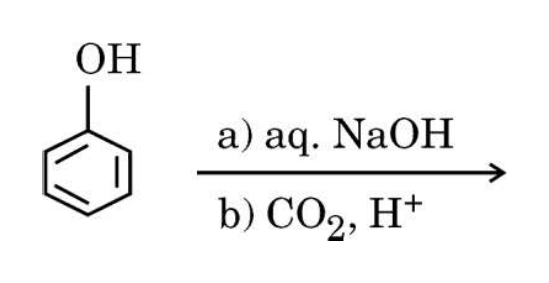
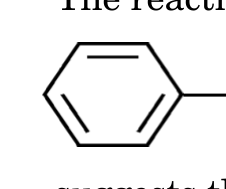 The reaction
$\mathrm{OH}+\mathrm{NaOH}(\mathrm{aq}) \longrightarrow$ $\mathrm{O}^{-} \mathrm{Na}^{+}+\dfrac{1}{2} \mathrm{H}_2(\mathrm{~g})$
suggests that phenol is :CBSE 12th Chemistry 2025 Set 56/7/3MCQ›65Phenol reacts with conc. $\mathrm{HNO}_3$ to form :CBSE 12th Chemistry 2025 Set 56/7/3MCQ›66Assertion (A) : A mixture of o -nitrophenol and p -nitrophenol can be separated by fractional distillation.
Reason (R) : o -nitrophenol is steam volatile due to intramolecular hydrogen bonding.CBSE 12th Chemistry 2025 Set 56/7/3MCQ›67The reaction
$\mathrm{R}-\mathrm{OH}+\mathrm{Na} \longrightarrow \mathrm{RO}^{-} \mathrm{Na}^{+}+\dfrac{1}{2} \mathrm{H}_2(\mathrm{~g})$
suggests that alcohols are :CBSE 12th Chemistry 2025 Set 56/7/1MCQ›68At low temperature, phenol reacts with $\mathrm{Br}_2$ in $\mathrm{CS}_2$ to form :CBSE 12th Chemistry 2025 Set 56/7/1MCQ›69Assertion (A) : A mixture of o -nitrophenol and p -nitrophenol can be separated by steam distillation.
Reason (R) : o -nitrophenol is steam volatile due to intermolecular hydrogen bonding.CBSE 12th Chemistry 2025 Set 56/7/1MCQ›70
 Write structure of the products of the following reactions :
(a) $+\mathrm{HI} \longrightarrow$
(b) $+$ conc. $\mathrm{HNO}_3 \longrightarrow$
(c) $+\mathrm{HCHO} \xrightarrow{\mathrm{H}^{+} / \mathrm{H}_2 \mathrm{O}}$CBSE 12th Chemistry 2025 Set 56/7/13 marks · Notebook›71In the reaction $\mathrm{R}-\mathrm{OH}+\mathrm{HCl} \xrightarrow{\mathrm{ZnCl}_2} \mathrm{RCl}+\mathrm{H}_2 \mathrm{O}$, what is the correct order of reactivity of alcohols ?CBSE 12th Chemistry 2025 Set 56/7/2MCQ›72Phenol reacts with Bromine ($\mathrm{Br}_2$) water to form :CBSE 12th Chemistry 2025 Set 56/7/2MCQ›73Assertion (A) : A mixture of o -nitrophenol and p -nitrophenol can be separated by steam distillation.
Reason (R) : o -nitrophenol is steam volatile due to intramolecular hydrogen bonding.CBSE 12th Chemistry 2025 Set 56/7/2MCQ›
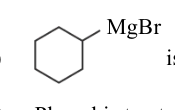 What happens when : (any three )
(a) is treated with $\mathrm{CH}_3 \mathrm{CHO}$ followed by hydrolysis.
(b) Phenol is treated with conc. $(\mathrm{HNO}_3+\mathrm{H}_2 \mathrm{SO}_4)$.
(c) Anisole is treated with $\mathrm{CH}_3 \mathrm{COCl}$ in the presence of anhydrous $\mathrm{AlCl}_3$.
(d) Propan-2-ol is heated with Cu at $573 \mathrm{~K}$.CBSE 12th Chemistry 2024 Compartment Set 56/S/13 marks · Notebook›82What happens when : (any three )
(a) $\mathrm{CH}_3 \mathrm{MgBr}$ is treated with cyclohexanone followed by hydrolysis
(b) Phenol is treated with $\mathrm{Br}_2$ in the presence of $\mathrm{CS}_2$
(c) Benzene diazonium chloride is treated with $\mathrm{H}_2 \mathrm{O}$
(d) Anisole is treated with HICBSE 12th Chemistry 2024 Compartment Set 56/S/23 marks · Notebook›83Which of the following compounds will give a ketone on oxidation with chromic anhydride ($\mathrm{CrO}_3$) ?CBSE 12th Chemistry 2024 Set 56/1/1MCQ›84The reaction of an alkyl halide with sodium alkoxide forming ether is known as :CBSE 12th Chemistry 2024 Set 56/1/1MCQ›85The correct order of the ease of dehydration of the following alcohols by the action of conc. $\mathrm{H}_2 \mathrm{SO}_4$ is :CBSE 12th Chemistry 2024 Set 56/1/1MCQ›86
 (a) Write the mechanism of the following reaction :
$\mathrm{CH}_3 \mathrm{CH}_2 \mathrm{OH} \xrightarrow[443 \mathrm{~K}]{\mathrm{H}^{+}} \mathrm{CH}_2=\mathrm{CH}_2$
(b) Write the main product in each of the following reactions :
(i) $\mathrm{CH}_3-\mathrm{CH}_2-\mathrm{CH}=\mathrm{CH}_2 \xrightarrow[\text{b) } 3 \mathrm{H}_2 \mathrm{O}_2 / \mathrm{OH}^{-}]{\text{a) } \mathrm{B}_2 \mathrm{H}_6}$CBSE 12th Chemistry 2024 Set 56/1/13 marks · Notebook›87Phenol does not undergo nucleophilic substitution reaction easily due to :CBSE 12th Chemistry 2024 Set 56/1/3MCQ›88The suitable Grignard reagent used for the synthesis of $\mathrm{CH}_3-\underset{\substack{| \\ \mathrm{CH}_3}}{\mathrm{CH}}-\mathrm{CH}_2-\mathrm{OH}$ with methanal is :CBSE 12th Chemistry 2024 Set 56/1/3MCQ›89
 Which of the following is most acidic ?CBSE 12th Chemistry 2024 Set 56/2/1MCQ›90Anisole reacts with HI to give :CBSE 12th Chemistry 2024 Set 56/2/1MCQ›91Ethanol on heating with conc. $\mathrm{H}_2 \mathrm{SO}_4$ at 413 K gives :CBSE 12th Chemistry 2024 Set 56/2/1MCQ›92Give the equations of reactions for the preparation of : (any three)
(a) Phenol from chlorobenzene
(b) Salicylaldehyde from phenol
(c) 2-Methoxyacetophenone from anisole
(d) Picric acid from phenolCBSE 12th Chemistry 2024 Set 56/2/13 marks · Notebook›93Phenol is less acidic than :CBSE 12th Chemistry 2024 Set 56/2/2MCQ›94$(\mathrm{CH}_3)_3 \mathrm{C}-\mathrm{O}-\mathrm{CH}_3$ reacts with HI to give :CBSE 12th Chemistry 2024 Set 56/2/2MCQ›95Aspirin is formed by the acetylation of :CBSE 12th Chemistry 2024 Set 56/2/2MCQ›96$(\mathrm{CH}_3)_2 \mathrm{CH}-\mathrm{O}-\mathrm{CH}_3$ reacts with HI to give :CBSE 12th Chemistry 2024 Set 56/2/3MCQ›97A compound (X) with the molecular formula $\mathrm{C}_3 \mathrm{H}_8 \mathrm{O}$ can be oxidized by strong oxidizing agents to another compound (Y) whose molecular formula is $\mathrm{C}_3 \mathrm{H}_6 \mathrm{O}_2$. The compound (X) is :CBSE 12th Chemistry 2024 Set 56/2/3MCQ›98Which one of the following compounds has the lowest $\mathrm{pK}_{\mathrm{a}}$ value ?CBSE 12th Chemistry 2024 Set 56/3/1MCQ›99$(\mathrm{CH}_3)_2 \mathrm{CH}-\mathrm{O}-\mathrm{CH}_3$ when treated with HI gives :CBSE 12th Chemistry 2024 Set 56/3/1MCQ›100Assertion (A) : The boiling point of ethanol is higher than that of dimethyl ether.
Reason (R) : Ethanol molecules are associated through hydrogen bonding whereas in dimethyl ether, it is not possible.CBSE 12th Chemistry 2024 Set 56/3/1MCQ›101(a) Write the equations of the reactions involved in the following :
(i) Reimer-Tiemann reaction
(ii) Kolbe’s reaction
(b) Name the reagent used in the bromination of phenol to form 2,4,6-Tribromophenol.CBSE 12th Chemistry 2024 Set 56/3/13 marks · Notebook›102Which one of the following compounds has the highest $\mathrm{pK}_{\mathrm{a}}$ value ?CBSE 12th Chemistry 2024 Set 56/3/2MCQ›103$\mathrm{C}_6 \mathrm{H}_5-\mathrm{O}-\mathrm{CH}_3$ when treated with HI gives :CBSE 12th Chemistry 2024 Set 56/3/2MCQ›104Assertion (A) : The boiling point of ethanol is higher than that of dimethyl ether.
Reason (R) : Dimethyl ether molecules are associated through hydrogen bonding.CBSE 12th Chemistry 2024 Set 56/3/2MCQ›105
 Which of the following Grignard reagent will be used with methanal to prepare ?CBSE 12th Chemistry 2024 Set 56/3/3MCQ›106$\mathrm{CH}_3-\mathrm{O}-\mathrm{CH}_3$ when treated with excess HI gives :CBSE 12th Chemistry 2024 Set 56/3/3MCQ›107Assertion (A) : Phenol on reaction with aqueous NaOH gives sodium phenoxide.
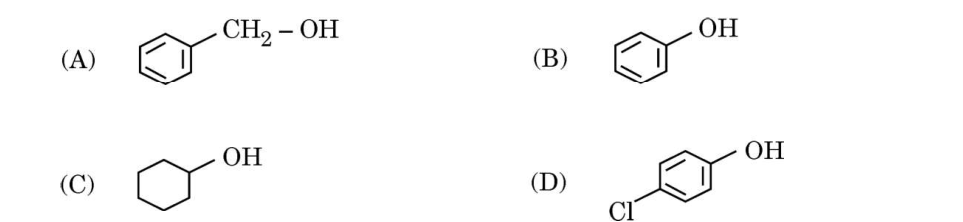
Reason (R) : This reaction supports the acidic nature of phenol.CBSE 12th Chemistry 2024 Set 56/3/3MCQ›108Assertion (A) : Boiling point of butan-1-ol is higher than that of butan-1-amine.
Reason (R) : Being more polar, butan-1-ol forms stronger intermolecular hydrogen bonds as compared to butan-1-amine.CBSE 12th Chemistry 2024 Set 56/3/3MCQ›109Match the reagents required for the given reactions :
I. Oxidation of primary alcohols to aldehydes (p) $\mathrm{NaBH}_4$
II. Butan-2-one to Butan-2-ol (q) 85% phosphoric acid at 440 K
III. Bromination of Phenol to 2, 4, 6-Tribromophenol (r) PCC
IV. Dehydration of propan-2-ol to propene (s) Bromine waterCBSE 12th Chemistry 2024 Set 56/4/1MCQ›110Assertion (A) : p-nitrophenol is less acidic than phenol.
Reason (R) : Nitro group is electron withdrawing and helps in the stabilisation of p-nitrophenoxide ion.CBSE 12th Chemistry 2024 Set 56/4/1MCQ›111Write chemical equations for the following reactions : (Do any three )
(a) Hydroboration – oxidation reaction
(b) Williamson Synthesis
(c) Friedel-Crafts Alkylation of Anisole
(d) Reimer-Tiemann ReactionCBSE 12th Chemistry 2024 Set 56/4/13 marks · Notebook›112Assertion (A) : Bromination of Phenol can be carried out even in the absence of Lewis acid.
Reason (R) : – OH group of Phenol has the high activation effect.CBSE 12th Chemistry 2024 Set 56/4/2MCQ›113Assertion (A) : p-methoxyphenol is a stronger acid than m-methoxyphenol.
Reason (R) : Methoxy group exerts +R effect at both ortho and para position.CBSE 12th Chemistry 2024 Set 56/5/3MCQ›114Give the structure of the major product expected from the following reactions :
(a) Reaction of propanal with methyl magnesium bromide followed by hydrolysis.
(b) Reaction of phenol with $\mathrm{Br}_2$ in $\mathrm{CS}_2$.
(c) Reaction of propene with diborane followed by oxidation.CBSE 12th Chemistry 2024 Set 56/5/33 marks · Notebook›
 Write the chemical equation involved in the following reactions :
(a) Reimer-Tiemann reaction
(b) Acetylation of Salicylic acidCBSE 12th Chemistry Outside Delhi Set 1 - 20232 marks · Notebook›117
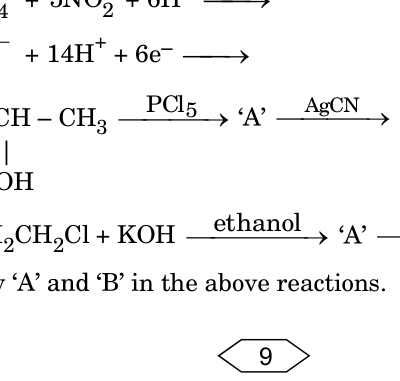 (a) (i) Write the mechanism of the following reaction :
$2 \mathrm{CH}_3 \mathrm{CH}_2 \mathrm{OH} \xrightarrow[413 \mathrm{~K}]{\mathrm{H}^{+}} \mathrm{CH}_3-\mathrm{CH}_2-\mathrm{O}-\mathrm{CH}_2-\mathrm{CH}_3+\mathrm{H}_2 \mathrm{O}$
(ii) Why ortho-nitrophenol is steam volatile while para-nitrophenol is not ?
OR
(b) What happens when
(i) Anisole is treated with $\mathrm{CH}_3 \mathrm{Cl}$/anhydrous $\mathrm{AlCl}_3$ ?
(ii) Phenol is oxidised with $\mathrm{Na}_2 \mathrm{Cr}_2 \mathrm{O}_7 / \mathrm{H}^{+}$ ?
(iii) $(\mathrm{CH}_3)_3 \mathrm{C}-\mathrm{OH}$ is heated with Cu/573 K ?
Write chemical equation in support of your answer.CBSE 12th Chemistry Outside Delhi Set 1 - 20233 marks · Notebook›118
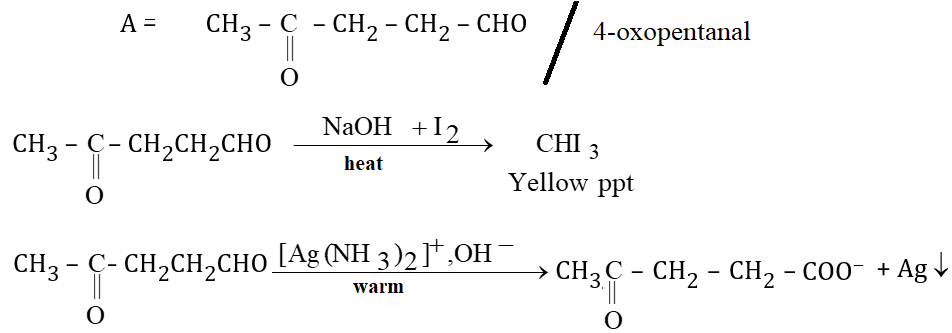 Which of the following alcohols will not undergo oxidation?CBSE 12th Chemistry Delhi Set 1 - 2023MCQ›119For the pair phenol and cyclohexanol, answer the following
(a) Why is phenol more acidic than cyclohexanol?
(b) Give one chemical test to distinguish between the two.CBSE 12th Chemistry Delhi Set 1 - 20232 marks · Notebook›120(a) (i) Why is the $$\mathrm{C}-\mathrm{O}$$ bond length in phenols less than that in methanol?
(ii) Arrange the following in order of increasing boiling point:
Ethoxyethane, Butanal, Butanol, n-butane
(iii) How can phenol be prepared from anisole? Give reaction.
OR
(b) (i) Give mechanism of the following reaction:
$$\mathrm{CH}_3-\mathrm{CH}_2-\mathrm{OH} \xrightarrow[413 \mathrm{~K}]{\mathrm{H}_2 \mathrm{SO}_4} \mathrm{CH}_3 \mathrm{CH}_2-\mathrm{O} -\mathrm{CH}_2 \mathrm{CH}_3+\mathrm{H}_2 \mathrm{O}$$
(ii) Illustrate hydroboration - oxidation reaction with an example.CBSE 12th Chemistry Delhi Set 1 - 20233 marks · Notebook›121In the reaction $\mathrm{R}-\mathrm{OH}+\mathrm{HCl} \xrightarrow{\mathrm{ZnCl}_2} \mathrm{RCl}+\mathrm{H}_2 \mathrm{O}$, what is the correct order of reactivity of alcohol ?CBSE 12th Chemistry 2023 Set 56/1/1MCQ›122(a) Account for the following :
(i) Phenol is a stronger acid than an alcohol.
(ii) The boiling point of alcohols decreases with increase in branching of alkyl chain.
OR
(b) (i) Write the mechanism of the following reaction :
$$\mathrm{CH}_3 \mathrm{CH}_2 \mathrm{OH} \xrightarrow[443 \mathrm{~K}]{\mathrm{H}^{+}} \mathrm{CH}_2=\mathrm{CH}_2+\mathrm{H}_2 \mathrm{O}$$
(ii) Write the equation involved in Reimer-Tiemann reaction.CBSE 12th Chemistry 2023 Set 56/1/12 marks · Notebook›123How do you convert the following : (Any three )
(a) Phenol to picric acid
(b) Propanone to 2-Methylpropan-2-ol
(c) Phenol to anisole
(d) Propene to Propan-1-olCBSE 12th Chemistry 2023 Set 56/1/13 marks · Notebook›124(a) Predict the products of the following reactions :
(i) $\mathrm{CH}_3 \mathrm{CH}_2 \mathrm{OH} \xrightarrow{\mathrm{Cu} / 273 \mathrm{~K}}$
(ii) $\mathrm{C}_6 \mathrm{H}_5 \mathrm{OH} \xrightarrow{\mathrm{Br}_2(\mathrm{aq})}$
OR
(b) Give reasons for the following :
(i) p-nitrophenol is more acidic than p-methylphenol.
(ii) $(\mathrm{CH}_3)_3 \mathrm{C}-\mathrm{Br}$ on reaction with $\mathrm{NaOCH}_3$ gives alkene as the main product and not an ether.CBSE 12th Chemistry 2023 Set 56/1/22 marks · Notebook›125How do you convert the following : (Any three )
(a) Phenol to 2-Hydroxybenzaldehyde
(b) Anisole to 2-Methoxyacetophenone
(c) Propene to Propan-2-ol
(d) Ethanol to EthanalCBSE 12th Chemistry 2023 Set 56/1/23 marks · Notebook›126Which of the following alkenes on acid catalysed hydration gives a tertiary alcohol ?CBSE 12th Chemistry 2023 Set 56/4/3MCQ›127Write the mechanism of acid dehydration of ethanol to yield ethene.CBSE 12th Chemistry 2023 Set 56/4/32 marks · Notebook›128Choose the compound which is more acidic than phenol :CBSE 12th Chemistry 2023 Compartment Set 56/C/1MCQ›129
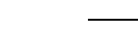 What would be the major product of the given reaction ?CBSE 12th Chemistry 2023 Compartment Set 56/C/1MCQ›130Assertion (A) : Phenol gives 2,4,6-trinitrophenol on treatment with concentrated $\mathrm{HNO}_3$ and concentrated $\mathrm{H}_2 \mathrm{SO}_4$.
Reason (R) : $-\mathrm{OH}$ group in phenol is $m$-directing.CBSE 12th Chemistry 2023 Compartment Set 56/C/1MCQ›131Write the chemical equation for the following :
(a) Hydration of propene in presence of an acid.
(b) Reaction between Ethyl bromide and $\mathrm{C}_2 \mathrm{H}_5 \mathrm{ONa}$.
(c) Reaction between Dimethyl ether and Hydrogen iodide.CBSE 12th Chemistry 2023 Compartment Set 56/C/13 marks · Notebook›132Write the chemical equation for the following :
(a) Oxidation of secondary alcohol to ketone by chromic anhydride ($\mathrm{CrO}_3$).
(b) Reaction of anisole with a mixture of concentrated sulphuric acid and nitric acid.
(c) Reaction of HI with 1-propoxypropane.CBSE 12th Chemistry 2023 Compartment Set 56/C/23 marks · Notebook›133Write chemical equations for the following :
(a) Reaction between phenol and Zn dust.
(b) Reaction of anisole with bromine in ethanoic acid.
(c) Reaction between methoxybenzene and HI.CBSE 12th Chemistry 2023 Compartment Set 56/C/33 marks · Notebook›134Write the chemical equation involved in the following :
(a) Kolbe's reaction
(b) Williamson synthesisCBSE 12th Chemistry 2023 Set 56/2/22 marks · Notebook›135
 Which of the following is an appropriate set of reactants for the preparation of 1-methoxy-4-nitrobenzene and why ?
(a) $+\mathrm{CH}_3 \mathrm{Br}$
(b) $+\mathrm{CH}_3 \mathrm{ONa}$CBSE 12th Chemistry 2023 Set 56/4/22 marks · Notebook›136Aspirin is obtained by the acetylation of which of the following compounds ?CBSE 12th Chemistry 2023 Set 56/3/1MCQ›137Write the structures and IUPAC names of the products expected from the following reactions :
(a) Reaction of methanal with $\left(\mathrm{CH}_3\right)_2 \mathrm{CHMgBr}$ followed by hydrolysis.
(b) Reaction of phenol with conc. $\mathrm{HNO}_3$.CBSE 12th Chemistry 2023 Set 56/3/12 marks · Notebook›138(a) Write the mechanism of the following reaction :
$$\mathrm{CH}_3-\mathrm{CH}_2-\mathrm{OH} \xrightarrow[443 \mathrm{~K}]{\mathrm{H}^{+}} \mathrm{CH}_2=\mathrm{CH}_2+\mathrm{H}_2 \mathrm{O}$$
(b) Write the equation of the reaction for the preparation of phenol from cumene.CBSE 12th Chemistry 2023 Set 56/3/13 marks · Notebook›139Sodium phenoxide when heated with $\mathrm{CO}_2$ under pressure, followed by acidification, yields :CBSE 12th Chemistry 2023 Set 56/3/2MCQ›140
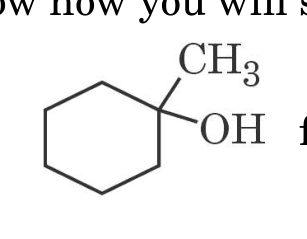 Show how you will synthesise : $2 \times 1=2$
(a) from a suitable alkene.
(b) from methanal using a suitable Grignard reagent.CBSE 12th Chemistry 2023 Set 56/3/22 marks · Notebook›141
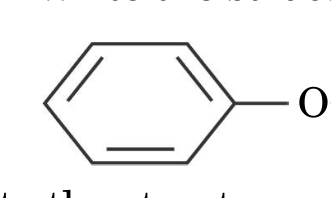 (a) Write the mechanism of the following reaction :
$$\mathrm{CH}_2=\mathrm{CH}_2+\mathrm{H}_2 \mathrm{O} \xrightarrow{\mathrm{H}^{+}} \mathrm{CH}_3 \mathrm{CH}_2 \mathrm{OH}$$
(b) Write the structures of the products obtained by heating
with conc. $\mathrm{HI}$. $2+1=3$CBSE 12th Chemistry 2023 Set 56/3/23 marks · Notebook›142For the conversion of propene into 1-propanol, which of the following reagents and conditions should be used ?CBSE 12th Chemistry 2023 Set 56/3/3MCQ›143
 Give the structures and IUPAC name of the products expected from the following reactions :
(a) Reaction of methanal with $\mathrm{MgBr}$ followed by hydrolysis.
(b) Reaction of phenol with $\mathrm{Br}_2$ (aq).CBSE 12th Chemistry 2023 Set 56/3/32 marks · Notebook›144When diethyl ether is heated with excess of HI, it produces :CBSE 12th Chemistry 2023 Set 56/4/1MCQ›145Write the mechanism of the following reaction :
$\mathrm{CH}_2=\mathrm{CH}_2+\mathrm{H}_2 \mathrm{O} \xrightarrow{\mathrm{H}^{+}} \mathrm{CH}_3 \mathrm{CH}_2 \mathrm{OH}$CBSE 12th Chemistry 2023 Set 56/4/12 marks · Notebook›146
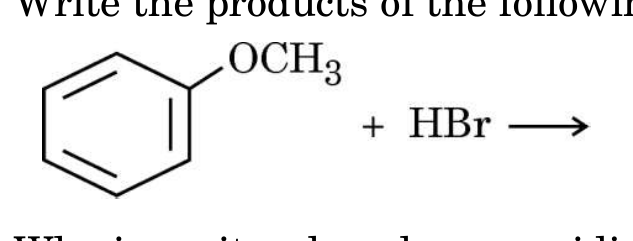 (a) (i) Write hydroboration-oxidation reaction with an example.
(ii) Write the products of the following reaction :
$+\mathrm{HBr} \longrightarrow$
(iii) Why is p-nitrophenol more acidic than phenol ?
OR
(b) (i) What happens when phenol reacts with
(1) Conc. $\mathrm{HNO}_3$, and
(2) $\mathrm{CHCl}_3$ in presence of aqueous NaOH followed by acidification ?
Write equations only.
(ii) Why does the reaction of $\mathrm{CH}_3 \mathrm{ONa}$ with $(\mathrm{CH}_3)_3 \mathrm{C}-\mathrm{Br}$ give 2-methylpropene and not $(\mathrm{CH}_3)_3 \mathrm{C}-\mathrm{OCH}_3$ ?CBSE 12th Chemistry 2023 Set 56/4/13 marks · Notebook›