
ExamQuark
Getting things ready
Your next step is almost ready.
Your progress
0
Correct
0
Wrong
0%
Accuracy
0 s
Time spent
—
Percentile
Questions by year
 (a) (i) A first order reaction is 20% complete in 10 minutes. Calculate the time taken when 80% of the reaction will be completed.
[Given : $\log 5=0.7, \log 4=0.6$]
(ii) For a chemical reaction $\mathrm{R} \rightarrow \mathrm{P}$, variation in $\ln [\mathrm{R}]$ vs. time (t) graph is given below :
(I) Predict the order of the reaction.
(II) Write the slope of the curve.
OR
(b) (i) For first order reaction, calculate the ratio between the time taken to complete $\frac{3}{4}^{\text {th }}$ of the reaction and the time taken to complete half of the reaction.
(ii) (I) What is meant by a complex reaction ?
(II) Give an example of a pseudo first order reaction.CBSE 12th Chemistry 2026 Compartment Set 56/7/15 marks · Notebook›36Assertion (A) : For complex reaction, order of reaction is given by the fast step.
Reason (R) : Order of reaction is determined experimentally.CBSE 12th Chemistry 2026 Set 56/4/2MCQ›
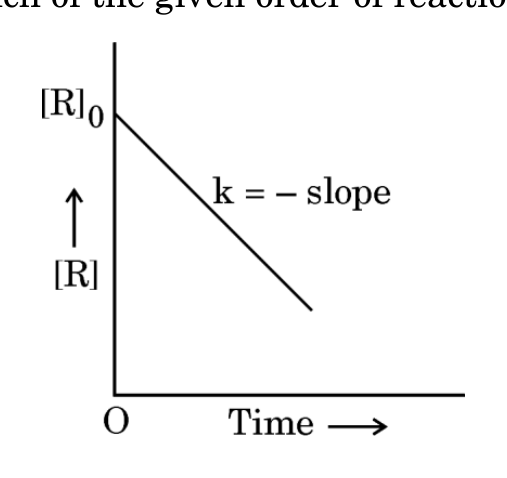 A plot between concentration of reactant [R] and time 't' is shown below. Which of the given order of reaction is indicated by the graph ?CBSE 12th Chemistry 2025 Set 56/5/1MCQ›52(a) Write the rate law expression for the reaction $2 \mathrm{HI} \rightarrow \mathrm{H}_2+\mathrm{I}_2$, if the order of the reaction is zero.
(b) What is the effect of temperature on the rate of reaction ? Write a mathematical expression for the same.CBSE 12th Chemistry 2025 Set 56/5/12 marks · Notebook›53For the reaction $\mathrm{A}+\mathrm{B} \rightarrow$ Products, the following initial rates were obtained at various initial concentrations of reactants :
Sl. No. [A] / mol $\mathrm{L}^{-1}$ [B] / mol $\mathrm{L}^{-1}$ Initial rate / mol $\mathrm{L}^{-1} \mathrm{~s}^{-1}$
1 0.1 0.1 0.05
2 0.2 0.1 0.10
3 0.1 0.2 0.05
Determine the order of the reaction with respect to A and B and overall order of the reaction.CBSE 12th Chemistry 2025 Set 56/5/13 marks · Notebook›54(a) Define rate constant.
(b) Identify the reaction order which has a rate constant of $4.5 \times 10^{-5} \mathrm{~L} \mathrm{~mol}^{-1} \mathrm{~s}^{-1}$.CBSE 12th Chemistry 2025 Set 56/5/22 marks · Notebook›55(a) Give any two differences between order and molecularity of a reaction.
(b) For a reaction $\mathrm{X}+\mathrm{Y} \rightarrow \mathrm{Z}$, in which both X and Y follow first order kinetics; if the concentration of X is increased 2 times and concentration of Y is increased 3 times, how does it affect the rate of reaction ?CBSE 12th Chemistry 2025 Set 56/5/32 marks · Notebook›56The unit of rate and rate constant are same for a :CBSE 12th Chemistry 2025 Set 56/6/1MCQ›57Assertion (A) : Hydrolysis of an ester follows first order kinetics.
Reason (R) : The concentration of water does not get altered much during the reaction.CBSE 12th Chemistry 2025 Set 56/6/1MCQ›58
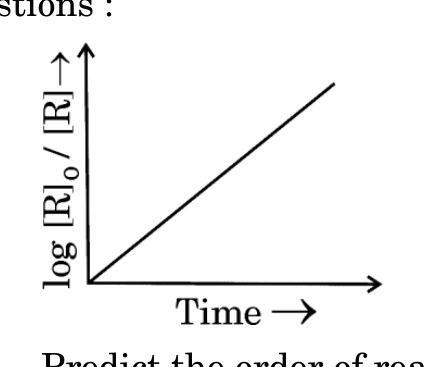 Observe the graph in the given figure and answer the following questions :
(a) Predict the order of reaction.
(b) What is the slope of the curve ?CBSE 12th Chemistry 2025 Set 56/6/12 marks · Notebook›59The rate of a reaction :
$\mathrm{A}+\mathrm{B} \longrightarrow$ product
is given below as a function of different initial concentrations of A and B.
Experiment $[\mathrm{A}] / \mathrm{mol} \mathrm{~L}^{-1}$ $[\mathrm{B}] / \mathrm{mol} \mathrm{~L}^{-1}$ Initial Rate/$\mathrm{mol} \mathrm{~L}^{-1} \mathrm{~min}^{-1}$
1 0.01 0.01 $5 \times 10^{-3}$
2 0.02 0.01 $1 \times 10^{-2}$
3 0.01 0.02 $5 \times 10^{-3}$
Calculate the order of the reaction with respect to A and B. Determine the rate constant of the reaction.CBSE 12th Chemistry 2025 Set 56/6/13 marks · Notebook›60The value of rate constant for a pseudo first order reaction :CBSE 12th Chemistry 2025 Set 56/6/2MCQ›61Assertion (A) : Order of the reaction can be zero or fractional.
Reason (R) : We cannot determine order from balanced chemical equation.CBSE 12th Chemistry 2025 Set 56/6/2MCQ›62In the Arrhenius equation $\mathrm{k}=\mathrm{Ae}^{-\mathrm{E}_{\mathrm{a}} / \mathrm{RT}}$, 'A' represents :CBSE 12th Chemistry 2025 Set 56/6/3MCQ›63Assertion (A) : Molecularity of reaction is determined experimentally.
Reason (R) : Molecularity is applicable only for an elementary reaction and not for a complex reaction.CBSE 12th Chemistry 2025 Set 56/6/3MCQ›64If the half-life period of a first order reaction is 2772 s, then the rate constant of this reaction is :CBSE 12th Chemistry 2025 Compartment Set 56/S/3MCQ›65The following results have been obtained during the kinetic studies of the reaction :
$2 \mathrm{A}+\mathrm{B} \rightarrow \mathrm{C}+\mathrm{D}$
Experiment [A]/mol L$^{-1}$ [B]/mol L$^{-1}$ Initial rate of formation of D (mol L$^{-1}$ min$^{-1}$)
1 0.1 0.1 $6.0 \times 10^{-3}$
2 0.3 0.2 $7.2 \times 10^{-3}$
3 0.3 0.4 $2.88 \times 10^{-1}$
4 0.4 0.1 $2.40 \times 10^{-2}$
What is the rate law ? What is the order of reaction with respect to each reactant and the overall order of reaction ?CBSE 12th Chemistry 2025 Compartment Set 56/S/33 marks · Notebook›66If the half-life period of a first order reaction is 1386 s, then the rate constant of this reaction is :CBSE 12th Chemistry 2025 Compartment Set 56/S/1MCQ›67Assertion (A) : The molecularity of the reaction $\mathrm{H}_2+\mathrm{Br}_2 \rightarrow 2 \mathrm{HBr}$ appears to be 2.
Reason (R) : Two molecules of the reactants are involved in the given elementary reaction.CBSE 12th Chemistry 2025 Compartment Set 56/S/1MCQ›68By giving reasons, explain how the rate of the reaction for a given reaction will be affected when :
(a) the temperature at which the reaction was taking place is decreased.
(b) a catalyst is added.CBSE 12th Chemistry 2025 Compartment Set 56/S/12 marks · Notebook›69The following data were obtained during the kinetic studies of the reaction :
$\mathrm{A}+2 \mathrm{B} \rightarrow \mathrm{C}+2 \mathrm{D}$
Experiment Initial [A] (mol/L) Initial [B] (mol/L) Initial rate of formation of C ($\mathrm{M} \mathrm{min}^{-1}$)
1 0.10 0.10 $3.0 \times 10^{-4}$
2 0.30 0.30 $9.0 \times 10^{-4}$
3 0.10 0.30 $3.0 \times 10^{-4}$
4 0.20 0.40 $6.0 \times 10^{-4}$
Determine the order of reaction with respect to each reactant and the overall order of the reaction. Write the rate law expression for the reaction.CBSE 12th Chemistry 2025 Compartment Set 56/S/13 marks · Notebook›70By giving reasons, explain that how the rate of reaction for a given reaction will be affected when :
(a) the temperature is increased.
(b) catalyst is added.CBSE 12th Chemistry 2025 Compartment Set 56/S/22 marks · Notebook›71Which of the following is the slope of the first order reaction in the plot of $\ln[\mathrm{R}]$ vs. time ?CBSE 12th Chemistry 2025 Set 56/7/3MCQ›72Why is molecularity applicable only for elementary reactions and order is applicable for elementary as well as complex reactions ?CBSE 12th Chemistry 2025 Set 56/7/32 marks · Notebook›73The activation energy ($\mathrm{E}_{\mathrm{a}}$) of a reaction can be determined from the slope of which of the following plots ?CBSE 12th Chemistry 2025 Set 56/7/1MCQ›74State a condition under which a bimolecular reaction is kinetically first order reaction. Give an example. For which type of reactions, do order and molecularity have the same value ?CBSE 12th Chemistry 2025 Set 56/7/12 marks · Notebook›75The following data were obtained during the first order thermal decomposition of $\mathrm{N}_2 \mathrm{O}_5(\mathrm{~g})$ at constant volume :
$2 \mathrm{~N}_2 \mathrm{O}_5(\mathrm{~g}) \longrightarrow 2 \mathrm{~N}_2 \mathrm{O}_4(\mathrm{~g})+\mathrm{O}_2(\mathrm{~g})$
S.No. Time/s Total Pressure/atm
1 0 0.5
2 100 0.625
Calculate rate constant.
[ Given : $\log 2=0.3010, \log 10=1$ ]CBSE 12th Chemistry 2025 Set 56/7/13 marks · Notebook›76Unit of rate constant 'k' for a second order reaction is :CBSE 12th Chemistry 2025 Set 56/7/2MCQ›
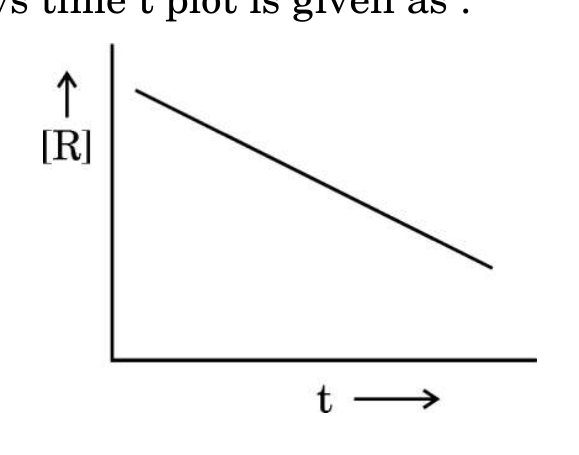 For a chemical reaction $\mathrm{R} \rightarrow \mathrm{P}$, the variation in the concentration [R] vs time t plot is given as :
(a) Predict the order of the reaction and write the unit of rate constant (k) for this order of reaction.
(b) What is the slope of the curve ?CBSE 12th Chemistry 2024 Set 56/1/32 marks · Notebook›97The addition of catalyst during a chemical reaction alters which of the following quantities of the reaction ?CBSE 12th Chemistry 2024 Set 56/2/1MCQ›98For the elementary reaction $\mathrm{P} \rightarrow \mathrm{Q}$, the rate of disappearance of 'P' increases by a factor of 8 upon doubling the concentration of 'P'. The order of the reaction with respect to 'P' is :CBSE 12th Chemistry 2024 Set 56/2/1MCQ›99A first order reaction has a rate constant $1.25 \times 10^{-3} \mathrm{~s}^{-1}$. How long will 5 g of this reactant take to reduce to 2.5 g ?
[ $\log 2=0.301, \log 3=0.4771, \log 4=0.6021$ ]CBSE 12th Chemistry 2024 Set 56/2/12 marks · Notebook›100The rate of a gaseous reaction triples when temperature is increased from $17^{\circ} \mathrm{C}$ to $27^{\circ} \mathrm{C}$. Calculate the energy of activation for this reaction.
[Given : $2.303 \mathrm{R}=19.15 \mathrm{~J} \mathrm{~K}^{-1} \mathrm{~mol}^{-1}, \log 3=0.48$]CBSE 12th Chemistry 2024 Set 56/2/13 marks · Notebook›101Half-life period of a first order reaction is 1386 seconds. The rate constant (k) of the reaction is :CBSE 12th Chemistry 2024 Set 56/2/2MCQ›102The rate of the reaction $2 \mathrm{A}+\mathrm{B}_2 \longrightarrow 2 \mathrm{AB}$ is given by
Rate $=\mathrm{k}[\mathrm{A}]^2\left[\mathrm{B}_2\right]$.
The value of rate constant (k) can be increased by :CBSE 12th Chemistry 2024 Set 56/2/2MCQ›103For a certain reaction $\mathrm{R} \longrightarrow$ products, a plot of $\log [\mathrm{R}]$ vs. time gives a straight line with a slope of $-1.25 \mathrm{~s}^{-1}$. The order of the reaction is :CBSE 12th Chemistry 2024 Set 56/2/3MCQ›104For a zero order reaction $\mathrm{A} \longrightarrow$ products, $\mathrm{t}_{1 / 2}$ is :
where $[\mathrm{A}]_0=$ initial concentration of the reactant, $\mathrm{k}=$ rate constant.CBSE 12th Chemistry 2024 Set 56/2/3MCQ›105When a catalyst increases the rate of a chemical reaction, then the rate constant (k) :CBSE 12th Chemistry 2024 Set 56/3/1MCQ›106Assertion (A) : Order of reaction and molecularity are always same for complex reactions.
Reason (R) : Order is determined experimentally and molecularity is applicable only for elementary reactions.CBSE 12th Chemistry 2024 Set 56/3/1MCQ›107(a) In a reaction, if the concentration of reactant ‘X’ is tripled, the rate of reaction becomes twenty-seven times. What is the order of the reaction ?
(b) State a condition under which a bimolecular reaction is kinetically a first-order reaction. Give an example of such a reaction.CBSE 12th Chemistry 2024 Set 56/3/12 marks · Notebook›108A first-order reaction is 25% complete in 40 minutes. Calculate the value of rate constant. In what time will the reaction be 80% complete ?
[Given : $\log 2=0.30, \log 3=0.48, \log 4=0.60, \log 5=0.69$]CBSE 12th Chemistry 2024 Set 56/3/13 marks · Notebook›109When the initial concentration of a reactant is doubled in the reaction, the half life period remains same. The order of reaction is :CBSE 12th Chemistry 2024 Set 56/3/2MCQ›110Assertion (A) : Rate of reaction increases with increase in temperature.
Reason (R) : Number of effective collisions increase with increase in temperature.CBSE 12th Chemistry 2024 Set 56/3/2MCQ›111The half life of a first order reaction with rate constant (k) of $3 \mathrm{~min}^{-1}$ is :CBSE 12th Chemistry 2024 Set 56/3/3MCQ›112Assertion (A) : Rate of reaction decreases with increase in temperature.
Reason (R) : Number of effective collisions increases with increase in temperature.CBSE 12th Chemistry 2024 Set 56/3/3MCQ›113The correct Mathematical expression of Arrhenius equation isCBSE 12th Chemistry 2024 Set 56/4/1MCQ›114
 In a given graph of zero order reaction, the slope and intercept are :CBSE 12th Chemistry 2024 Set 56/4/1MCQ›115Define the following terms :
(a) Order of a reaction
(b) Activation energyCBSE 12th Chemistry 2024 Set 56/4/12 marks · Notebook›116Show that the time required for 99.9% completion in a first order reaction is 10 times of half-life ($\mathrm{t}_{1 / 2}$) of the reaction [$\log 2=0.3010$, $\log 10=1$].CBSE 12th Chemistry 2024 Set 56/4/13 marks · Notebook›117In effective collisions the colliding molecules must have :CBSE 12th Chemistry 2024 Set 56/4/2MCQ›118Define the following terms :
(a) Molecularity of reaction
(b) Complex reactionCBSE 12th Chemistry 2024 Set 56/4/22 marks · Notebook›119A first order reaction takes 40 min for 75% decomposition. Calculate rate constant.
[Given : $\log 2=0.30, \log 4=0.60$]CBSE 12th Chemistry 2024 Set 56/5/32 marks · Notebook›120The rate constant of a reaction quadruples when the temperature changes from 700 K to 720 K. Calculate the activation energy for this reaction.
[$\log 2=0.30, \log 4=0.60, 2.303 \mathrm{R}=19.15 \mathrm{~J} \mathrm{~K}^{-1} \mathrm{~mol}^{-1}$]CBSE 12th Chemistry 2024 Set 56/5/33 marks · Notebook›(a) The variation in the concentration (R) vs. time (t) plot is given below. Answer the following questions on the basis of the given figure :
(i) Predict the order of the reaction.
(ii) What is the slope of the curve ?
(iii) What are the units of the rate constant k ?
OR
(b) A first order reaction takes 24 minutes for 50% decomposition. Calculate the time required for 25% decomposition.
(Given : $\log 4=0.6021$, $\log 3=0.4771$)CBSE 12th Chemistry 2022 Compartment Set 56/6/13 marks · Notebook›166In the given reaction
$\mathrm{N}_2(\mathrm{g})+3 \mathrm{H}_2(\mathrm{g}) \longrightarrow 2 \mathrm{NH}_3(\mathrm{g})$
the rate of formation of $\mathrm{NH}_3$ is $3.6 \times 10^{-4} \mathrm{~mol} \mathrm{~L}^{-1} \mathrm{~s}^{-1}$.
Calculate the
(i) rate of reaction, and
(ii) rate of disappearance of $\mathrm{H}_2(\mathrm{g})$.CBSE 12th Chemistry 2022 Term 2 Set 56/2/12 marks · Notebook›167A first order reduction takes 30 minutes for 75% decomposition. Calculate $t_{1/2}$.
Given : [log 2 = 0.3, log 3 = 0.48, log 4 = 0.6, log 5 = 0.7]CBSE 12th Chemistry 2022 Term 2 Set 56/2/13 marks · Notebook›168Read the passage given below and answer the questions that follow :
The rate law for a chemical reaction relates the reaction rate with the concentrations or partial pressures of the reactants. For a general reaction $\mathrm{aA} + \mathrm{bB} \rightarrow \mathrm{C}$ with no intermediate steps in its reaction mechanism, meaning that it is an elementary reaction, the rate law is given by $r = k[\mathrm{A}]^x[\mathrm{B}]^y$, where [A] and [B] express the concentrations of A and B in moles per litre. Exponents x and y vary for each reaction and are determined experimentally. The value of k varies with conditions that affect reaction rate, such as temperature, pressure, surface area, etc. The sum of these exponents is known as overall reaction order. A zero order reaction has a constant rate that is independent of the concentration of the reactants. A first order reaction depends on the concentration of only one reactant. A reaction is said to be second order when the overall order is two. Once we have determined the order of the reaction, we can go back and plug in one set of our initial values and solve for k.
(i) Calculate the overall order of a reaction which has the following rate expression : Rate = $k[\mathrm{A}]^{1/2}[\mathrm{B}]^{3/2}$
(ii) What is the effect of temperature on rate of reaction ?
(iii) What is meant by rate of a reaction ?
(iv) (a) A first order reaction takes 77.78 minutes for 50% completion. Calculate the time required for 30% completion of this reaction. ($\log 10 = 1$, $\log 7 = 0.8450$)
OR
(b) A first order reaction has a rate constant $1 \times 10^{-3}$ per sec. How long will 5 g of this reactant take to reduce to 3 g ? ($\log 3 = 0.4771$; $\log 5 = 0.6990$)CBSE 12th Chemistry 2022 Term 2 Set 56/4/15 marks · Notebook›169Answer the following questions (Do any two) :
(a) Identify the order of reaction from the following unit for its rate constant : $\mathrm{L} \mathrm{mol}^{-1} \mathrm{~s}^{-1}$
(b) The conversion of molecules A to B follow second order kinetics. If concentration of A is increased to three times, how will it affect the rate of formation of B?
(c) Write the expression of integrated rate equation for zero order reaction.CBSE 12th Chemistry 2022 Term 2 Set 56/5/12 marks · Notebook›170
 Observe the graph shown in figure and answer the following questions :
(a) What is the order of the reaction ?
(b) What is the slope of the curve?
(c) Write the relationship between $k$ and $t_{1/2}$ (half life period)CBSE 12th Chemistry 2022 Term 2 Set 56/5/13 marks · Notebook›171Define rate of reaction. Write two factors that affect the rate of reaction.CBSE 12th Chemistry 2022 Term 2 Set 56/1/12 marks · Notebook›172A first order reaction is 50% complete in 40 minutes. Calculate the time required for the completion of 90% of reaction.
[Given : $\log 2=0.3010, \log 10=1$]CBSE 12th Chemistry 2022 Term 2 Set 56/1/13 marks · Notebook›173(a) A reaction is second order in X and first order in Y. How is the rate affected when the concentrations of both X and Y are doubled ?
(b) Write the units of 'k' for
(i) zero order reaction
(ii) first order reactionCBSE 12th Chemistry 2022 Term 2 Set 56/1/22 marks · Notebook›174Read the following passage and answer the questions that follow :
The rate of reaction is concerned with decrease in concentration of reactants or increase in the concentration of products per unit time. It can be expressed as instantaneous rate at a particular instant of time and average rate over a large interval of time. A number of factors such as temperature, concentration of reactants, catalyst affect the rate of reaction. Mathematical representation of rate of a reaction is given by rate law :
$$\text { Rate }=\mathrm{k}[\mathrm{A}]^x[\mathrm{~B}]^y$$
$x$ and $y$ indicate how sensitive the rate is to the change in concentration of A and B. Sum of $x+y$ gives the overall order of a reaction.
When a sequence of elementary reactions gives us the products, the reactions are called complex reactions. Molecularity and order of an elementary reaction are same. Zero order reactions are relatively uncommon but they occur under special conditions. All natural and artificial radioactive decay of unstable nuclei take place by first order kinetics.
(a) What is the effect of temperature on the rate constant of a reaction ?
(b) For a reaction $\mathrm{A}+\mathrm{B} \rightarrow$ Product, the rate law is given by, Rate $=\mathrm{k}[\mathrm{A}]^2[\mathrm{~B}]^{1 / 2}$. What is the order of the reaction ?
(c) How order and molecularity are different for complex reactions ?
(d) A first order reaction has a rate constant $2 \times 10^{-3} \mathrm{~s}^{-1}$. How long will $6 \mathrm{~g}$ of this reactant take to reduce to $2 \mathrm{~g}$ ?
OR
The half life for radioactive decay of $^{14} \mathrm{C}$ is 6930 years. An archaeological artifact containing wood had only $75 \%$ of the $^{14} \mathrm{C}$ found in a living tree. Find the age of the sample.
[$\log 4=0.6021$ $\log 3=0.4771$ $\log 2=0.3010$ $\log 10=1$]CBSE 12th Chemistry 2022 Term 2 Set 56/3/15 marks · Notebook›175What do you mean by complex reactions ? Can we determine order and molecularity of a complex reaction ?CBSE 12th Chemistry 2022 Term 2 Set 56/1/32 marks · Notebook›176A reaction is first order in X and second order in Y.
(i) How is the rate affected on increasing the concentration of Y three times ?
(ii) How is the rate affected when the concentrations of both X and Y are doubled ?CBSE 12th Chemistry 2022 Term 2 Set 56/2/32 marks · Notebook›