
ExamQuark
Getting things ready
Your next step is almost ready.
Your progress
0
Correct
0
Wrong
0%
Accuracy
0 s
Time spent
—
Percentile
Questions by year
 Draw a schematic arrangement of Geiger-Marsden experiment. Briefly explain the conclusions drawn from the observations about the structure of an atom. Define ‘distance of closest approach’ in this case.CBSE 12th Physics 2024 Set 55/2/33 marks · Notebook›48The radius $\left(r_n\right)$ of $n^{\text {th }}$ orbit in Bohr model of hydrogen atom varies with $n$ asCBSE 12th Physics 2024 Set 55/4/1MCQ›49In Balmer series of hydrogen atom, as the wavelength of spectral lines decreases, they appearCBSE 12th Physics 2024 Set 55/4/1MCQ›50Draw the graph showing variation of scattered particles detected $(N)$ with the scattering angle $(\theta)$ in Geiger-Marsden experiment. Write two conclusions that you can draw from this graph. Obtain the expression for the distance of closest approach in this experiment.CBSE 12th Physics 2024 Set 55/4/13 marks · Notebook›51State the three postulates of Bohr’s theory of hydrogen atom.
A hydrogen atom de-excites from level $n$ to level $(n-1)$. Show that, according to Bohr’s theory, the frequency of radiation emitted $\nu \cong \frac{\alpha}{n^3}$, for large values of $n$, where $\alpha$ is a constant. This result exactly agrees with that obtained from classical physics – one of the successes of Bohr’s theory.CBSE 12th Physics 2024 Set 55/1/33 marks · Notebook›52Energy levels A, B and C of an atom correspond to increasing values of energy i.e. $E_A < E_B < E_C$. Let $\lambda_1$, $\lambda_2$ and $\lambda_3$ be the wavelengths of radiation corresponding to the transitions C to B, B to A and C to A, respectively. The correct relation between $\lambda_1$, $\lambda_2$ and $\lambda_3$ is :CBSE 12th Physics 2024 Set 55/2/1MCQ›53Using Bohr’s postulates, derive the expression for the radius of the $n^{\text{th}}$ orbit of an electron in a hydrogen atom. Also find the numerical value of Bohr’s radius $a_0$.CBSE 12th Physics 2024 Set 55/2/13 marks · Notebook›54The transition of electron that gives rise to the formation of the second spectral line of the Balmer series in the spectrum of hydrogen atom corresponds to :CBSE 12th Physics 2024 Set 55/1/1MCQ›55Write the drawbacks of Rutherford’s atomic model. How did Bohr remove them ? Show that different orbits in Bohr’s atom are not equally spaced.CBSE 12th Physics 2024 Set 55/1/13 marks · Notebook›56An electron makes a transition from $n=2$ level to $n=1$ level in the Bohr model of a hydrogen atom. Its period of revolution :CBSE 12th Physics 2024 Set 55/3/1MCQ›57State Bohr’s first and second postulates. Use them to derive an expression for the radius of the $n^{\text {th }}$ orbit in a hydrogen atom.CBSE 12th Physics 2024 Set 55/3/13 marks · Notebook›58(a) Define atomic mass unit (u).
(b) Calculate the energy required to separate a deuteron into its constituent parts (a proton and a neutron). Given :
$m(\mathrm{D})=2.014102 \mathrm{~u}$
$m_{\mathrm{H}}=1.007825 \mathrm{~u}$
$m_n=1.008665 \mathrm{~u}$CBSE 12th Physics 2024 Set 55/3/13 marks · Notebook›59State Bohr’s second postulate for his theory of hydrogen atom. Prove that the radius of Bohr’s orbit of a hydrogen atom is directly proportional to $n^2$, where $n$ is the principal quantum number.CBSE 12th Physics 2024 Set 55/3/33 marks · Notebook›60Explain the origin of the spectral lines of hydrogen atom using Bohr’s theory. Draw the energy level diagram of hydrogen atom showing its various spectral series.CBSE 12th Physics 2024 Set 55/3/23 marks · Notebook›61The ionisation energy of the hydrogen atom, in Bohr model, is :CBSE 12th Physics 2024 Compartment Set 55/S/2MCQ›62Which of the following statements is correct for alpha particle scattering experiment ?CBSE 12th Physics 2024 Compartment Set 55/S/1MCQ›63An electron makes a transition from orbit $n=2$ to orbit $n=1$, in Bohr's model of hydrogen atom. Consider change in magnitudes of its kinetic energy $(K)$ and potential energy $(U)$.CBSE 12th Physics 2024 Compartment Set 55/S/1MCQ›64The electron in hydrogen atom is revolving with the speed of $2.2 \times 10^6 \mathrm{~m} / \mathrm{s}$ in an orbit of radius $0.53 \mathrm{~\AA}$. Calculate the initial frequency of light emitted by the electron using classical physics.CBSE 12th Physics 2024 Set 55/5/32 marks · Notebook›
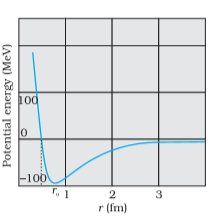
 Draw a plot showing the variation of potential energy of two nucleons as a function of distance between them. Identify the regions in which the force between the nucleons is (i) attractive, and (ii) repulsive. Justify your answers.CBSE 12th Physics 2023 Set 55/4/33 marks · Notebook›71The atomic number of an atom represents :CBSE 12th Physics 2023 Set 55/1/2MCQ›72Calculate the wavelength of the second line of Lyman series in a spectrum of hydrogen atom. (Take Rydberg constant, $R=1.1 \times 10^7 \mathrm{~m}^{-1}$)CBSE 12th Physics 2023 Set 55/1/22 marks · Notebook›73The ground state energy of hydrogen atom is $-13.6 \mathrm{~eV}$ in Bohr model. An electron makes a transition from an energy level of $-1.51 \mathrm{~eV}$ to that of $-3.4 \mathrm{~eV}$. Calculate the wavelength of the spectral line emitted.CBSE 12th Physics 2023 Set 55/1/32 marks · Notebook›74Specify the transition of electron in the wavelength of the line in the Bohr model of hydrogen atom which gives rise to the spectral line of highest wavelength.CBSE 12th Physics 2023 Set 55/2/2MCQ›75The radius of the $n^{\text {th }}$ orbit in Bohr model of hydrogen atom is proportional to :CBSE 12th Physics 2023 Set 55/1/1MCQ›76Hydrogen atom initially in the ground state, absorbs a photon which excites it to $n=5$ level. The wavelength of the photon is :CBSE 12th Physics 2023 Set 55/1/1MCQ›77The ground state energy of hydrogen atom is $-13.6 \mathrm{~eV}$. What is the potential energy and kinetic energy of an electron in the third excited state ?CBSE 12th Physics 2023 Set 55/1/12 marks · Notebook›78The ratio of maximum frequency and minimum frequency of light emitted in Balmer series of hydrogen spectrum, in Bohr’s model is :CBSE 12th Physics 2023 Set 55/3/1MCQ›79The potential energy of an electron in the second excited state in hydrogen atom is :CBSE 12th Physics 2023 Set 55/4/1MCQ›80Briefly explain Geiger-Marsden experiment. Show the variation of the number of particles scattered $(N)$ with scattering angle $(\theta)$ in this experiment. What is the main conclusion that can be inferred from this plot ?CBSE 12th Physics 2023 Set 55/4/13 marks · Notebook›
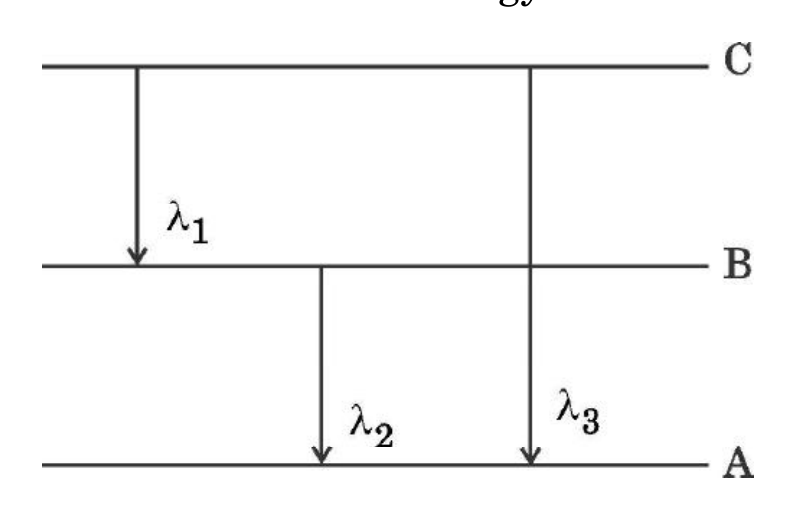 (a) State Bohr’s quantization condition for defining stationary orbits.
(b) Use the energy level diagram shown below to obtain the relation between three wavelengths $\lambda_1, \lambda_2$ and $\lambda_3$ emitted due to the transition of electron from the energy states C and B.CBSE 12th Physics 2022 Term 2 Set 55/2/23 marks · Notebook›83(a) Draw the graph showing the variation of the number (N) of scattered alpha particles with scattering angle $(\theta)$ in Geiger – Marsden experiment. Infer two conclusions from the graph.
OR
(b) Plot suitable graphs to show the variation of photoelectric current with the collector plate potential for the incident radiation of
(i) the same intensity but different frequencies $\nu_1, \nu_2$ and $\nu_3\left(\nu_1<\nu_2<\nu_3\right)$
(ii) the same frequency but different intensities $\mathrm{I}_1, \mathrm{I}_2$ and $\mathrm{I}_3\left(\mathrm{I}_1<\mathrm{I}_2<\mathrm{I}_3\right)$CBSE 12th Physics 2022 Term 2 Set 55/1/12 marks · Notebook›84Define the term – Distance of closest approach. How will it be affected, for an $\alpha$ - particle, if kinetic energy of the particle is doubled ?CBSE 12th Physics 2022 Term 2 Set 55/1/13 marks · Notebook›85Calculate the energy released in MeV in the following reaction :
${ }_1^2 \mathrm{H}+{ }_1^3 \mathrm{H} \longrightarrow{ }_2^4 \mathrm{He}+\mathrm{n}$
Given : $\mathrm{m}\left({ }_1^2 \mathrm{H}\right)=2.014102 \mathrm{~u}$
$\mathrm{m}\left({ }_1^3 \mathrm{H}\right)=3.016049 \mathrm{~u}$
$\mathrm{m}\left({ }_2^4 \mathrm{He}\right)=4.002603 \mathrm{~u}$
$\mathrm{m}_{\mathrm{n}}=1.008665 \mathrm{~u}$CBSE 12th Physics 2022 Term 2 Set 55/1/13 marks · Notebook›86(a) Name the spectral series for a hydrogen atom which lies in the visible region. Find the ratio of the maximum to the minimum wavelengths of this series.
OR
(b) What are matter waves ? A proton and an alpha particle are accelerated through the same potential difference. Find the ratio of the de Broglie wavelength associated with the proton to that with the alpha particle.CBSE 12th Physics 2022 Term 2 Set 55/4/12 marks · Notebook›87State Bohr’s postulate to explain stable orbits in a hydrogen atom. Prove that the speed with which the electron revolves in $\mathrm{n}^{\text {th }}$ orbit is proportional to $(1 / \mathrm{n})$.CBSE 12th Physics 2022 Term 2 Set 55/3/13 marks · Notebook›88A narrow beam of protons, each having $4.1 \mathrm{~MeV}$ energy is approaching a sheet of lead $(\mathrm{Z}=82)$. Calculate :
(i) the speed of a proton in the beam, and
(ii) the distance of its closest approachCBSE 12th Physics 2022 Term 2 Set 55/3/13 marks · Notebook›89(a) Use Bohr's postulate to prove that the radius of $n^{th}$ orbit in a hydrogen atom is proportional to $n^2$.
(b) How will the energy of a hydrogen atom change if $n$ increases from 1 to $\infty$ ?CBSE 12th Physics 2022 Term 2 Set 55/5/23 marks · Notebook›90An electron in a hydrogen atom makes transitions from orbits of higher energies to orbits of lower energies.
(i) When will such transitions result in (a) Lyman (b) Balmer series ?
(ii) Find the ratio of the longest wavelength in Lyman series to the shortest wavelength in Balmer series.CBSE 12th Physics 2022 Term 2 Set 55/5/33 marks · Notebook›91(a) What results do you expect if $\alpha$-particle scattering experiment is repeated using a thin sheet of hydrogen in place of a gold foil ? Explain. (Hydrogen is a solid at temperature below $14 \mathrm{~K}$)
OR
(b) Why it is the frequency and not the intensity of light source that determines whether emission of photoelectrons will occur or not ? Explain.CBSE 12th Physics 2022 Term 2 Set 55/5/12 marks · Notebook›92(a) Sketch the energy level diagram for hydrogen atom.
(b) Find the ratio of the longest and the shortest wavelength in Lyman series in hydrogen atom.CBSE 12th Physics 2022 Term 2 Set 55/1/23 marks · Notebook›93(a) (i) Define the terms : ‘impact parameter’ and ‘distance of closest approach’ for an $\alpha$-particle in Geiger-Marsden scattering experiment.
(ii) What will be the value of the impact parameter for scattering angle (I) $\theta=0^{\circ}$ and (II) $\theta=180^{\circ}$ ?
OR
(b) Photoelectric emission occurs when a surface is irradiated with the radiation of frequency (i) $\nu_1$, and (ii) $\nu_2$. The maximum kinetic energy of the electrons emitted in the two cases are K and 2K respectively. Obtain the expression for the threshold frequency for the surface.CBSE 12th Physics 2022 Term 2 Set 55/2/12 marks · Notebook›94The energy of a hydrogen atom in the first excited state is $-3.4 \mathrm{~eV}$. Find :
(a) the radius of this orbit. (Take Bohr radius $=0.53 \mathrm{~\mathring{A}}$)
(b) the angular momentum of the electron in the orbit.
(c) the kinetic and potential energy of the electron in the orbit.CBSE 12th Physics 2022 Term 2 Set 55/2/13 marks · Notebook›95(a) How did de Broglie hypothesis provide an explanation for Bohr’s second postulate for quantisation of orbital angular momentum of the orbiting electron in hydrogen atom ? Discuss.
(b) Identify the transition of electron in Bohr model which gives rise to (i) the maximum, and (ii) the minimum wavelength in Balmer series of hydrogen spectrum.CBSE 12th Physics 2022 Compartment Set 55/6/13 marks · Notebook›