
ExamQuark
Getting things ready
Your next step is almost ready.
Your progress
0
Correct
0
Wrong
0%
Accuracy
0 s
Time spent
—
Percentile
Questions by year
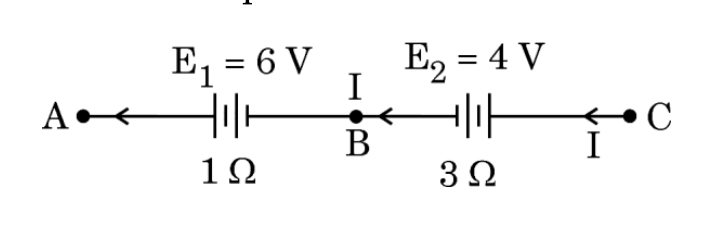 (a) In the given figure, a steady current $I$ flows through the circuit when points A and C are connected by a wire of negligible resistance. Find the potential difference between points B and C.
OR
(b) A battery of emf $21 \mathrm{~V}$ and internal resistance $3 \Omega$ is connected to a resistor. If the current in the circuit is $3 \mathrm{~A}$, find :
(i) the resistance of the resistor.
(ii) the terminal voltage of the battery.CBSE 12th Physics 2026 Set 55/3/12 marks · Notebook›4(a) Establish the relation between drift velocity of electrons $\left(v_d\right)$ and electric current $(I)$ in a conductor.
(b) How is $v_d$ affected when the length of the conductor is doubled, keeping the voltage applied across the conductor constant ?CBSE 12th Physics 2026 Set 55/3/13 marks · Notebook›5(a) Why manganin is used in wire-wound standard resistors ? Calculate the temperature at which the resistance of a wire increases by $25 \%$ of its resistance at room temperature $27.5^{\circ} \mathrm{C}$ ? The temperature coefficient of resistance of the material of the wire is $0.004^{\circ} \mathrm{C}^{-1}$.
(b) How does the resistivity of a semiconductor depend on temperature ? Show it on a plot.CBSE 12th Physics 2026 Set 55/2/32 marks · Notebook›6Calculate the temperature at which the resistance of a conductor becomes $20 \%$ more than its resistance at $27^{\circ} \mathrm{C}$. The value of the temperature coefficient of resistance of the material of conductor is $2.0 \times 10^{-4}{ }^{\circ} \mathrm{C}^{-1}$.CBSE 12th Physics 2026 Set 55/2/22 marks · Notebook›7Assertion (A) : Two electric heaters of power $P_1$ and $P_2\left(>P_1\right)$ are joined in series across a dc source of voltage $V$. The power consumed by the combination will be less than that consumed by $P_1$ when connected across the same source.
Reason (R) : The power consumed by a electric device when connected to a dc source of voltage $V$ is proportional to its resistance.CBSE 12th Physics 2026 Set 55/2/1MCQ›8A heating element using nichrome is connected to a $220 \mathrm{~V}$ supply. Initially it draws a current of $2.9 \mathrm{~A}$. After some time, the current attains a steady value of $2.5 \mathrm{~A}$. Find the steady temperature of the heating element if the room temperature is $27^{\circ} \mathrm{C}$. The temperature coefficient of resistance of nichrome is $1.7 \times 10^{-4}{ }^{\circ} \mathrm{C}^{-1}$.CBSE 12th Physics 2026 Set 55/2/12 marks · Notebook›9
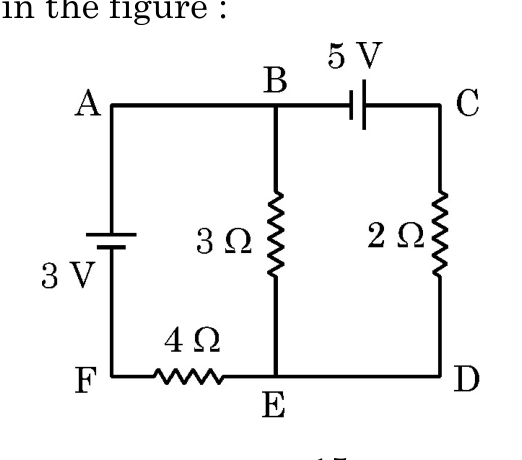 (a) Explain the statement : “Current is a scalar although we represent current with an arrow”.
(b) Use Kirchhoff’s rules to find the current through $3 \Omega$ resistor in the circuit shown in the figure :CBSE 12th Physics 2026 Set 55/2/13 marks · Notebook›10Two wires of same length and same area of cross-section but made of different material of resistivities $\rho_1$ and $\rho_2$ are connected in series. The equivalent resistivity of the combination is :CBSE 12th Physics 2026 Set 55/4/1MCQ›11An electron moves around the nucleus in a circular orbit of radius $r$ and makes $n$ revolutions per second. The value of equivalent current in the orbit is :CBSE 12th Physics 2026 Set 55/4/1MCQ›12Assertion (A) : The work done, in taking a unit charge around a closed loop of an electric circuit involving cells and resistors in the loop, is zero.
Reason (R) : The potential at a point depends on the location of the point in the loop. After completing one round, the charge comes back to the point of start.CBSE 12th Physics 2026 Set 55/4/1MCQ›13
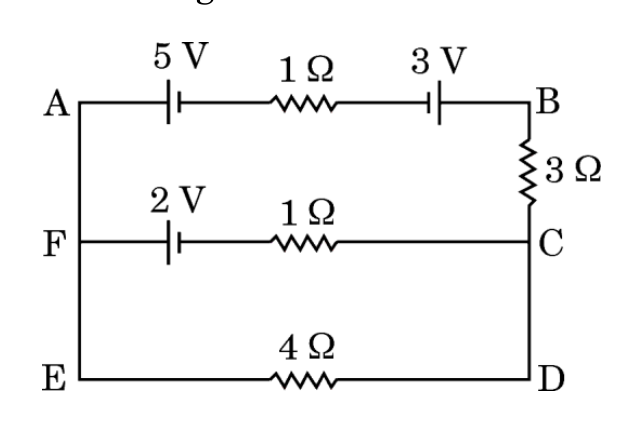 State Kirchhoff’s rules. Using these rules, find the current flowing through branch FC in the given circuit.CBSE 12th Physics 2026 Set 55/4/13 marks · Notebook›14
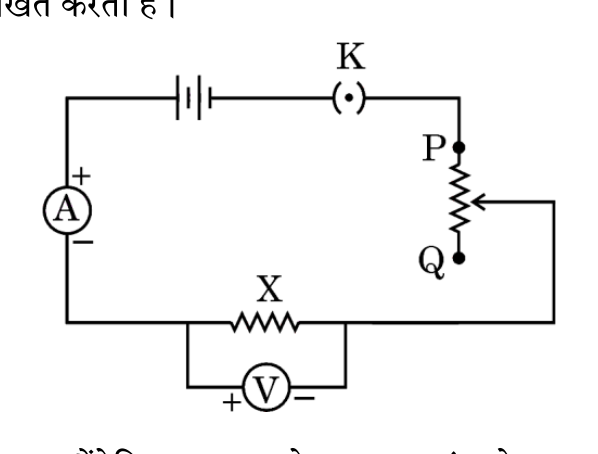 A student sets up the circuit as shown in the figure to find the value of unknown resistance X and records a set of readings of the voltmeter and the ammeter by using the rheostat.
(i) If resistor X were made of manganin and readings for V and I are taken without switching off the circuit, the graph between V and I will be as :
(A)
(B)
(C)
(D)
(ii) Error in the value of X obtained from different sets of voltmeter and ammeter readings, is :
(A) due to error in voltmeter reading only.
(B) due to error in ammeter reading only.
(C) equal to the sum of error in voltmeter reading and error in ammeter reading.
(D) equal to error in voltmeter reading divided by the error in ammeter reading.
(iii) If the movable end of rheostat is moved towards P, then :
(A) reading in ammeter decreases and reading in voltmeter increases.
(B) readings in both voltmeter and ammeter increase.
(C) reading in ammeter increases and reading in voltmeter decreases.
(D) readings in both voltmeter and ammeter decrease.
(iv) (a) Suppose the unknown resistance X is replaced by a wire made of the same metal. This wire consists of three parts, of the same length L but has radii $r$, $r / 3$ and $r / 2$ as shown in the figure.
For a particular setting of the rheostat, let $v_1, v_2$ and $v_3$ be the value of drift velocities in parts AC, CD and DB. Then :
(A) $v_1>v_2>v_3$
(B) $v_2>v_3>v_1$
(C) $v_3>v_2>v_1$
(D) $v_1=v_2=v_3$
OR
(b) Consider the same wire, as shown in figure in question (iv) (a) connected in place of X. For a particular setting of rheostat, let $E_1, E_2$ and $E_3$ be the value of electric fields in part AC, CD and DB. Then :
(A) $E_1=E_2=E_3$
(B) $E_3>E_2>E_1$
(C) $E_2>E_3>E_1$
(D) $E_1>E_2>E_3$CBSE 12th Physics 2026 Set 55/4/14 marks · Notebook›15A current of $1.5 \mathrm{~A}$ is maintained in a copper wire of length $1 \mathrm{~m}$ with area of cross-section $1.7 \times 10^{-7} \mathrm{~m}^2$. The magnitude of electric field in the wire is [$\rho_{\mathrm{Cu}}=1.7 \times 10^{-8} \Omega \mathrm{~m}$)CBSE 12th Physics 2026 Set 55/1/3MCQ›16
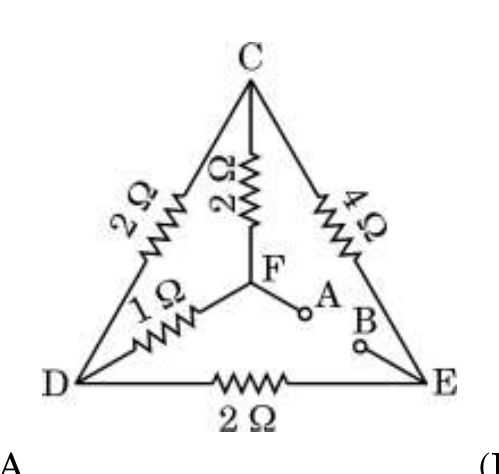 Five resistors are joined as shown in the figure. Between the points A and B, a battery of $6 \mathrm{~V}$ is connected. How much current is flowing in arm FC ?CBSE 12th Physics 2026 Compartment Set 55/7/1MCQ›17
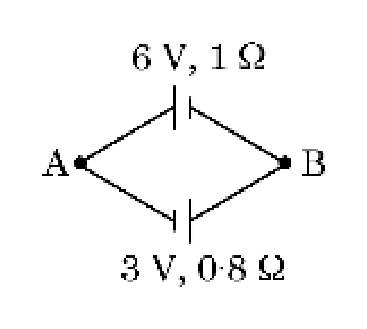 Find the equivalent emf and the equivalent resistance between points A and B for two cells arranged as shown in the figure.CBSE 12th Physics 2026 Compartment Set 55/7/12 marks · Notebook›18
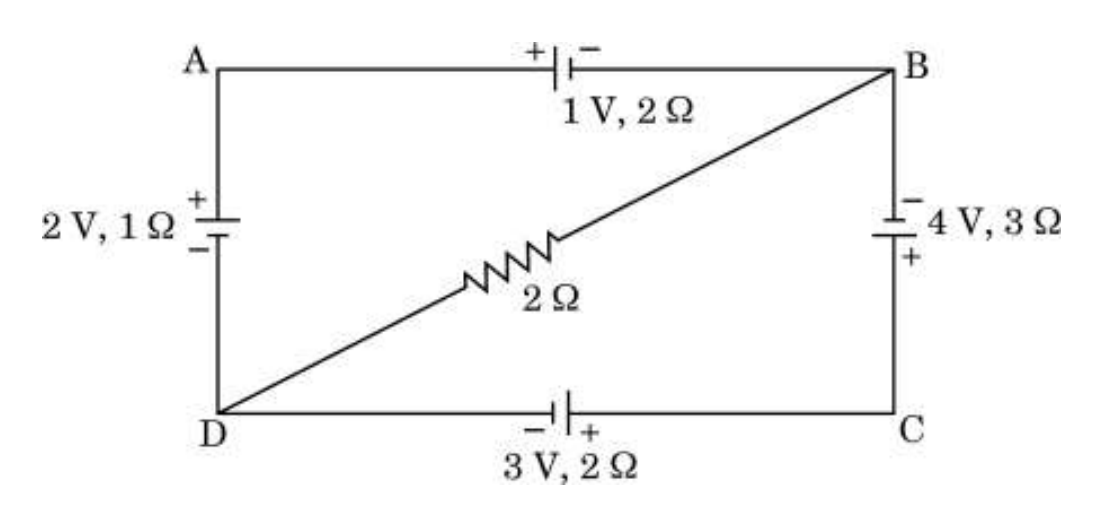 (a) A potential difference $V$ is applied across the ends of a cylindrical conductor of length $l$, area of cross-section $A$ and resistance $R$. It is gradually stretched till its length is tripled. How will (i) the drift speed of electrons in the conductor, and (ii) the resistance of the conductor be affected ? Justify your answers.
(b) In the given circuit diagram, find the potential difference between points B and D.
OR
(a) A cell of emf $E$ and internal resistance $r$ is connected across a resistor of variable resistance $R$. Draw a plot showing the variation of (i) the current $(I)$ in the circuit with $R$, and (ii) the terminal potential difference of the cell with $R$.
(b) The resistance of a heating coil is $100 \Omega$ at $25^{\circ} \mathrm{C}$ and $120 \Omega$ at $1025^{\circ} \mathrm{C}$. (i) Find its resistance at $425^{\circ} \mathrm{C}$. (ii) Draw a plot showing variation of its resistance as a function of increase in temperature.CBSE 12th Physics 2026 Compartment Set 55/7/15 marks · Notebook›19A wire is gradually stretched to make it 100% longer. Its resistance will increase by :CBSE 12th Physics 2026 Set 55/4/2MCQ›20Which of the following characteristics of electrons determines the current in the conductor ?CBSE 12th Physics 2026 Set 55/4/2MCQ›21
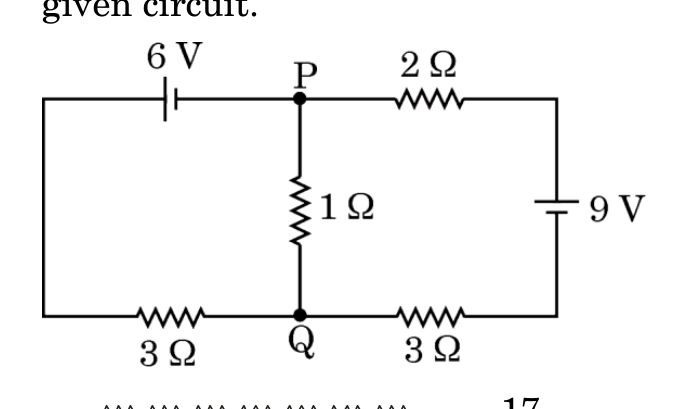 (a) The two Kirchhoff’s rules are based on law of conservation of two physical quantities. Name the quantities.
(b) Find magnitude and direction of current in $1 \Omega$ resistor in the given circuit.CBSE 12th Physics 2026 Set 55/4/23 marks · Notebook›22The resistivity $\rho$ of a metal increases with rise in temperature because :CBSE 12th Physics 2026 Set 55/4/3MCQ›23Which of the following statements is true about mobility of charge carriers in a metal ?CBSE 12th Physics 2026 Set 55/4/3MCQ›24(a) ‘Current is a scalar quantity, although we represent current with an arrow.’ Explain.
(b) Derive the balance condition of a Wheatstone Bridge.CBSE 12th Physics 2026 Set 55/4/33 marks · Notebook›25(a) An electric iron rated $2.2 \mathrm{~kW}, 220 \mathrm{~V}$ is operated at $110 \mathrm{~V}$ supply. Find :
(i) its resistance, and
(ii) heat produced by it in 10 minutes.
OR
(b) A current of $4.0 \mathrm{~A}$ flows through a wire of length $1 \mathrm{~m}$ and cross-sectional area $1.0 \mathrm{~mm}^2$, when potential difference of $2 \mathrm{~V}$ is applied across its ends.
Calculate the resistivity of the material of the wire.CBSE 12th Physics 2026 Set 55/5/12 marks · Notebook›26
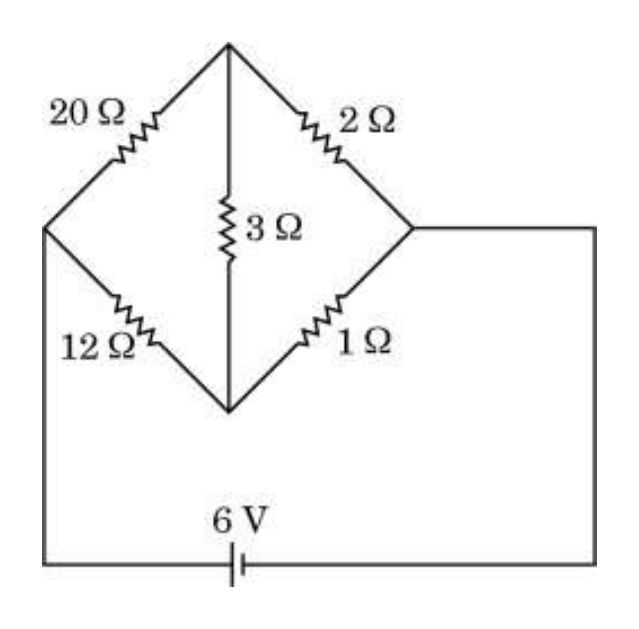 (a) (i) Derive the condition for which a Wheatstone Bridge is balanced.
(ii) Determine the current in $3 \Omega$ branch of a Wheatstone Bridge in the circuit shown in the figure.
OR
(b) (i) Consider a cylindrical conductor of length $l$ and area of cross-section A. Current I is maintained in the conductor and electrons drift with velocity $v_d$ $\left(\left|\vec{v}_d\right|=\frac{e|\vec{E}|}{m} \tau\right)$, (where symbols have their usual meanings). Show that the conductivity $\sigma$ of the material of the conductor is given by $\sigma=\frac{n e^2}{m} \tau$.
(ii) The resistance of a metal wire at $20^{\circ} \mathrm{C}$ is $1.05 \Omega$ and at $100^{\circ} \mathrm{C}$ is $1.38 \Omega$. Determine the temperature coefficient of resistivity of this metal.CBSE 12th Physics 2026 Set 55/5/15 marks · Notebook›27A $2.00 \mathrm{~m}$ long wire, ABC made of steel ($\rho=20 \times 10^{-8} \Omega \mathrm{~m}$ at $20^{\circ} \mathrm{C}$) consists of two parts AB and BC, each of $1.00 \mathrm{~m}$. Part AB has a radius of $0.70 \mathrm{~mm}$ while BC has a radius of $0.35 \mathrm{~mm}$. Find the magnitude of electric field at a point in part AB and part BC, at $20^{\circ} \mathrm{C}$, if a steady current of $1.54 \mathrm{~mA}$ passes through the wire.CBSE 12th Physics 2026 Compartment Set 55/7/22 marks · Notebook›28Two heaters rated as $\left(P_1, V\right)$ and $\left(P_2, V\right)$ are connected in series across a dc source of $\frac{V}{2}$ volt. The power consumed by the combination will be –CBSE 12th Physics 2026 Set 55/1/1MCQ›29What is the order of magnitude of drift velocity of electrons in a conductor ? Deduce the relation between the current flowing through a conductor and drift velocity of electrons in it.CBSE 12th Physics 2026 Set 55/1/12 marks · Notebook›30The number of free electrons per unit volume $\left(\mathrm{m}^3\right)$ in a wire made of copper (resistivity $1.72 \times 10^{-8} \Omega \mathrm{~m}$) is $8.5 \times 10^{28}$. Calculate the average number of collisions made by an electron in one second when an electric field is maintained in the wire.CBSE 12th Physics 2026 Compartment Set 55/7/32 marks · Notebook›
 (a) A cell of e.m.f. $E$ and internal resistance $r$ is connected with a variable external resistance $R$ and a voltmeter showing potential drop $V$ across R. Obtain the relationship between $V$, $E$, $R$ and $r$.
(b) Draw the shape of the graph showing the variation of terminal voltage $V$ of the cell as a function of current $I$ drawn from it. How one can determine the e.m.f. of the cell and its internal resistance from this graph ?CBSE 12th Physics Outside Delhi Set 1 - 20253 marks · Notebook›33(a) Two wires of the same material and the same radius have their lengths in the ratio $2: 3$. They are connected in parallel to a battery which supplies a current of $15 \mathrm{~A}$. Find the current through the wires.
OR
(b) In the circuit three ideal cells of e.m.f. $V$, $V$ and $2 V$ are connected to a resistor of resistance $R$, a capacitor of capacitance $C$ and another resistor of resistance $2 R$ as shown in figure. In the steady state find (i) the potential difference between P and Q and (ii) potential difference across capacitor C.CBSE 12th Physics Outside Delhi Set 1 - 20252 marks · Notebook›34Two wires $P$ and $Q$ are made of the same material. The wire $\mathbf{Q}$ has twice the diameter and half the length as that of wire $P$. If the resistance of wire $P$ is $R$, the resistance of the wire $Q$ will beCBSE 12th Physics Delhi Set 1 - 2025MCQ›35A battery of emf $E$ and internal resistance $r$ is connected to a rheostat. When a current of 2 A is drawn from the battery, the potential difference across the rheostat is $\mathbf{5 ~ V}$. The potential difference becomes 4 V when a current of 4 A is drawn from the battery. Calculate the value of $E$ and $r$.CBSE 12th Physics Delhi Set 1 - 20252 marks · Notebook›36(a) Two batteries of emf's 3 V and 6 V and internal resistances $0.2 \Omega$ and $0.4 \Omega$ are connected in parallel. This combination is connected to a $4 \Omega$ resistor. Find:
(i) the equivalent emf of the combination
(ii) the equivalent internal resistance of the combination
(iii) the current drawn from the combination
OR
(b) (i) A conductor of length $l$ is connected across an ideal cell of emf $E$. Keeping the cell connected, the length of the conductor is increased to $2 l$ by gradually stretching it. If $R$ and $R^{\prime}$ are initial and final values of resistance and $v_d$ and $v_d{ }^{\prime}$ are initial and final values of drift velocity, find the relation between
(1) $R^{\prime}$ and $R$ and
(2) $v_d{ }^{\prime}$ and $v_d$.
(ii) When electrons drift in a conductor from lower to higher potential, does it mean that all the 'free electrons' of the conductor are moving in the same direction?CBSE 12th Physics Delhi Set 1 - 20253 marks · Notebook›37
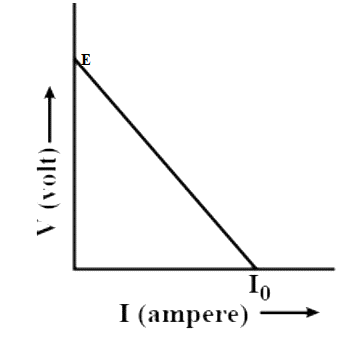
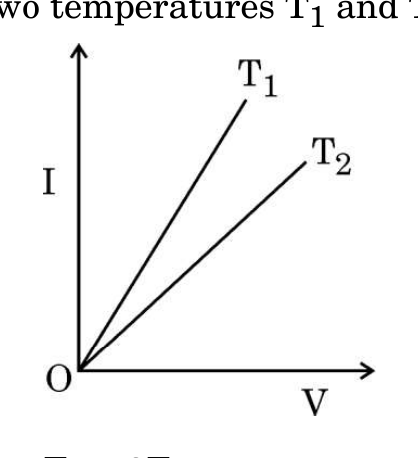 The figure shows the voltage (V) versus the current (I) graphs for a wire at two temperatures $T_1$ and $T_2$. One can conclude that :CBSE 12th Physics 2025 Set 55/6/1MCQ›38If $R_s$ and $R_p$ are the equivalent resistances of $n$ resistors, each of value $R$, in series and parallel combinations respectively, then the value of $\left(R_s-R_p\right)$ is :CBSE 12th Physics 2025 Set 55/6/1MCQ›39
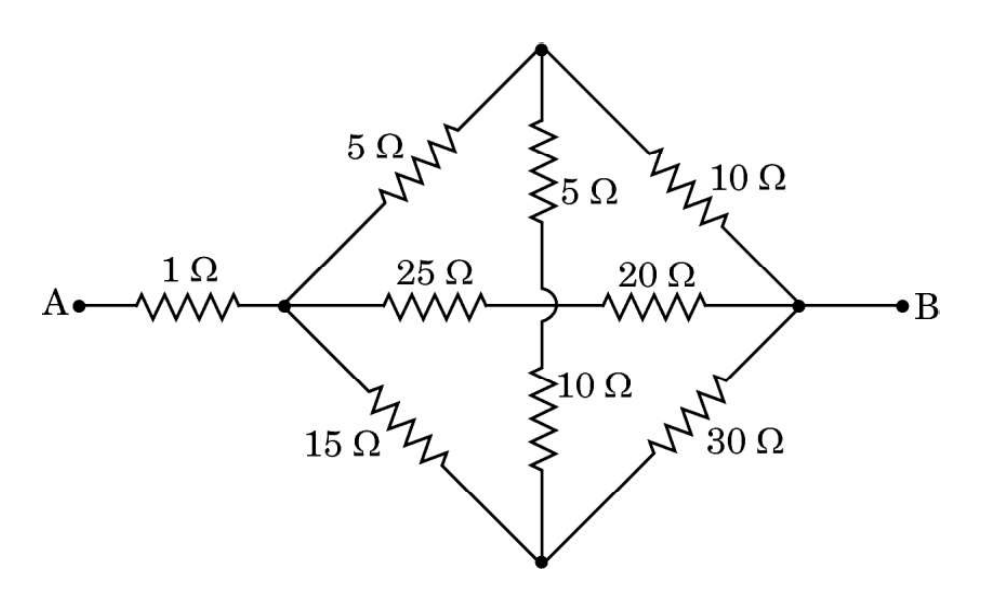 Find the equivalent resistance between points A and B for the network shown in the figure.CBSE 12th Physics 2025 Set 55/6/12 marks · Notebook›40What is the difference between 'emf' and 'terminal voltage' of a cell ?
Two cells of emfs $E_1$ and $E_2$ and internal resistances $r_1$ and $r_2$ are connected in parallel. Derive an expression for the emf and internal resistance of the equivalent cell.CBSE 12th Physics 2025 Set 55/6/13 marks · Notebook›41
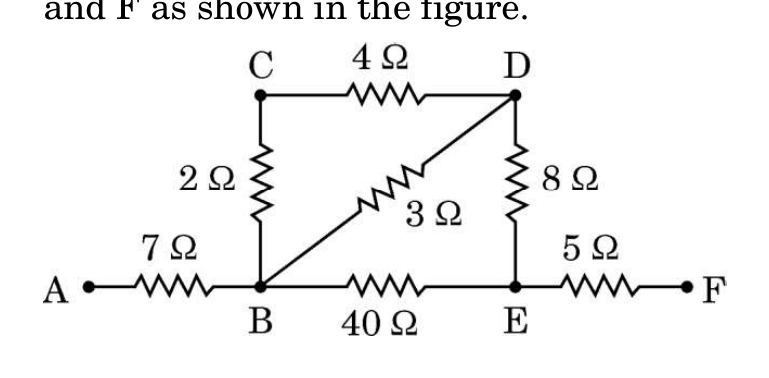 Find the effective resistance of the network of resistors between points A and F as shown in the figure.CBSE 12th Physics 2025 Set 55/5/32 marks · Notebook›42
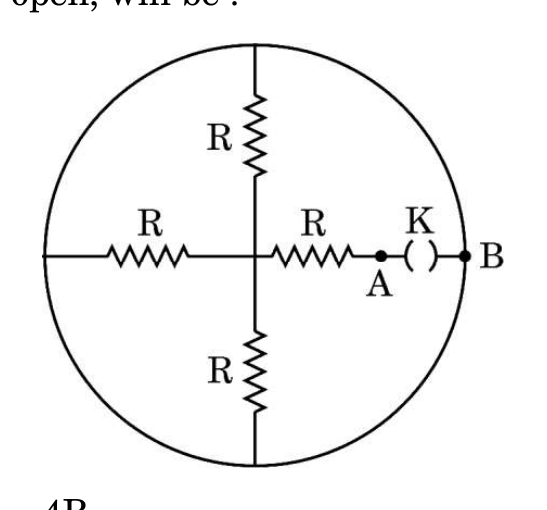 Four resistors, each of resistance $R$ and a key K are connected as shown in the figure. The equivalent resistance between points A and B when key K is open, will be :CBSE 12th Physics 2025 Set 55/5/1MCQ›43A voltmeter of resistance $1000 \Omega$ can measure up to $25 \mathrm{~V}$. How will you convert it so that it can read up to $250 \mathrm{~V}$ ?CBSE 12th Physics 2025 Set 55/5/12 marks · Notebook›44The resistance of a wire at $25^{\circ} \mathrm{C}$ is $10.0 \Omega$. When heated to $125^{\circ} \mathrm{C}$, its resistance becomes $10.5 \Omega$. Find (i) the temperature coefficient of resistance of the wire, and (ii) the resistance of the wire at $425^{\circ} \mathrm{C}$.CBSE 12th Physics 2025 Set 55/5/12 marks · Notebook›45
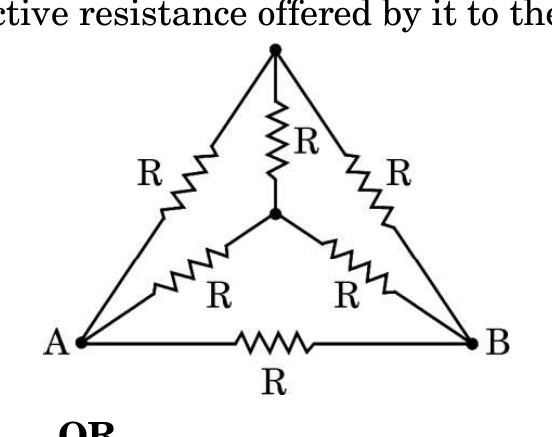 (a) (i) Three batteries $E_1, E_2$ and $E_3$ of emfs and internal resistances $(4 \mathrm{~V}, 2 \Omega),(2 \mathrm{~V}, 4 \Omega)$ and $(6 \mathrm{~V}, 2 \Omega)$ respectively are connected as shown in the figure. Find the values of the currents passing through batteries $E_1, E_2$ and $E_3$.
(ii) The ends of six wires, each of resistance $R(=10 \Omega)$ are joined as shown in the figure. The points A and B of the arrangement are connected in a circuit. Find the value of the effective resistance offered by it to the circuit.
OR
(b) (i) Current $I(=1 \mathrm{~A})$ is passing through a copper rod $\left(n=8.5 \times 10^{28} \mathrm{~m}^{-3}\right)$ of varying cross-sections as shown in the figure. The areas of cross-section at points A and B along its length are $1.0 \times 10^{-7} \mathrm{~m}^2$ and $2.0 \times 10^{-7} \mathrm{~m}^2$ respectively. Calculate :
(I) the ratio of electric fields at points A and B.
(II) the drift velocity of free electrons at point B.
(ii) Two point charges $q_1(=16 \mu \mathrm{C})$ and $q_2(=1 \mu \mathrm{C})$ are placed at points $\vec{r}_1=(3 \mathrm{~m}) \hat{i}$ and $\vec{r}_2=(4 \mathrm{~m}) \hat{j}$. Find the net electric field $\vec{E}$ at point $\vec{r}=(3 \mathrm{~m}) \hat{i}+(4 \mathrm{~m}) \hat{j}$.CBSE 12th Physics 2025 Set 55/5/15 marks · Notebook›46Three wires A, B and C of the same material have lengths and area of cross-sections as $\left(2 l, \frac{A}{2}\right),(l, A)$ and $\left(\frac{l}{2}, 2 A\right)$, respectively. If the resistances of these wires are $R_A, R_B$ and $R_C$ respectively, then :CBSE 12th Physics 2025 Set 55/4/3MCQ›47When the switch of the circuit is turned on, the filament of the bulb glows instantaneously because :CBSE 12th Physics 2025 Set 55/4/2MCQ›48A current flows through a cylindrical conductor of radius $R$. The current density at a point in the conductor is $j=\alpha r$ (along its axis), here $\alpha$ is a constant and $r$ is distance from the axis of the conductor. The current flowing through the portion of the conductor from $r=0$ to $r=\frac{R}{2}$ is proportional to :CBSE 12th Physics 2025 Set 55/4/1MCQ›49
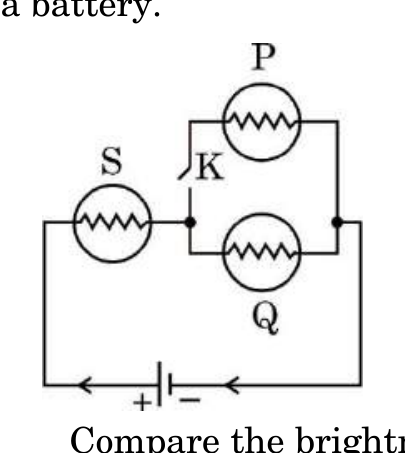 (a) In the given figure, three identical bulbs P, Q and S are connected to a battery.
(i) Compare the brightness of bulbs P and Q with that of bulb S when key K is closed.
(ii) Compare the brightness of the bulbs S and Q when the key K is opened.
Justify your answer in both cases.
OR
(b) Two cells of emf $10 \mathrm{~V}$ each, two resistors of $20 \Omega$ and $10 \Omega$ and a bulb B of $10 \Omega$ resistance are connected together as shown in the figure. Find the current that flows through the bulb.CBSE 12th Physics 2025 Set 55/4/12 marks · Notebook›50
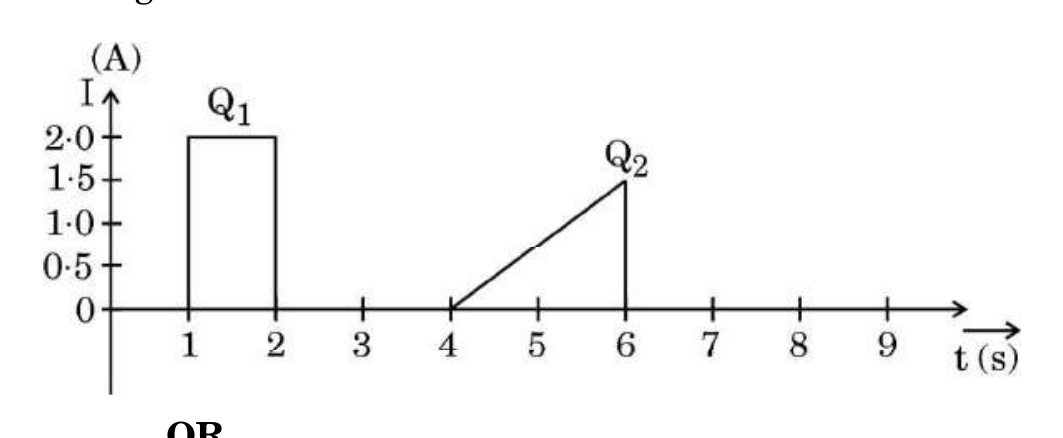 (a) (i) Derive an expression for the resistivity of a conductor in terms of number density of free electrons and relaxation time.
(ii) The figure shows the plot of current through a cross-section of wire over two different time intervals. Compare the charges $\left(Q_1\right.$ and $\left.Q_2\right)$ that pass through the cross-section during these time intervals.
OR
(b) (i) A battery of emf $E$ and internal resistance $r$ is connected to a variable external resistance $R$.
(I) Obtain the expression for current $I$ in the circuit and the value of maximum current the battery can supply.
(II) Obtain the terminal voltage $V$ across the battery and its maximum possible value.
(ii) The above battery sends a current $I_1$ when $R=R_1$ and a current $I_2$ when $R=R_2$. Obtain the internal resistance of the battery in terms of $I_1, I_2, R_1$ and $R_2$.CBSE 12th Physics 2025 Set 55/4/13 marks · Notebook›51A wire of resistance $X$ ohm is gradually stretched till its length becomes twice its original length. If its new resistance becomes $40 \Omega$, find the value of $X$.CBSE 12th Physics 2025 Set 55/5/22 marks · Notebook›52The resistance of a wire of length $L$ and radius $r$ is $R$. Which one of the following would provide a wire of the same material of resistance $\frac{R}{2}$ ?CBSE 12th Physics 2025 Set 55/1/2MCQ›53Show that $\vec{E}=\rho \vec{j}$ leads to Ohm’s law. Write a condition in which the Ohm’s law is not valid for a material.CBSE 12th Physics 2025 Set 55/1/22 marks · Notebook›54Which pair of readings of ideal voltmeter and ideal ammeter in the given circuit is possible when a suitable power source of $3 \Omega$ internal resistance is connected between P and Q ?CBSE 12th Physics 2025 Set 55/2/3MCQ›55(a) Define Electrical conductivity. Obtain the expression of electrical conductivity of a conductor in terms of number density and relaxation time of free electrons.
(b) Explain qualitative change in resistivity of a conductor with temperature using expression obtained in (a).CBSE 12th Physics 2025 Set 55/2/33 marks · Notebook›56The figure shows a network of resistors connected across a battery. Find the current supplied by the battery of emf $5 \mathrm{~V}$ and internal resistance $\frac{2}{3} \Omega$.CBSE 12th Physics 2025 Compartment Set 55/S/12 marks · Notebook›57Define the term 'drift velocity' of electrons in a current carrying conductor and derive, in its term, the expression for current flowing through the conductor.CBSE 12th Physics 2025 Compartment Set 55/S/13 marks · Notebook›58Define 'emf' of a cell. Derive expression for the equivalent emf and the equivalent internal resistance of two cells connected in series.CBSE 12th Physics 2025 Compartment Set 55/S/23 marks · Notebook›59Two cells are connected in parallel by connecting their positive terminals together and connecting their negative terminals together. Derive expression for the equivalent emf and the equivalent internal resistance of the combination.CBSE 12th Physics 2025 Compartment Set 55/S/33 marks · Notebook›60A wire of resistance $R$, connected to an ideal battery consumes a power $P$. If the wire is gradually stretched to double its initial length, and connected across the same battery, the power consumed will be :CBSE 12th Physics 2025 Set 55/6/2MCQ›61A cell of emf $E$ and internal resistance $r$ is connected to an external variable resistance $R$. Plot a graph showing the variation of terminal voltage $V$ of the cell as a function of current $I$, supplied by the cell. Explain how the emf of the cell and its internal resistance can be found from it.CBSE 12th Physics 2025 Set 55/6/22 marks · Notebook›62(a) Define the term 'drift velocity' of conduction electrons in a conductor.
(b) A conductor of length $l$ and area of cross-section $A$ is connected across an ideal battery of emf $V$. Derive the formula for the current density in terms of relaxation time $\tau$.CBSE 12th Physics 2025 Set 55/6/23 marks · Notebook›63Two wires made of the same material have the same length $(l)$ but different cross-sectional areas $\mathrm{A}_1$ and $\mathrm{A}_2$. They are connected together with a cell of voltage V. Find the ratio of the drift velocities of free electrons in the two wires when they are joined in (i) series, and (ii) parallel.CBSE 12th Physics 2025 Set 55/7/22 marks · Notebook›64A battery of e.m.f. $12 \mathrm{~V}$ and internal resistance $0.5 \Omega$ is connected to a $9.5 \Omega$ resistor through a key. The ratio of potential difference between the two terminals of the battery, when the key is open to that when the key is closed, isCBSE 12th Physics 2025 Set 55/2/2MCQ›65
 (a) Define resistivity of a conductor. Discuss its dependence on temperature of the conductor and draw a plot of resistivity of copper as a function of temperature.
(b) (i) “A low voltage battery from which high current is required must have low internal resistance.” Justify.
(ii) “A high voltage battery must have a large internal resistance.” Justify.CBSE 12th Physics 2025 Set 55/2/23 marks · Notebook›66A steady current $\mathrm{I}$ is passed through a conductor at room temperature for time $\mathrm{t}$. It is observed that its temperature rises by $0.5^{\circ} \mathrm{C}$. If $2 \mathrm{I}$ current is passed through the conductor (at room temperature) for the same duration, the rise in its temperature will be approximately :CBSE 12th Physics 2025 Set 55/7/3MCQ›67
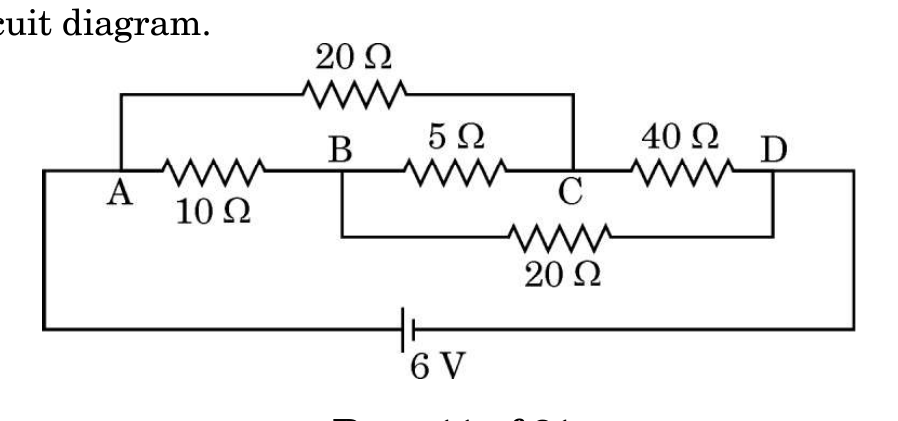 Calculate the value of the current passing through the battery in the given circuit diagram.CBSE 12th Physics 2025 Set 55/7/32 marks · Notebook›68
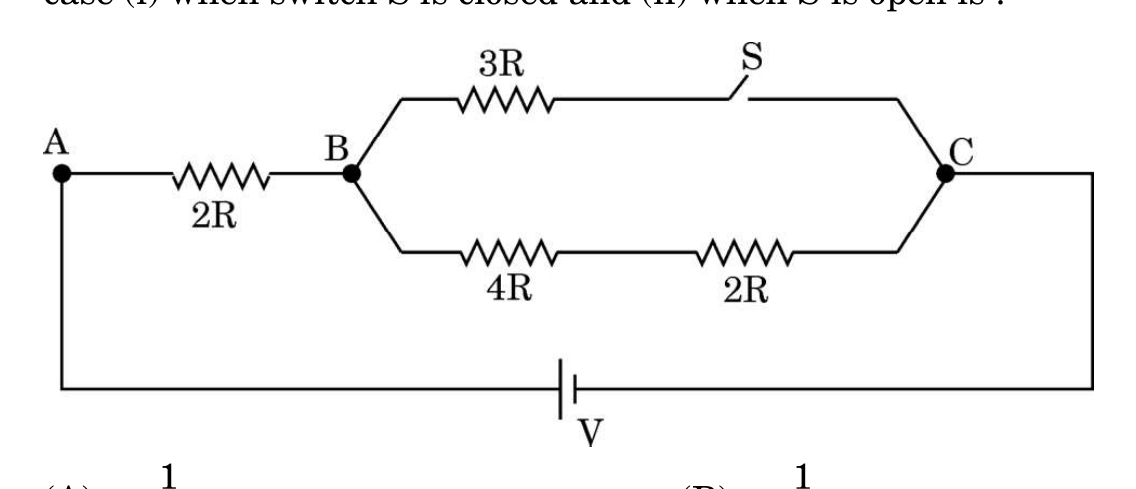 The ratio of potential difference across AB in the circuit shown for the case (i) when switch S is closed and (ii) when S is open is :CBSE 12th Physics 2025 Set 55/6/3MCQ›69(a) What is the difference between 'velocity' and 'drift velocity' of electrons in a current-carrying conductor.
(b) A copper wire of uniform cross-sectional area carries a current of $3.4 \mathrm{~A}$. The drift velocity of conduction electrons is $0.2 \mathrm{~mm} / \mathrm{s}$. If the number density of electrons in copper is $8.5 \times 10^{28} \mathrm{~m}^{-3}$, find the area of cross-section of the wire.CBSE 12th Physics 2025 Set 55/6/32 marks · Notebook›70
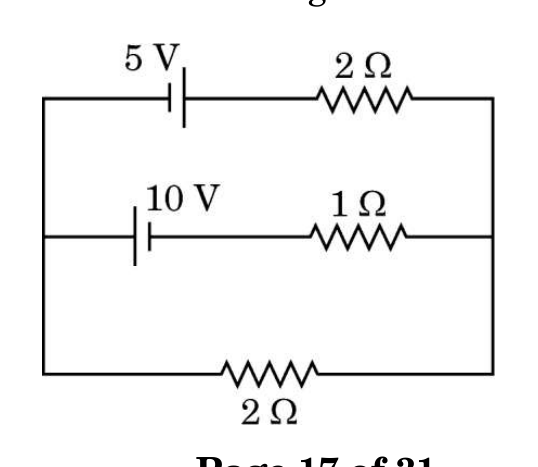 State Kirchhoff's laws. Apply these laws to find the values of current flowing in the three branches of the given circuit.CBSE 12th Physics 2025 Set 55/6/33 marks · Notebook›71Two conductors A and B of the same material have their lengths in the ratio $1: 2$ and radii in the ratio $2: 3$. If they are connected in parallel across a battery, the ratio $\frac{v_A}{v_B}$ of the drift velocities of electrons in them will be -CBSE 12th Physics 2025 Set 55/1/3MCQ›72$n$ identical cells, each of e.m.f. $E$ and internal resistance $r$, are connected in series. Later on it was found out that two cells ‘X’ and ‘Y’ are connected in reverse polarities. Calculate the potential difference across the cell ‘X’.CBSE 12th Physics 2025 Set 55/1/32 marks · Notebook›73
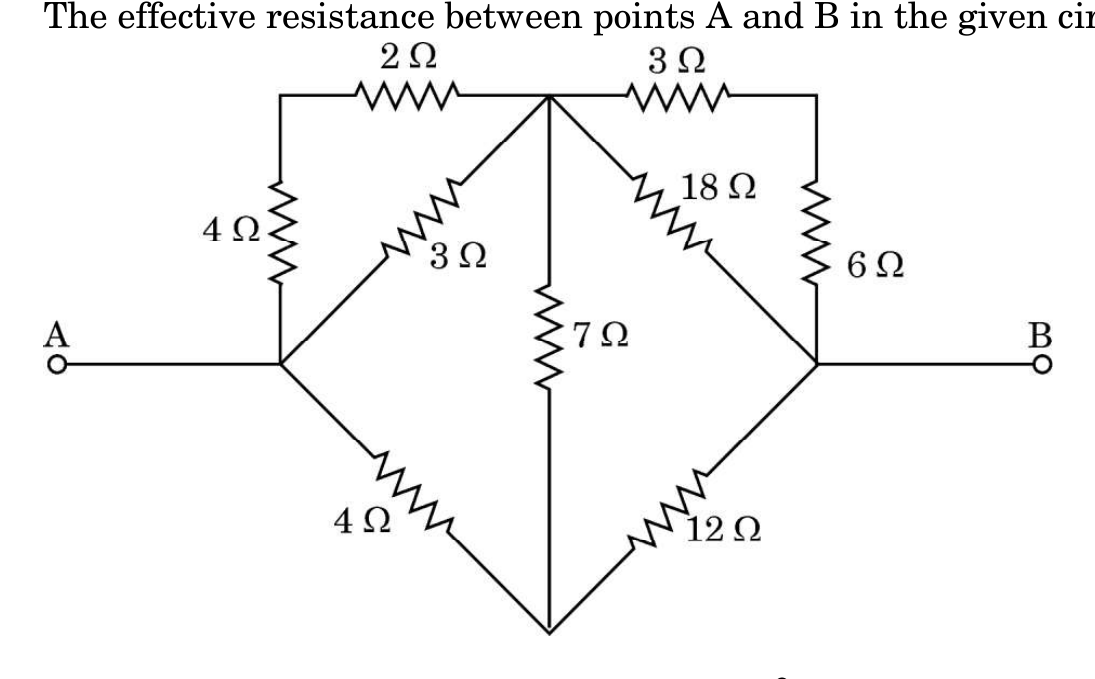 The effective resistance between points A and B in the given circuit is :CBSE 12th Physics 2025 Set 55/7/1MCQ›74
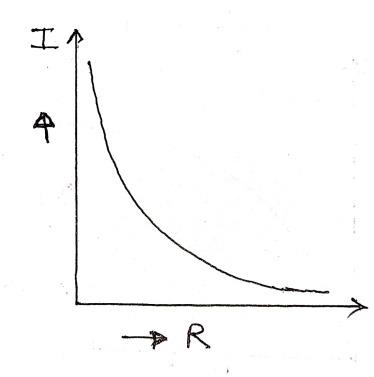 A cell of emf $E$ and internal resistance $r$ is connected across a resistor of variable resistance $R$. Show graphically the variation of
(a) the terminal voltage across the cell,
(b) the current supplied by the cell,
with $R$ as it is increased from 0 to the maximum value.CBSE 12th Physics 2025 Set 55/7/12 marks · Notebook›75
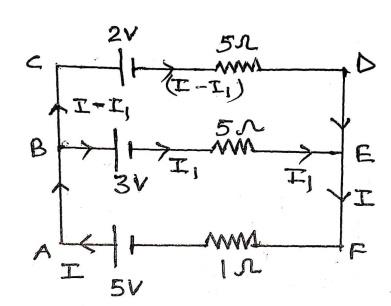 Three cells A, B and C of emfs $2 \mathrm{~V}$, $3 \mathrm{~V}$ and $5 \mathrm{~V}$ respectively are connected in parallel to each other. Their internal resistances are $5 \Omega$, $5 \Omega$ and $1 \Omega$ respectively. Calculate the currents flowing through the cells A, B and C.CBSE 12th Physics 2025 Set 55/7/13 marks · Notebook›76In a metallic conductor, an electron, moving due to thermal motion, suffers collisions with the heavy fixed ions but after collision, it will emerge out with the same speed but in random directions. If we consider all the electrons, their average velocity will be zero. When an electric field is applied, electrons move with an average velocity, known as drift velocity $\left(v_d\right)$. The average time between successive collisions is known as relaxation time $(\tau)$. The magnitude of drift velocity per unit electric field is called mobility $(\mu)$.
An expression for current through the conductor can be obtained in terms of drift velocity, number of electrons per unit volume $(n)$, electronic charge $(-e)$, and the cross-sectional area $(A)$ of the conductor. This expression leads to an expression between current density $(\hat{j})$ and the electric field $(\vec{E})$. Hence, an expression for resistivity $(\rho)$ of a metal is obtained. This expression helps us to understand increase in resistivity of a metal with increase in its temperature, in terms of change in the relaxation time $(\tau)$ and change in the number density of electrons $(n)$.
(i) Consider two cylindrical conductors A and B, made of the same metal connected in series to a battery. The length and the radius of B are twice that of A. If $\mu_{\mathrm{A}}$ and $\mu_{\mathrm{B}}$ are the mobility of electrons in A and B respectively, then $\frac{\mu_{\mathrm{A}}}{\mu_{\mathrm{B}}}$ is :
(A) $\frac{1}{2}$
(B) $\frac{1}{4}$
(C) $2$
(D) $1$
(ii) A wire of length $0.5 \mathrm{~m}$ and cross-sectional area $1.0 \times 10^{-7} \mathrm{~m}^2$ is connected to a battery of $2 \mathrm{~V}$ that maintains a current of $1.5 \mathrm{~A}$ in it. The conductivity of the material of the wire (in $\Omega^{-1} \mathrm{~m}^{-1}$) is :
(A) $2.5 \times 10^4$
(B) $3.0 \times 10^5$
(C) $3.75 \times 10^6$
(D) $5.0 \times 10^7$
(iii) The temperature coefficient of resistance of nichrome is $1.70 \times 10^{-4}{ }^{\circ} \mathrm{C}^{-1}$. In order to increase resistance of a nichrome wire by $8.5 \%$, the temperature of the wire should be increased by :
(A) $250^{\circ} \mathrm{C}$
(B) $500^{\circ} \mathrm{C}$
(C) $850^{\circ} \mathrm{C}$
(D) $1000^{\circ} \mathrm{C}$
(iv) (a) Consider the contribution of the following two factors I and II in resistivity of a metal :
I. Relaxation time of electrons
II. Number of electrons per unit volume
The resistivity of a metal increases with increase in its temperature because :
(A) I decreases and II increases.
(B) I increases and II is almost constant.
(C) Both I and II increase.
(D) I decreases and II is almost constant.
OR
(b) A steady current flows in a copper wire of non-uniform cross-section. Consider the following three physical quantities :
I. Electric field
II. Current density
III. Drift speed
Then at the different points along the wire :
(A) II and III change, but I is constant.
(B) I and II change, but III is constant.
(C) I and III change, but II is constant.
(D) All I, II and III change.CBSE 12th Physics 2025 Set 55/7/14 marks · Notebook›
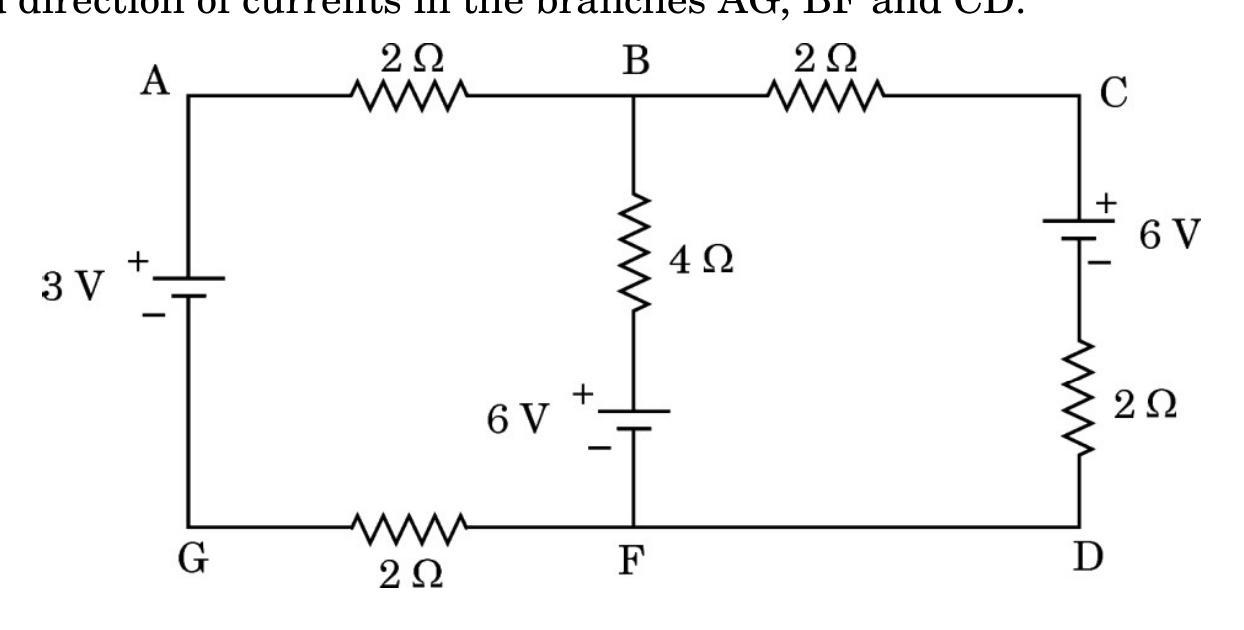 The figure shows a circuit with three ideal batteries. Find the magnitude and direction of currents in the branches AG, BF and CD.CBSE 12th Physics 2024 Set 55/2/13 marks · Notebook›93When the terminals of a cell are connected to a conductor of resistance $R$, an electric current flows through the circuit. The electrolyte of the cell also offers some resistance in the path of the current, like the conductor. This resistance offered by the electrolyte is called internal resistance of the cell $(r)$. It depends upon the nature of the electrolyte, the area of the electrodes immersed in the electrolyte and the temperature. Due to internal resistance, a part of the energy supplied by the cell is wasted in the form of heat.
When no current is drawn from the cell, the potential difference between the two electrodes in known as emf of the cell $(\varepsilon)$. With a current drawn from the cell, the potential difference between the two electrodes is termed as terminal potential difference $(V)$.
(i) Choose the incorrect statement :
(A) The potential difference $(V)$ between the two terminals of a cell in a closed circuit is always less than its emf $(\varepsilon)$, during discharge of the cell.
(B) The internal resistance of a cell decreases with the decrease in temperature of the electrolyte.
(C) When current is drawn from the cell then $V=\varepsilon-I r$.
(D) The graph between potential difference between the two terminals of the cell $(V)$ and the current $(I)$ through it is a straight line with a negative slope.
(ii) Two cells of emfs $2.0 \mathrm{~V}$ and $6.0 \mathrm{~V}$ and internal resistances $0.1 \Omega$ and $0.4 \Omega$ respectively, are connected in parallel. The equivalent emf of the combination will be :
(A) $2.0 \mathrm{~V}$
(B) $2.8 \mathrm{~V}$
(C) $6.0 \mathrm{~V}$
(D) $8.0 \mathrm{~V}$
(iii) Dipped in the solution, the electrode exchanges charges with the electrolyte. The positive electrode develops a potential $V_{+}\left(V_{+}>0\right)$, and the negative electrode develops a potential $-\left(V_{-}\right)\left(V_{-} \geq 0\right)$, relative to the electrolyte adjacent to it. When no current is drawn from the cell then :
(A) $\varepsilon=V_{+}+V_{-}>0$
(B) $\varepsilon=V_{+}-V_{-}>0$
(C) $\varepsilon=V_{+}+V_{-} < 0$
(D) $\varepsilon=V_{+}+V_{-}=0$
(iv) (a) Five identical cells, each of emf $2 \mathrm{~V}$ and internal resistance $0.1 \Omega$ are connected in parallel. This combination in turn is connected to an external resistor of $9.98 \Omega$. The current flowing through the resistor is :
(A) $0.05 \mathrm{~A}$
(B) $0.1 \mathrm{~A}$
(C) $0.15 \mathrm{~A}$
(D) $0.2 \mathrm{~A}$
OR
(b) Potential difference across a cell in the open circuit is $6 \mathrm{~V}$. It becomes $4 \mathrm{~V}$ when a current of $2 \mathrm{~A}$ is drawn from it. The internal resistance of the cell is :
(A) $1.0 \Omega$
(B) $1.5 \Omega$
(C) $2.0 \Omega$
(D) $2.5 \Omega$CBSE 12th Physics 2024 Set 55/2/14 marks · Notebook›94A student is asked to connect four cells, each of emf $E$ and internal resistance $r$, in series. But she/he connects one cell wrongly in series with the other cells. The equivalent emf and the equivalent internal resistance of the combination will be :CBSE 12th Physics 2024 Set 55/1/2MCQ›95
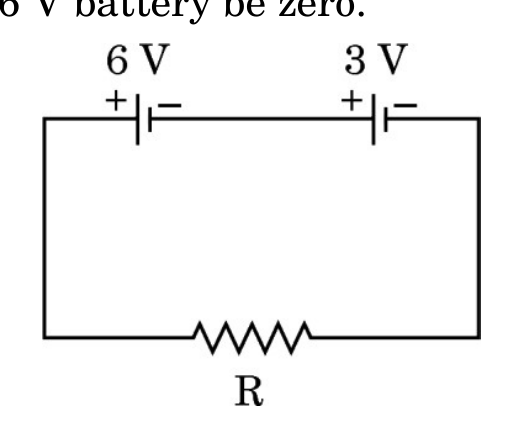 Two batteries of emfs $6 \mathrm{~V}$ and $3 \mathrm{~V}$ and internal resistances $0.8 \Omega$ and $0.2 \Omega$ respectively are connected in series to an external resistance $R$, as shown in figure. Find the value of $R$ so that the potential difference across the $6 \mathrm{~V}$ battery be zero.CBSE 12th Physics 2024 Set 55/1/22 marks · Notebook›96
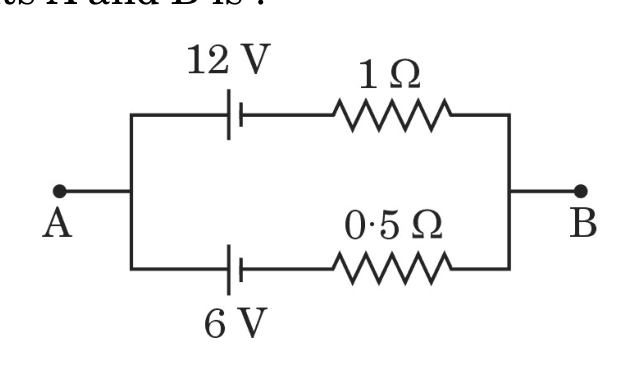 Consider the circuit shown in the figure. The potential difference between points A and B is :CBSE 12th Physics 2024 Set 55/1/1MCQ›97Find the temperature at which the resistance of a wire made of silver will be twice its resistance at $20^{\circ} \mathrm{C}$. Take $20^{\circ} \mathrm{C}$ as the reference temperature and temperature coefficient of resistance of silver at $20^{\circ} \mathrm{C}=4.0 \times 10^{-3} \mathrm{~K}^{-1}$.CBSE 12th Physics 2024 Set 55/1/12 marks · Notebook›98Plot a graph showing the variation of current with voltage for the material GaAs. On the graph, mark the region where :
(a) resistance is negative, and
(b) Ohm’s law is obeyed.CBSE 12th Physics 2024 Set 55/1/12 marks · Notebook›99(a) Define ‘current density’. Is it a scalar or a vector ? An electric field $\vec{E}$ is maintained in a metallic conductor. If $n$ be the number of electrons (mass $m$, charge $-e$) per unit volume in the conductor and $\tau$ its relaxation time, show that the current density $\vec{j}=\alpha \vec{E}$, where $\alpha=\left(\frac{n e^2}{m}\right) \tau$.
OR
(b) What is a Wheatstone bridge ? Obtain the necessary conditions under which the Wheatstone bridge is balanced.CBSE 12th Physics 2024 Set 55/1/13 marks · Notebook›100(a) What is meant by ‘relaxation time’ of free electrons in a conductor ? Show that the resistance of a conductor can be expressed by $R=\frac{m l}{n e^2 \tau A}$, where symbols have their usual meanings.
OR
(b) Draw the circuit diagram of a Wheatstone bridge. Obtain the condition when no current flows through the galvanometer in it.CBSE 12th Physics 2024 Set 55/3/12 marks · Notebook›101
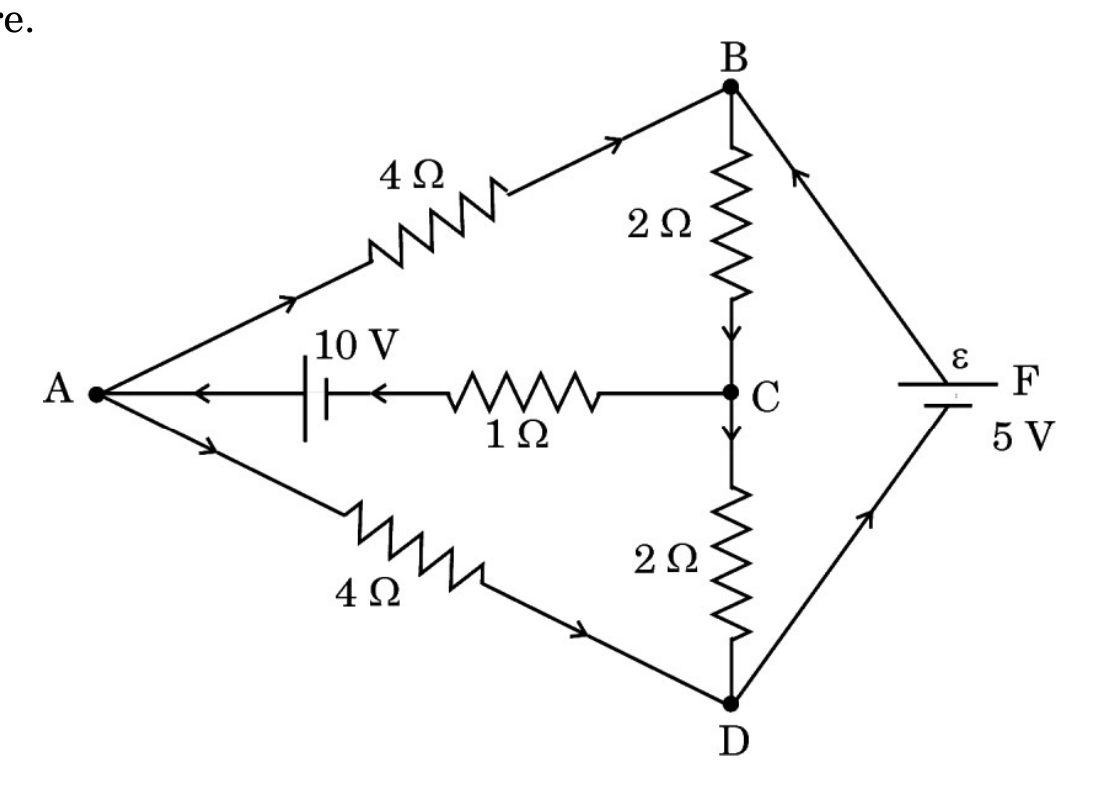 Determine the current in branches AB, AC and BC of the network shown in figure.CBSE 12th Physics 2024 Set 55/3/13 marks · Notebook›102A current of $1.6 \mathrm{~A}$ flows through a wire when a potential difference of $1.0 \mathrm{~V}$ is applied across it. The length and cross-sectional area of the wire are $1.0 \mathrm{~m}$ and $1.0 \times 10^{-7} \mathrm{~m}^2$ respectively. Calculate :
(a) Electric field across the wire
(b) Current density
(c) Average relaxation time $(\tau)$
(Number density of free electrons in the wire is $9.0 \times 10^{28} \mathrm{~m}^{-3}$)CBSE 12th Physics 2024 Set 55/3/33 marks · Notebook›103
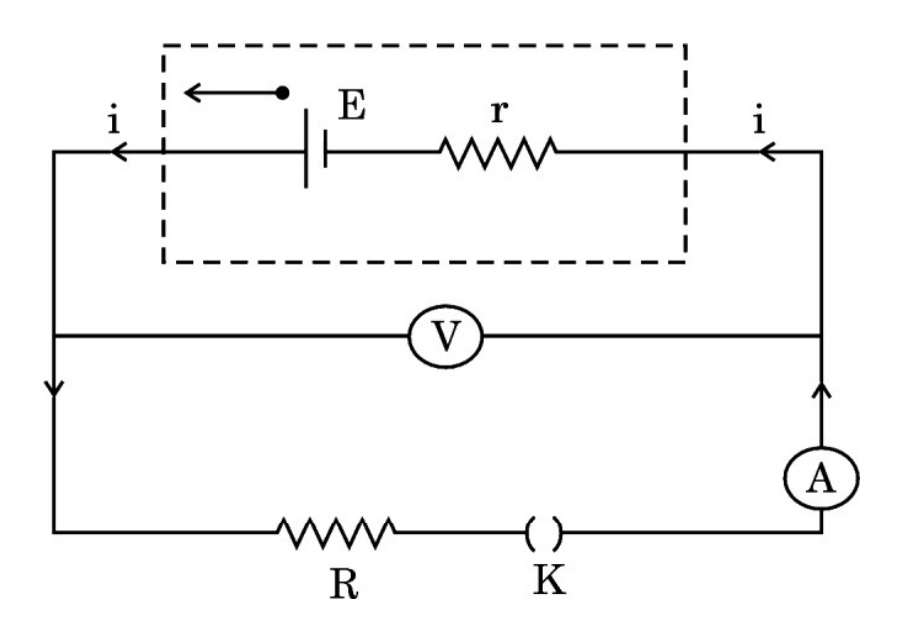 A battery of unknown emf $\mathrm{E}$ and internal resistance $\mathrm{r}$ is connected in a circuit as shown in the figure. When the key $(\mathrm{K})$ is open, the voltmeter reads $10.0 \mathrm{~V}$ and ammeter reads $0 \mathrm{~A}$. In the closed circuit, the voltmeter reads $6.0 \mathrm{~V}$ and ammeter reads $2.0 \mathrm{~A}$. Calculate :
(a) emf of the battery,
(b) internal resistance of the battery $(\mathrm{r})$, and
(c) external resistance $(\mathrm{R})$.CBSE 12th Physics 2024 Set 55/3/23 marks · Notebook›104Find the temperature at which the resistance of a conductor increases by $25 \%$ of its value at $27^{\circ} \mathrm{C}$. The temperature coefficient of resistance of the conductor is $2.0 \times 10^{-4}{ }^{\circ} \mathrm{C}^{-1}$.CBSE 12th Physics 2024 Set 55/4/32 marks · Notebook›105In the given network, calculate :
(i) effective resistance between points A and M, and
(ii) power supplied by the battery.CBSE 12th Physics 2024 Set 55/4/33 marks · Notebook›106An ammeter and a voltmeter are connected in series to a battery. Their readings are noted as ‘A’ and ‘V’ respectively. If a resistor is connected in parallel with the voltmeter, thenCBSE 12th Physics 2024 Set 55/5/2MCQ›107(i) Define ‘temperature coefficient of resistance’ of a metal.
(ii) Show the variation of resistivity of copper with rise in temperature.
(iii) The resistance of a wire is $10 \Omega$ at $27^{\circ} \mathrm{C}$. Find its resistance at $-73^{\circ} \mathrm{C}$. The temperature coefficient of resistance of the material of the wire is $1.70 \times 10^{-4}{ }^{\circ} \mathrm{C}^{-1}$.CBSE 12th Physics 2024 Set 55/5/23 marks · Notebook›108Assertion (A) : The current density $(\vec{J})$ at a point in a conducting wire is in the direction of electric field $(\vec{E})$ at that point.
Reason (R) : A conducting wire obeys Ohm's law.CBSE 12th Physics 2024 Compartment Set 55/S/1MCQ›109(a) A cell is connected across an external resistance $12 \Omega$ and supplies $0.25 \mathrm{~A}$ current. When the external resistance is increased by $4 \Omega$, the current reduces to $0.2 \mathrm{~A}$. Calculate (i) the emf, and (ii) the internal resistance, of the cell.
OR
(b) Two point charges of $3 \mu \mathrm{C}$ and $4 \mu \mathrm{C}$ are kept in air at $(0.3 \mathrm{~m}, 0)$ and $(0,0.3 \mathrm{~m})$ in $x$-$y$ plane. Find the magnitude and direction of the net electric field produced at the origin $(0,0)$.CBSE 12th Physics 2024 Compartment Set 55/S/12 marks · Notebook›110
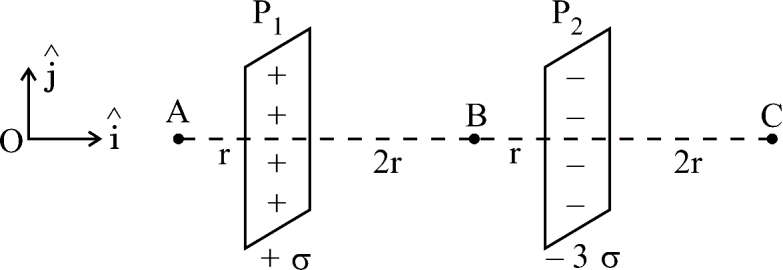 (a) The radius of a conducting wire AB uniformly decreases from its one end A to another end B. It is connected across a battery. How will (i) electric field, (ii) current density, and (iii) mobility of electrons change from end A to end B ? Justify your answer in each case.
OR
(b) Two large plane sheets $P_1$ and $P_2$ having charge densities $+\sigma$ and $-3 \sigma$ respectively are arranged parallel to each other as shown in the figure. Find the net electric field $(\vec{E})$ at points A, B and C.CBSE 12th Physics 2024 Compartment Set 55/S/13 marks · Notebook›111A heater coil rated as $(P, V)$ is cut into two equal parts. One of the parts is then connected to a battery of $V$ volt. The power consumed by it will beCBSE 12th Physics 2024 Set 55/5/3MCQ›112A potential difference of $1.0 \mathrm{~V}$ is applied across a conductor of length $5.0 \mathrm{~m}$ and area of cross-section $1.0 \mathrm{~mm}^2$. When current of $4.25 \mathrm{~A}$ is passed through the conductor, calculate
(i) the drift speed and (ii) relaxation time, of electrons. (Given number density of electrons in the conductor, $n=8.5 \times 10^{28} \mathrm{~m}^{-3}$).CBSE 12th Physics 2024 Set 55/5/33 marks · Notebook›
 (a) (i) Explain how free electrons in a metal at constant temperature attain an average velocity under the action of an electric field. Hence obtain an expression for it.
(ii) Consider two conducting wires A and B of the same diameter but made of different materials joined in series across a battery. The number density of electrons in $$\mathrm{A}$$ is 1.5 times that in $$\mathbf{B}$$. Find the ratio of drift velocity of electrons in wire A to that in wire. B.
OR
(b) (i) A cell emf of $$(\mathrm{E})$$ and internal resistance $$(\mathrm{r})$$ is connected across a variable load resistance (R). Draw plots showing the variation of terminal voltage $$V$$ with (i) $$R$$ and (ii) the current (I) in the load.
(ii) Three cells, each of emf $$\mathrm{E}$$ but internal resistances $$2 r, 3 r$$ and $$6 r$$ are connected in parallel across a resistor $$R$$.
Obtain expressions for (i) current flowing in the circuit, and (ii) the terminal potential difference across the equivalent cell.CBSE 12th Physics Delhi Set 1 - 20235 marks · Notebook›117A current of 0.8 A flows in a conductor of $$40 \Omega$$ for 1 minute. The heat produced in the conductor will beCBSE 12th Physics Outside Delhi Set 1 - 2023MCQ›118
 A cell of emf $$E$$ is connected across an external resistance $$R$$. When current '$$I$$' is drawn from the cell, the potential difference across the electrodes of the cell drops to $$\mathrm{V}$$. The internal resistance '$$r$$' of the cell isCBSE 12th Physics Outside Delhi Set 1 - 2023MCQ›119
 Briefly explain why and how a galvanometer is converted into an ammeter.CBSE 12th Physics Outside Delhi Set 1 - 20232 marks · Notebook›120Define current density and relaxation time. Derive an expression for resistivity of a conductor in terms of number density of charge carriers in the conductor and relaxation time.CBSE 12th Physics Outside Delhi Set 1 - 20233 marks · Notebook›121A potential difference $(\mathrm{V})$ is applied across a conductor of length ‘L’ and cross-sectional area ‘A’.
How will the drift velocity of electrons and the current density be affected if another identical conductor of the same material were connected in series with the first conductor ? Justify your answers.CBSE 12th Physics 2023 Set 55/5/22 marks · Notebook›122
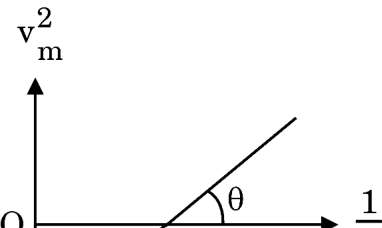 A cell of emf $E$ and internal resistance $r$ is connected to a variable resistance $R$. Draw plots showing the variation of (a) terminal voltage $V$ with $R$, and (b) $V$ with current $I$, in the circuit.CBSE 12th Physics 2023 Set 55/4/32 marks · Notebook›123Two identical cells, each of emf $E$ and internal resistance $r$, are connected with a load resistance $R$, first in series and then in parallel. Obtain the condition under which the current through $R$ is same in both cases.CBSE 12th Physics 2023 Set 55/4/22 marks · Notebook›124The masses of two cylindrical wires of copper are in the ratio of $1: 3$ and their lengths are in the ratio of $5: 3$. The ratio of their resistances will be :CBSE 12th Physics 2023 Set 55/1/21 marks · Notebook›125Which one of the following is the correct representation of variation of conductivity of a conductor with temperature ?CBSE 12th Physics 2023 Set 55/1/2MCQ›126The number of electrons flowing through a conductor per second is $3.3 \times 10^{19}$. The current flowing through the conductor is :CBSE 12th Physics 2023 Set 55/1/3MCQ›127The correct graph showing the variation of the resistance $(R)$ of a cylindrical metal wire as a function of its radius $(r)$, keeping its length and temperature constant, is :CBSE 12th Physics 2023 Set 55/1/3MCQ›128A steady current of $8 \mathrm{~mA}$ flows through a wire. The number of electrons passing through a cross-section of the wire in $10 \mathrm{~s}$ isCBSE 12th Physics 2023 Set 55/2/2MCQ›129A conductor of $10 \Omega$ is connected across a $6 \mathrm{~V}$ ideal source. The power supplied by the source to the conductor isCBSE 12th Physics 2023 Set 55/2/2MCQ›130Two cells of emf $E_1$ and $E_2$ and internal resistances $r_1$ and $r_2$ are connected in parallel, with their terminals of the same polarity connected together. Obtain an expression for the equivalent emf of the combination.CBSE 12th Physics 2023 Set 55/2/23 marks · Notebook›131The current in a device varies with time $t$ as $I=6 t$, where $I$ is in $\mathrm{mA}$ and $t$ is in $\mathrm{s}$. The amount of charge that passes through the device during $t=0 \mathrm{~s}$ to $t=3 \mathrm{~s}$ isCBSE 12th Physics 2023 Set 55/2/3MCQ›132A potential difference $V$ is applied across a conductor of length $l$ and cross-sectional area $A$. Briefly explain how the current density $j$ in the conductor will be affected if
(a) the potential difference $V$ is doubled,
(b) the conductor were gradually stretched to reduce its cross-sectional area to $\frac{A}{2}$ and then the same potential difference $V$ is applied across it.CBSE 12th Physics 2023 Set 55/2/33 marks · Notebook›133Assertion (A) : The temperature coefficient of resistance is positive for metals and negative for semi-conductors.
Reason (R) : The charge carriers in metals are negatively charged whereas in semiconductors they are positively charged.CBSE 12th Physics 2023 Compartment Set 55/C/1MCQ›134(a) When is more power delivered to a light bulb — just after it is turned on and the glow of the filament is increasing or after the glow becomes steady ? Why ?
OR
(b) A battery is connected first across the series combination and then across the parallel combination, of three resistances R, 2R and 3R. In which of the three resistances will power dissipated be maximum in the two cases ? Justify your answer.CBSE 12th Physics 2023 Compartment Set 55/C/12 marks · Notebook›135(a) (i) Derive the relation between the current and the drift velocity of free electrons in a conductor. Briefly explain the variation of resistance of a conductor with rise in temperature.
(ii) An ammeter, together with an unknown resistance in series is connected across two identical batteries, each of emf $1.5 \mathrm{~V}$, connected (i) in series, and (ii) in parallel. If the current recorded in the two cases be $\left(\frac{1}{2}\right) \mathrm{A}$ and $\left(\frac{1}{3}\right) \mathrm{A}$ respectively, calculate the internal resistance of each battery.
OR
(b) (i) State Kirchhoff's rules. Use them to obtain the condition of balance for a Wheatstone Bridge.
(ii) Use Kirchhoff's rule to determine the currents flowing through the branches MN, TO and SP in the circuit shown in the figure.CBSE 12th Physics 2023 Compartment Set 55/C/15 marks · Notebook›136For a metallic conductor, the correct representation of variation of resistance $R$ with temperature $T$ is :CBSE 12th Physics 2023 Set 55/1/1MCQ›137The potential difference across a cell in an open circuit is $8 \mathrm{~V}$. It falls to $4 \mathrm{~V}$ when a current of $4 \mathrm{~A}$ is drawn from it. The internal resistance of the cell is :CBSE 12th Physics 2023 Set 55/1/1MCQ›138A steady current flows through a metallic wire whose area of cross-section $(A)$ increases continuously from one end of the wire to the other. The magnitude of drift velocity $\left(v_d\right)$ of the free electrons as a function of ‘$A$’ can be shown by :CBSE 12th Physics 2023 Set 55/1/1MCQ›139
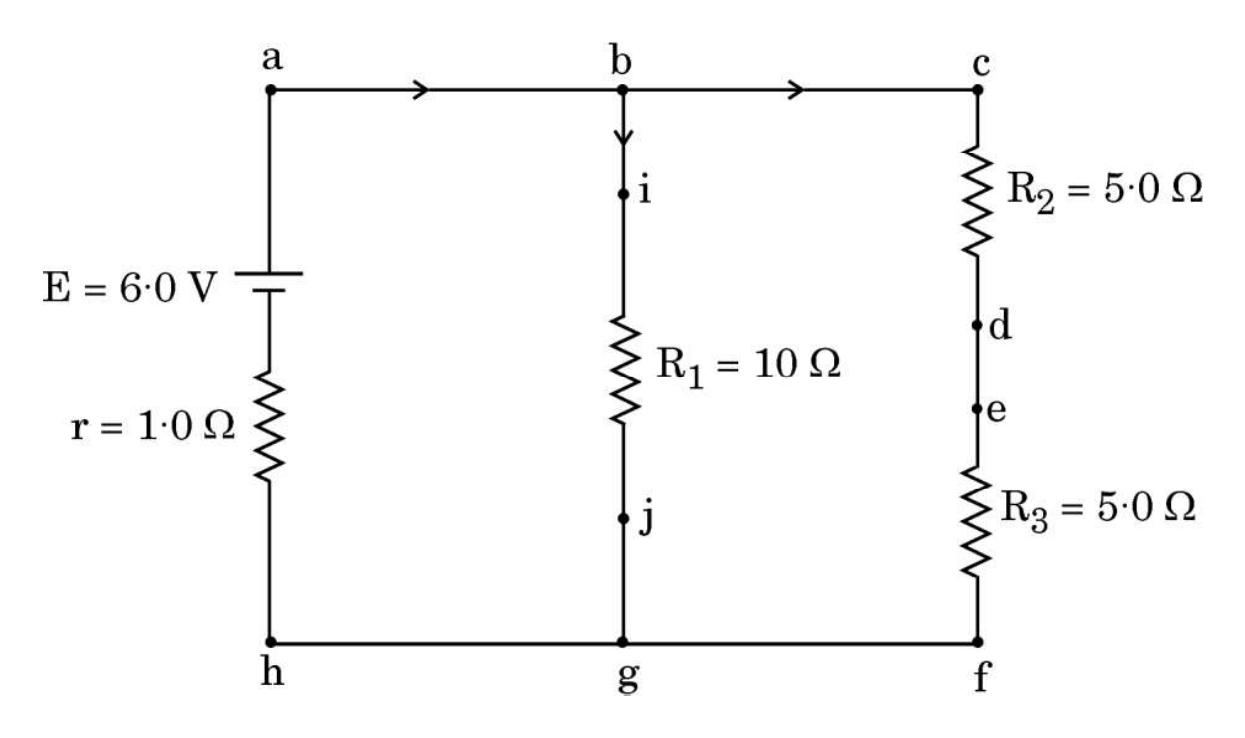 The following figure shows a circuit diagram. We can find the currents through and potential differences across different resistors using Kirchhoff’s rules.
Answer the following questions based on the above :
(a) Which points are at the same potential in the circuit ?
(b) What is the current through arm bg ?
(c) Find the potential difference across resistance $R_3$.
OR
(c) What is the power dissipated in resistance $R_2$ ?CBSE 12th Physics 2023 Set 55/1/14 marks · Notebook›140Assertion (A) : The given figure does not show a balanced Wheatstone bridge.
Reason (R) : For a balanced bridge small current should flow through the galvanometer.CBSE 12th Physics 2023 Set 55/5/3MCQ›141Two conductors, made of the same material have equal lengths but different cross-sectional areas $A_1$ and $A_2\left(A_1>A_2\right)$. They are connected in parallel across a cell. Show that the drift velocities of electrons in two conductors are equal.CBSE 12th Physics 2023 Set 55/5/32 marks · Notebook›142The current density due to drift of electrons in a conductor is given by : (symbols have their usual meanings)CBSE 12th Physics 2023 Set 55/3/1MCQ›143Assertion (A) : The internal resistance of a cell is constant.
Reason (R) : Ionic concentration of the electrolyte remains same during use of a cell.CBSE 12th Physics 2023 Set 55/3/1MCQ›144A potential difference $V$ is applied across a conductor of length $l$ and uniform cross-section area $A$. How will the (i) electric field $E$, (ii) drift velocity $v_d$, and (iii) current density $j$ be affected when (a) $V$ is doubled and (b) $l$ is halved (keeping other factors constant) ?CBSE 12th Physics 2023 Set 55/3/13 marks · Notebook›145The SI unit of mobility of charge carriers is :CBSE 12th Physics 2023 Set 55/3/2MCQ›146The emf and internal resistance of a cell are $E$ and $r$ respectively. It is connected across an external resistance $R=2 r$. The potential drop across the terminals of the cell will be :CBSE 12th Physics 2023 Set 55/3/2MCQ›147A potential difference $V$ is applied across a load resistor of resistance $R$. $V$ and $R$ can be varied. If the current that flows in the circuit is $I$, draw a plot showing the variation of power consumed by the resistor as a function of :
(a) $R$, keeping $V$ constant
(b) $I$, keeping $R$ constant
(c) $V$, keeping $R$ constantCBSE 12th Physics 2023 Set 55/3/23 marks · Notebook›148A battery of emf E and internal resistance r is connected to an external circuit. The potential drop within the battery is proportional to :CBSE 12th Physics 2023 Set 55/3/3MCQ›149Two wires of equal length and radii $r$ and $2 r$ are connected in series. Their resistivities are $2 \rho$ and $\rho$ respectively. For the same current passing through the combination, the potential drop across their ends will be in the ratio of :CBSE 12th Physics 2023 Set 55/3/3MCQ›150
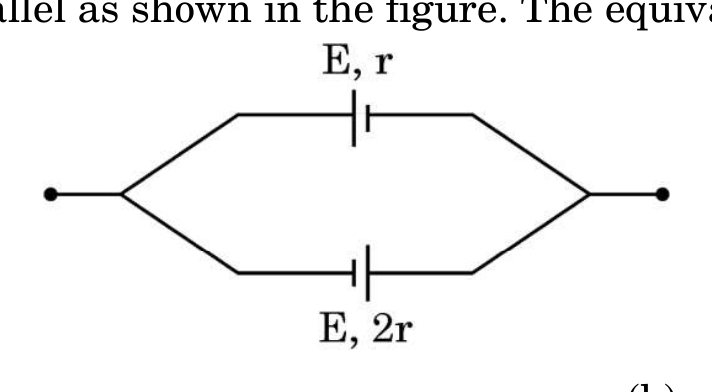 Two cells of emf $\mathrm{E}$ each and internal resistances $r$ and $2 r$ are connected in parallel as shown in the figure. The equivalent emf of the combination is :CBSE 12th Physics 2023 Set 55/3/3MCQ›151Obtain a relation between the current flowing in a conductor and drift velocity of electrons in it. Hence, obtain Ohm’s law.CBSE 12th Physics 2023 Set 55/3/33 marks · Notebook›152Assertion (A) : When three electric bulbs of power $200 \mathrm{~W}, 100 \mathrm{~W}$ and $50 \mathrm{~W}$ are connected in series to a source, the power consumed by the $50 \mathrm{~W}$ bulb is maximum.
Reason (R) : In a series circuit, current is the same through each bulb, but the potential difference across each bulb is different.CBSE 12th Physics 2023 Set 55/4/1MCQ›153Write two differences between the emf and terminal potential difference of a cell. What is the most important precaution that one should take while drawing current from a cell ?CBSE 12th Physics 2023 Set 55/4/12 marks · Notebook›154
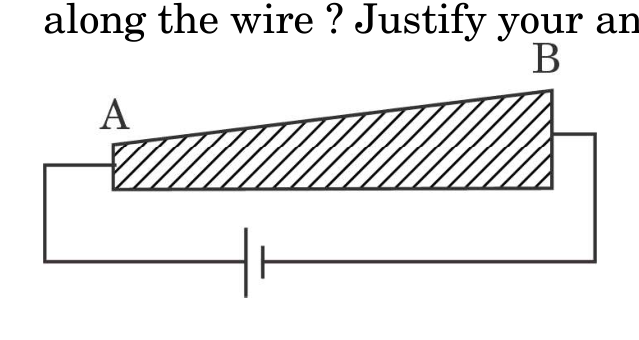 (a) (i) Define mobility of electrons. Give its SI units.
(ii) A steady current flows through a wire AB, as shown in the figure. What happens to the electric field and the drift velocity along the wire ? Justify your answer.
(iii) Consider the circuit shown in the figure. Find the effective resistance of the circuit and the current drawn from the battery.
OR
(b) (i) Define electrical conductivity of a wire. Give its SI unit.
(ii) High current is to be drawn safely from (1) a low-voltage battery, and (2) a high-voltage battery. What can you say about the internal resistance of the two batteries ?
(iii) Calculate the total energy supplied by the batteries to the circuit shown in the figure, in one minute.CBSE 12th Physics 2023 Set 55/4/15 marks · Notebook›