
ExamQuark
Getting things ready
Your next step is almost ready.
Your progress
0
Correct
0
Wrong
0%
Accuracy
0 s
Time spent
—
Percentile
Questions by year
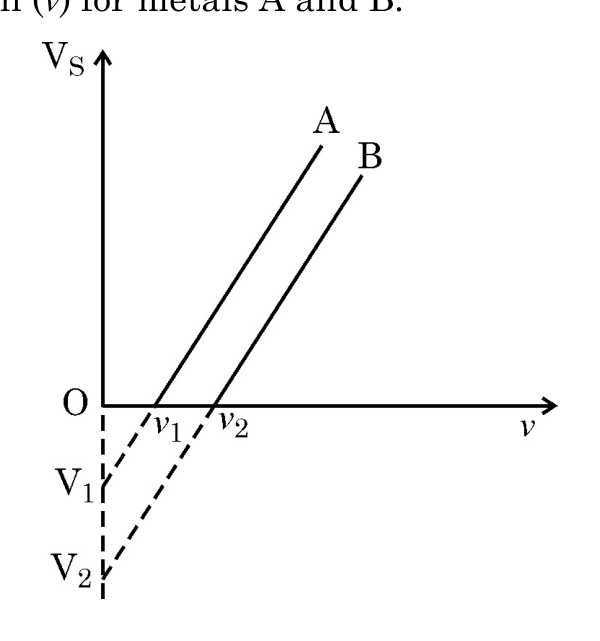 A researcher performs an experiment on photo-electric effect using two metals A and B with unknown work functions. She illuminates the surfaces of A and B with monochromatic radiation of various frequencies and records the value of corrosponding stopping potentials $\left(V_s\right)$. The graph shows the variation of stopping potential $\left(V_s\right)$ with the frequency of incident radiation $(\nu)$ for metals A and B.
Answer the following questions :
(I) From the graph, the work functions of A and B are ($h$ is Planck’s constant and $e$ value of charge on an electron)
(A) $\nu_1$ and $\nu_2$
(B) $V_1$ and $V_2$
(C) $h \nu_1$ and $h \nu_2$
(D) $\frac{h \nu_1}{e}$ and $\frac{h \nu_2}{e}$
(II) For radiation of frequency $\nu>\nu_2$ incident on the surfaces of A and B, the maximum kinetic energy of ejected electron is
(A) greater for metal A because it has a smaller work function.
(B) greater for metal B because it has a larger work function.
(C) greater for metal B because it has higher threshold frequency.
(D) the same for both metal A and metal B because it is independent of work functions of metals.
(III) If the intensity of the incident radiation for both metals A and B, is doubled keeping its frequency constant, then
(A) the slope of the parallel lines will increase.
(B) the slope of the parallel lines will decrease.
(C) the threshold frequencies for both A and B will decrease.
(D) the slope of the parallel lines will not change but more electrons will be emitted per second.
(IV) The threshold frequency for a metal surface is $\nu_0$. If the radiation of frequency $3 \nu_0$ illuminates the surface, the maximum kinetic energy (KE) of photoelectrons is $E_1$. If the frequency were increased to $6 \nu_0$, the maximum KE of the photoelectrons becomes $E_2$. Then $\left(\frac{E_1}{E_2}\right)$ equals
(A) $1 / 3$
(B) $1 / 2$
(C) $2 / 5$
(D) $3 / 4$
OR
Let $m$ be the slope of the graph line for metal B. If $e$ is the value of electron charge, then Planck’s constant ‘$h$’ is given by
(A) $m e$
(B) $\frac{1}{m e}$
(C) $\frac{m}{e}$
(D) $\frac{e}{m}$CBSE 12th Physics 2026 Set 55/1/14 marks · Notebook›
 Einstein explained photoelectric effect on the basis of Planck’s quantum theory, where light travels in the form of small bundles of energy called photons. The energy of each photon is $h \nu$, where $\nu$ is the frequency of incident light and $h$ is Planck’s constant. The number of photons in a beam of light determines the intensity of the incident light. A photon incident on a metal surface transfers its total energy $h \nu$ to a free electron in the metal. A part of this energy is used in ejecting the electron from the metal and is called its work function. The rest of the energy is carried by the ejected electron as its kinetic energy.
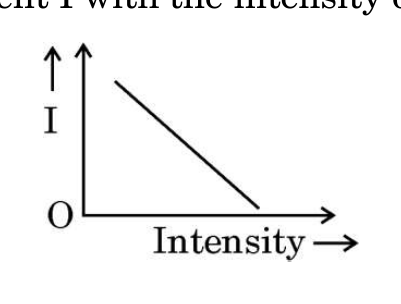
(i) Which of the following graphs shows the variation of photoelectric current $I$ with the intensity of light ?
(A)
(B)
(C)
(D)
(ii) When the frequency of the incident light is increased without changing its intensity, the saturation current :
(A) increases linearly
(B) decreases
(C) increases non-linearly
(D) remains the same
(iii) Which of the following graphs can be used to obtain the value of Planck’s constant ?
(A) Photocurrent versus Intensity of incident light
(B) Photocurrent versus Frequency of incident light
(C) Cut-off potential versus Frequency of incident light
(D) Cut-off potential versus Intensity of incident light
(iv) (a) Red light, yellow light and blue light of the same intensity are incident on a metal surface successively. $K_R, K_Y$ and $K_B$ represent the maximum kinetic energy of photoelectrons respectively, then :
(A) $K_R>K_Y>K_B$
(B) $K_Y>K_B>K_R$
(C) $K_B>K_Y>K_R$
(D) $K_R>K_B>K_Y$
OR
(b) Which of the following metals exhibits photoelectric effect with visible light ?
(A) Caesium
(B) Zinc
(C) Cadmium
(D) MagnesiumCBSE 12th Physics 2025 Set 55/5/14 marks · Notebook›47Choose the correct statement :CBSE 12th Physics 2025 Set 55/4/1MCQ›48A beam of red light and a beam of blue light have equal intensities. Which of the following statements is true ?CBSE 12th Physics 2025 Set 55/4/1MCQ›49Assertion (A) : For monochromatic incident radiation, the emitted photoelectrons from a given metal have speed ranging from zero to a certain maximum value.
Reason (R) : Each metal has a definite work function.CBSE 12th Physics 2025 Set 55/4/1MCQ›50Explain the following observations using Einstein’s photoelectric equation :
(a) Photoelectric emission does not occur from a surface when the frequency of the light incident on it is less than a certain minimum value.
(b) It is the frequency, and not the intensity of the incident light which affects the maximum kinetic energy of the photoelectrons.
(c) The cut-off voltage $\left(V_0\right)$ versus frequency $(\nu)$ of the incident light curve is a straight line with a slope $\frac{h}{e}$.CBSE 12th Physics 2025 Set 55/4/13 marks · Notebook›51A source produces monochromatic light of frequency $5.0 \times 10^{14} \mathrm{~Hz}$ and the power emitted is $3.31 \mathrm{~mW}$. The number of photons emitted per second by the source, on an average isCBSE 12th Physics 2025 Set 55/1/2MCQ›52(a) Draw a plot of frequency $\nu$ of incident radiations as a function of stopping potential $V_0$ for a given photo emissive material. What information can be obtained from the value of the intercept on the stopping potential axis ?
(b) Calculate : (i) the momentum and (ii) de Broglie wavelength, of an electron with kinetic energy of $80 \mathrm{~eV}$.CBSE 12th Physics 2025 Set 55/1/23 marks · Notebook›53The threshold wavelength of a metal is $450 \mathrm{~nm}$. Calculate (i) the work function of the metal in eV and (ii) the maximum energy of the ejected photoelectrons in eV by incident radiation of $250 \mathrm{~nm}$.CBSE 12th Physics 2025 Set 55/2/32 marks · Notebook›54The figure shows the variation of maximum kinetic energy $\left(K_{\max }\right)$ of emitted electrons as a function of the frequency $v$ of radiation incident on a photosensitive surface. The slope of the curve is :CBSE 12th Physics 2025 Compartment Set 55/S/1MCQ›55Assertion (A) : In process of photoelectric emission using a monochromatic light, all emitted electrons do not have the same kinetic energy.
Reason (R) : If radiation falling on a photosensitive surface consists of different wavelengths, the energy of emitted photoelectrons by absorbing photons of different wavelengths, shall be different.CBSE 12th Physics 2025 Compartment Set 55/S/1MCQ›56The work function of Caesium is $2.14 \mathrm{~eV}$.
(a) Find the threshold frequency for Caesium.
(b) Find the wavelength of the incident light if the photocurrent is brought to zero by a stopping potential of $0.86 \mathrm{~V}$.CBSE 12th Physics 2025 Compartment Set 55/S/12 marks · Notebook›57Monochromatic light of frequency $7.0 \times 10^{14} \mathrm{~Hz}$ is produced by a laser. The power emitted is $21 \mathrm{~mW}$. Calculate (i) the energy of a photon in the light beam, and (ii) the number of photons per second, on an average, emitted by the source.CBSE 12th Physics 2025 Compartment Set 55/S/22 marks · Notebook›58An electron of mass $m$ and charge $e$ is accelerated from rest through a potential $V$. Prove that, after acceleration, the de Broglie wavelength associated with the electron is proportional to $\frac{1}{\sqrt{V}}$.CBSE 12th Physics 2025 Compartment Set 55/S/32 marks · Notebook›59The de Broglie wavelength associated with an electron moving with energy $5 \mathrm{~eV}$ is :CBSE 12th Physics 2025 Set 55/6/2MCQ›60A laser beam of wavelength $500 \mathrm{~nm}$ and power $5 \mathrm{~mW}$ strikes normally on a perfectly reflecting surface of area $1 \mathrm{~mm}^2$ of a body. It rebounds back from the surface. Find the force exerted by the laser beam on the body.CBSE 12th Physics 2025 Set 55/6/22 marks · Notebook›61(a) Briefly explain Einstein’s photoelectric equation.
(b) Four metals with their work functions are listed below :
$\mathrm{K}=2.3 \mathrm{~eV}$, $\mathrm{Na}=2.75 \mathrm{~eV}$, $\mathrm{Mo}=4.17 \mathrm{~eV}$ and $\mathrm{Ni}=5.15 \mathrm{~eV}$.
The radiation of wavelength $330 \mathrm{~nm}$ from a laser source placed $1 \mathrm{~m}$ away, falls on these metals. Which of these metals will not show photoelectric emission ? What will happen if the laser source is brought closer to a distance of $50 \mathrm{~cm}$ ?CBSE 12th Physics 2025 Set 55/7/23 marks · Notebook›62Radiations of two frequencies are incident on a metal surface of work function $2.0 \mathrm{~eV}$ one by one. The energies of their photons are $2.5 \mathrm{~eV}$ and $4.5 \mathrm{~eV}$ respectively. Find the ratio of the maximum speed of the electrons emitted in the two cases.CBSE 12th Physics 2025 Set 55/2/22 marks · Notebook›63Answer the following, giving reasons :
(a) The maximum kinetic energy of the photoelectrons is independent of the intensity of incident radiation.
(b) Photoelectric current increases with the increase in the intensity of the incident radiation.
(c) The stopping potential $V_0$ varies linearly with the frequency $v$ of the incident radiation for a given photosensitive surface.CBSE 12th Physics 2025 Set 55/7/33 marks · Notebook›64The wavelength of a photon is equal to the wavelength associated with an electron. Both will have the same value of :CBSE 12th Physics 2025 Set 55/6/3MCQ›65In a photoelectric experiment with a material of work function $2.1 \mathrm{eV}$, the stopping potential is found to be $2.5 \mathrm{~V}$. The maximum kinetic energy of ejected photoelectrons isCBSE 12th Physics 2025 Set 55/1/3MCQ›66(a) Mention any three features of results of experiment on photoelectric effect which cannot be explained using the wave theory of light.
(b) In his experiment on photoelectric effect, Robert A. Millikan found the slope of the cut-off voltage versus frequency of incident light plot to be $4.12 \times 10^{-15} \mathrm{Vs}$. Calculate the value of Planck’s constant from it.CBSE 12th Physics 2025 Set 55/1/33 marks · Notebook›67The frequency of a photon of energy $1.326 \mathrm{~eV}$ is :CBSE 12th Physics 2025 Set 55/7/1MCQ›68Assertion (A) : The minimum negative potential applied to the anode in a photoelectric experiment at which photoelectric current becomes zero, is called cut-off voltage.
Reason (R) : The threshold frequency for a metal is the minimum frequency of incident radiation below which emission of photoelectrons does not take place.CBSE 12th Physics 2025 Set 55/7/1MCQ›69(a) Define ‘work function’ of a metal. How can its value be determined from a graph between stopping potential and frequency of the incident radiation ?
(b) The work function of a metal is $2.4 \mathrm{~eV}$. A stopping potential of $0.6 \mathrm{~V}$ is required to reduce the photocurrent to zero, in a photoelectric experiment. Calculate the wavelength of light used.CBSE 12th Physics 2025 Set 55/7/13 marks · Notebook›
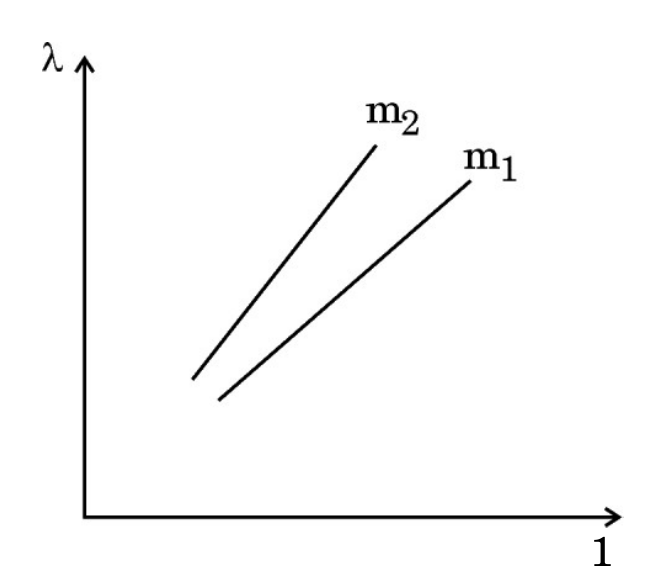 de Broglie wavelength $\lambda$ as a function of $\frac{1}{\sqrt{K}}$, for two particles of masses $m_1$ and $m_2$ are shown in the figure. Here, $K$ is the energy of the moving particles.
(a) What does the slope of a line represent ?
(b) Which of the two particles is heavier ?
(c) Is this graph also valid for a photon ?
Justify your answer in each case.CBSE 12th Physics 2024 Set 55/2/13 marks · Notebook›84Two beams, A and B whose photon energies are $3.3 \mathrm{~eV}$ and $11.3 \mathrm{~eV}$ respectively, illuminate a metallic surface (work function $2.3 \mathrm{~eV}$) successively. The ratio of maximum speed of electrons emitted due to beam A to that due to beam B is :CBSE 12th Physics 2024 Set 55/1/1MCQ›85The waves associated with a moving electron and a moving proton have the same wavelength $\lambda$. It implies that they have the same :CBSE 12th Physics 2024 Set 55/1/1MCQ›86Assertion (A) : In photoelectric effect, the kinetic energy of the emitted photoelectrons increases with increase in the intensity of the incident light.
Reason (R) : Photoelectric current depends on the wavelength of the incident light.CBSE 12th Physics 2024 Set 55/1/1MCQ›87Consider a neutron (mass $m$) of kinetic energy $E$ and a photon of the same energy. Let $\lambda_n$ and $\lambda_p$ be the de Broglie wavelength of neutron and the wavelength of photon respectively. Obtain an expression for $\frac{\lambda_n}{\lambda_p}$.CBSE 12th Physics 2024 Set 55/1/12 marks · Notebook›88Which one of the following is the correct graph between the maximum kinetic energy $\left(\mathrm{K}_{\mathrm{m}}\right)$ of the emitted photoelectrons and the frequency of incident radiation $(\nu)$ for a given photosensitive surface ?CBSE 12th Physics 2024 Set 55/3/1MCQ›89Assertion (A) : Photoelectric effect demonstrates the particle nature of light.
Reason (R) : Photoelectric current is proportional to frequency of incident radiation.CBSE 12th Physics 2024 Set 55/3/1MCQ›90The minimum intensity of white light that our eyes can perceive is about $0.1 \mathrm{~nWm}^{-2}$. Calculate the number of photons of this light entering our pupil $\left(\text{area } 0.4 \mathrm{~cm}^2\right)$ per second.
(Take average wavelength of white light $=500 \mathrm{~nm}$ and Planck’s constant $=6.6 \times 10^{-34} \mathrm{~Js}$)CBSE 12th Physics 2024 Set 55/3/12 marks · Notebook›91The wavelength of matter wave associated with an electron of kinetic energy $\mathrm{K}$ is $\lambda$. If the kinetic energy of the electron is doubled, the associated wavelength becomes :CBSE 12th Physics 2024 Set 55/3/3MCQ›92Light of wavelength $600 \mathrm{~nm}$ is incident on potassium (work function $2.3 \mathrm{eV}$). Will photoemission of electrons occur ? What is the longest wavelength that will cause photoemission of electrons ?
(Take $\mathrm{hc}=1240 \mathrm{eV} . \mathrm{nm}$)CBSE 12th Physics 2024 Set 55/3/32 marks · Notebook›93
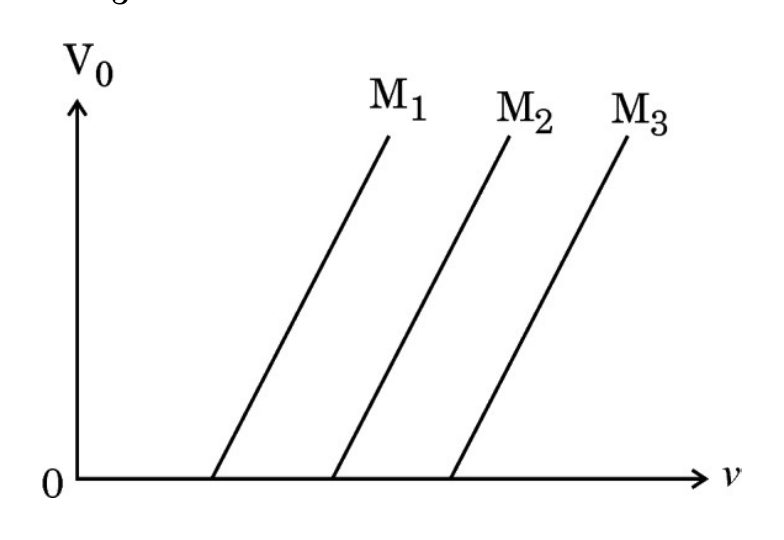 The figure shows the variation of stopping potential $\mathrm{V}_0$ with frequency $\nu$ of incident radiation, for three materials $\mathrm{M}_1, \mathrm{M}_2$ and $\mathrm{M}_3$ with work functions $\phi_1, \phi_2$ and $\phi_3$ respectively. Then :CBSE 12th Physics 2024 Set 55/3/2MCQ›94Light of wavelength $500 \mathrm{~nm}$ is incident on caesium metal (work function $2.14 \mathrm{~eV}$) and photoemission of electrons occurs. Calculate the (i) kinetic energy (in eV) of the fastest electrons and (ii) stopping potential for this situation. (Take $\mathrm{hc}=1240 \mathrm{~eV} . \mathrm{nm}$)CBSE 12th Physics 2024 Set 55/3/22 marks · Notebook›95The ratio of de Broglie wavelengths of a proton and a deuteron accelerated by potential $V_p$ and $V_d$ respectively, $\left(\frac{\lambda_p}{\lambda_d}\right)$ is $\frac{1}{2}$. Find $\frac{V_p}{V_d}$.CBSE 12th Physics 2024 Set 55/4/32 marks · Notebook›96A photosensitive surface of work function $2.1 \mathrm{~eV}$ is irradiated by radiation of wavelength $150 \mathrm{~nm}$. Calculate (i) the threshold wavelength, (ii) energy (in eV) of an incident photon, and (iii) maximum kinetic energy of emitted photoelectron.CBSE 12th Physics 2024 Set 55/5/23 marks · Notebook›97
 In photoelectric effect experiment, show the variation of
(a) photocurrent with collector plate potential for a given surface for different intensities of incident radiation. Do the curves meet at any point ? If so, why ?
(b) photocurrent with intensity of radiation incident on a surface keeping the frequency and plate potential fixed.CBSE 12th Physics 2024 Compartment Set 55/S/13 marks · Notebook›98(a) (i) What are matter waves ? A particle of mass $m$ and charge $q$ is accelerated from rest through a potential difference $V$. Obtain an expression for de Broglie wavelength associated with the particle.
(ii) Monochromatic light of frequency $5.0 \times 10^{14} \mathrm{~Hz}$ is produced by a source of power output $3.315 \mathrm{~mW}$. Calculate :
(1) energy of the photon in the beam
(2) number of photons emitted per second by the source
OR
(b) (i) State Bohr's postulates and derive an expression for the energy of electron in $n^{\text {th }}$ orbit in Bohr's model of hydrogen atom.
(ii) Calculate binding energy per nucleon (in MeV) of ${ }_6^{12} \mathrm{C}$.
Given :
$m\left({ }_6^{12} \mathrm{C}\right)=12.000000 \mathrm{~u}$
$m\left({ }_0^1 \mathrm{n}\right)=1.008665 \mathrm{~u}$
$m\left({ }_1^1 \mathrm{H}\right)=1.007825 \mathrm{~u}$CBSE 12th Physics 2024 Compartment Set 55/S/15 marks · Notebook›99The threshold frequency for a metal is $3.0 \times 10^{14} \mathrm{~Hz}$. A beam of frequency $9.0 \times 10^{14} \mathrm{~Hz}$ is incident on the metal. Calculate (i) the work function (in eV) of the metal and (ii) the maximum speed of photoelectrons.CBSE 12th Physics 2024 Set 55/5/33 marks · Notebook›
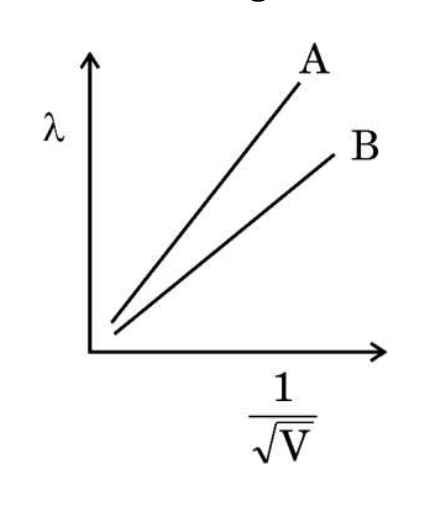 (a) The figure shows de Broglie wavelength $(\lambda)$ for two particles A and B having same charges but different masses as a function of $\frac{1}{\sqrt{V}}$, where $V$ is the potential through which the particles are accelerated.
(i) Which of them is heavier and why ?
(ii) What does the slope of the line represent ?
(b) Calculate the momentum of an electron having de Broglie wavelength of $3.0 \AA$.CBSE 12th Physics 2023 Set 55/3/33 marks · Notebook›131Photons of energy $3.2 \mathrm{~eV}$ are incident on a photosensitive surface. If the stopping potential for the emitted electrons is $1.5 \mathrm{~V}$, the work function for the surface is :CBSE 12th Physics 2023 Set 55/4/1MCQ›132A proton and an alpha particle have the same kinetic energy. The ratio of de Broglie wavelengths associated with the proton to that with the alpha particle is :CBSE 12th Physics 2023 Set 55/4/1MCQ›133
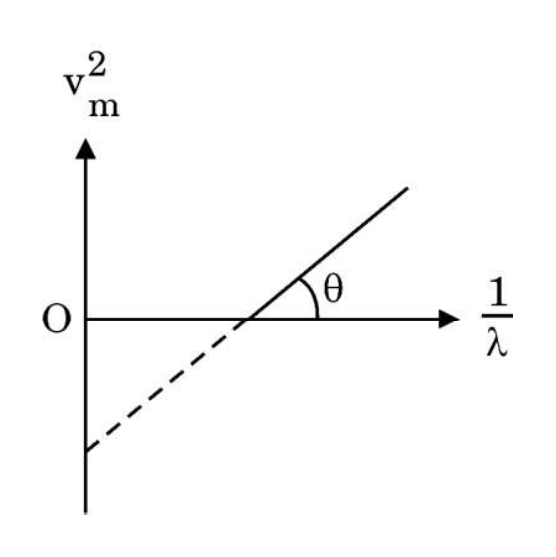 The figure shows $v_m^2$ versus $\frac{1}{\lambda}$ graph for photoelectrons emitted from a surface where $v_m$ is the maximum speed of electrons and $\lambda$ is the wavelength of incident radiation. Using this graph and Einstein’s photoelectric equation, obtain the expression for Planck’s constant and work function of the surface.CBSE 12th Physics 2023 Set 55/4/12 marks · Notebook›