
ExamQuark
Getting things ready
Your next step is almost ready.
Your progress
0
Correct
0
Wrong
0%
Accuracy
0 s
Time spent
—
Percentile
Questions by year
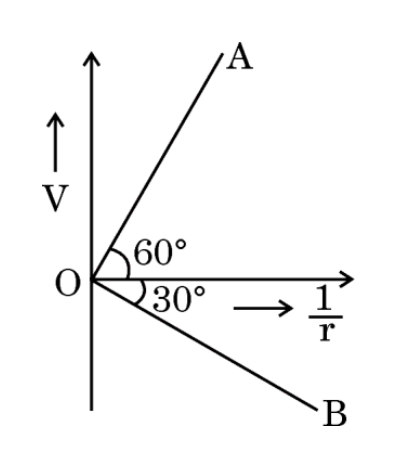 (a) (i) In the figure, OA and OB show the variation of electric potential $V$ at a point due to two point charges $Q_1$ and $Q_2$ with $\frac{1}{r}$ respectively. Here $r$ represents the distance of the point from the two point charges.
(I) Identify the nature of the two charges $Q_1$ and $Q_2$.
(II) What is the value of $\left(\frac{Q_1}{Q_2}\right)$ ? Justify your answer.
(ii) Two point charges $-2 \mu \mathrm{C}$ and $5 \mu \mathrm{C}$ are placed at $(-30 \mathrm{~cm}, 0)$ and $(30 \mathrm{~cm}, 0)$ respectively in an external electric field $\vec{E}=\frac{A}{x^2} \hat{i}$, where $A=9 \times 10^5 \mathrm{~N} \mathrm{~m}^2 \mathrm{C}^{-1}$. Find the electrostatic potential energy of this configuration.
OR
(b) (i) Two infinitely long straight wires having linear charge densities $-\lambda$ and $3 \lambda$ are held vertically parallel to each other, distance $r$ apart in free space. Find the nature and magnitude of the force/length exerted by one wire on the other.
(ii) A small hollow conducting sphere of radius $r_1$ is given a charge $Q$. It is surrounded by a concentric conducting spherical shell of inner radius $r_2$ and outer radius $r_3$, having charge $-3 q$.
If a point charge $2 q$ were kept at the centre, find :
(I) the electric flux through a concentric spherical Gaussian surface of radius $x$ for (1) $x < r_1$, and (2) $r_1 < x < r_2$.
(II) electric field at a point distant $x$ from the centre for (1) $x>r_3$, and (2) $r_1 < x < r_2$.
(III) surface charge density on the inner surface of (1) sphere, and (2) shell.CBSE 12th Physics 2026 Set 55/3/15 marks · Notebook›3(a) Draw electric field lines and equipotential surfaces for a system of two equal positive charges separated by some distance.
(b) Using the drawing in (a) above, explain that electric field need not be a constant over each point of an equipotential surface.CBSE 12th Physics 2026 Set 55/2/33 marks · Notebook›4Three point charges $+q$, $-2 q$ and $+q$ are placed along $x$-axis at points $x=-1 \mathrm{~m}$, $x=0 \mathrm{~m}$ and $x=2 \mathrm{~m}$ respectively. The potential energy of the system isCBSE 12th Physics 2026 Set 55/2/2MCQ›5
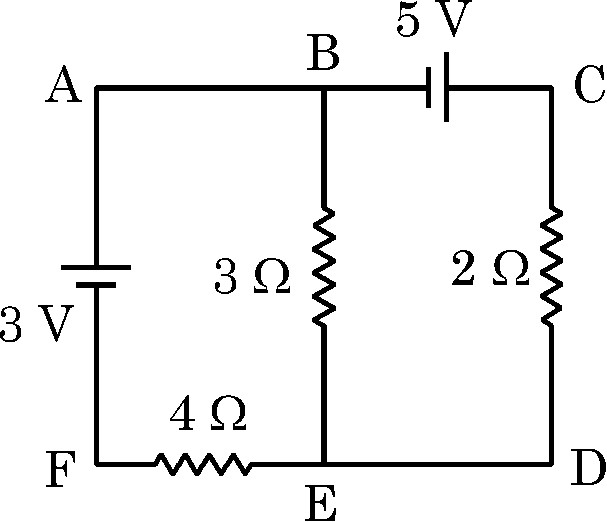 (i) Draw electric field lines and equipotential surfaces for a system of two equal and opposite point charges separated by some distance.
(ii) Why electric field $\vec{E}$ at a point on an equipotential surface must be perpendicular to the surface at that point ?CBSE 12th Physics 2026 Set 55/2/23 marks · Notebook›6Three point charges $2 q,-2 q$ and $q$ are kept at the vertices of an equilateral triangle of side $l$. The potential energy of the system isCBSE 12th Physics 2026 Set 55/2/1MCQ›7
 (a) An electric field $\vec{E}=E_0 \hat{i}$ exists in a region of space. Draw three equipotential surfaces in the region.
(b) Two point charges $-q$ and $+q$ are located at points $(-a, 0,0)$ and $(a, 0,0)$ respectively. Find the electrostatic potential at point $(x, 0,0)$ where $x \gg a$.CBSE 12th Physics 2026 Set 55/2/13 marks · Notebook›8
 (a) (i) Explain the following statements giving reason :
(I) An equipotential surface through a point is normal to the electric field at that point.
(II) When a dielectric is placed in an external electric field, the electric field inside the dielectric is less than that outside it.
(III) The potential difference between the plates of a charged parallel plate capacitor decreases when its plates are brought closer.
(ii) Obtain an expression for the work done to dissociate the system of three charges $q$, $-4 q$ and $2 q$ placed at the vertices A, B and C respectively of an equilateral triangle of side ‘$a$’.
OR
(b) (i) Answer the following giving reason :
(I) The electron drift speed is estimated to be only a few $\mathrm{mm} / \mathrm{s}$ for currents in the range of a few amperes. How, then, is the current established almost the instant a circuit is closed ?
(II) A low voltage supply from which one needs high currents must have very low internal resistance. Why ?
(III) The assertion that $V=I R$ is a statement of Ohm’s law is not true. Why ?
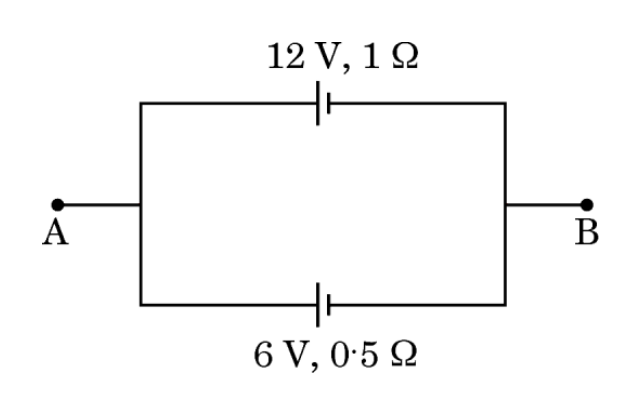
(ii) Two cells of emfs $12 \mathrm{~V}$ and $6 \mathrm{~V}$ are connected in parallel as shown in the figure. Their internal resistances are $1 \Omega$ and $0.5 \Omega$ respectively. Calculate the emf and internal resistance of the equivalent cell between points A and B.CBSE 12th Physics 2026 Set 55/4/15 marks · Notebook›9The electric potential for various points in $x$-$y$ plane is given by $\mathrm{V}=1.0 x^2-2.0 \mathrm{y}^2$, where $\mathrm{V}$ is in volts and $x, \mathrm{y}$ are in metres. The angle that the electric field at point $(2.0 \mathrm{~m}, 1.0 \mathrm{~m})$ makes with the positive $x$-axis is –CBSE 12th Physics 2026 Set 55/1/3MCQ›10Assume that the surface charge density of the Earth is 1 electron charge/$\mathrm{m}^2$. The potential of the Earth’s surface (radius $6400 \mathrm{~km}$) will be :CBSE 12th Physics 2026 Compartment Set 55/7/1MCQ›11
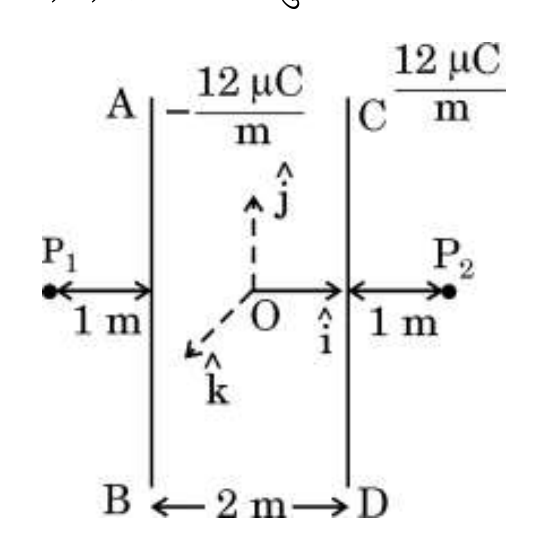 (a) Two infinitely long thin straight wires AB and CD with charge densities $-\frac{12 \mu \mathrm{C}}{\mathrm{m}}$ and $+\frac{12 \mu \mathrm{C}}{\mathrm{m}}$ are lying parallel to y-axis at points $(-1 \mathrm{~m}, 0,0)$ and $(1 \mathrm{~m}, 0,0)$ respectively, as shown in the figure. Find the net electric field $\vec{E}$ at points $P_1(-2 \mathrm{~m}, 0,0)$, $O(0,0,0)$ and $P_2(2 \mathrm{~m}, 0,0)$.
OR
(b) Two charges of $8 \mu \mathrm{C}$ and $-4 \mu \mathrm{C}$ are located at points $(-18 \mathrm{~cm}, 0,0)$ and $(18 \mathrm{~cm}, 0,0)$ respectively.
(i) Calculate the electrostatic potential energy of the system of the two charges.
(ii) The same system of charges is placed in a region where electrostatic potential $V(r)=\frac{A}{r}$, where $A=9 \times 10^4 \mathrm{~V} . \mathrm{m}$. Calculate the potential energy of the system.CBSE 12th Physics 2026 Compartment Set 55/7/13 marks · Notebook›12
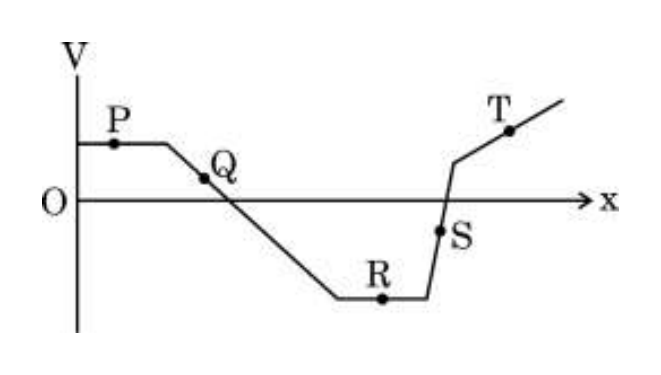 The figure represents the variation of the electric potential V at a point in a region of space as a function of its position along the x-axis. A charged particle will experience the maximum force at :CBSE 12th Physics 2026 Set 55/5/1MCQ›13
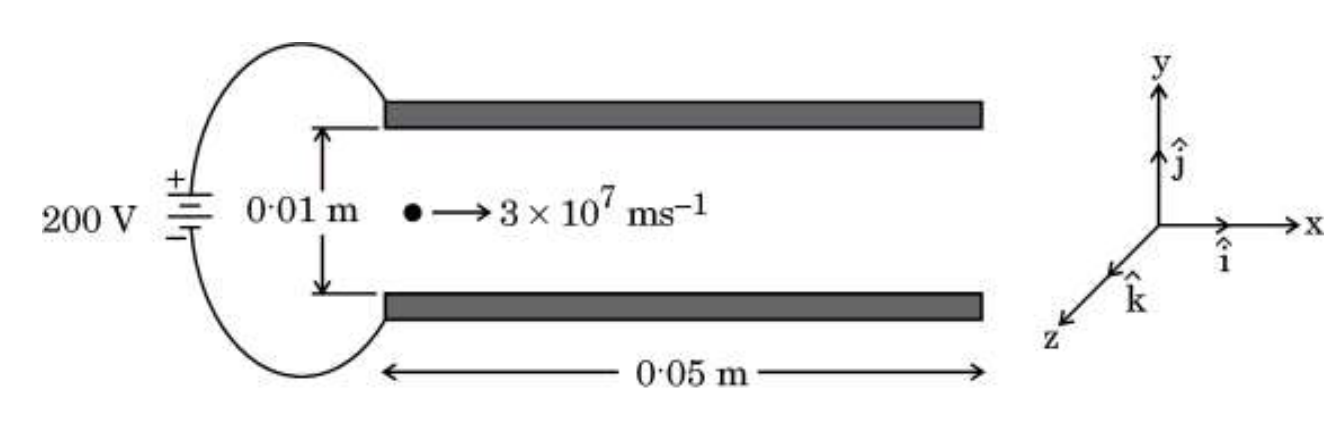 The electric potential (V) and electric field (E) are closely related concepts in electrostatics. The electric field is a vector quantity that represents the force per unit charge at a given point in space, whereas electric potential is a scalar quantity that represents the potential energy per unit charge at a given point in space. Electric field and electric potential are related by the equations $E_r=\frac{-d V}{d r}$ and $\vec{E}=E_r \hat{r}$, i.e., electric field is the negative gradient of the electric potential. This means that electric field points in the direction of decreasing potential and its magnitude is the rate of change of potential with distance. The electric field is the force that drives a unit charge to move from higher potential region to lower potential region and electric potential difference between the two points determines the work done in moving a unit charge from one point to the other point.
A pair of square conducting plates having sides of length $0.05 \mathrm{~m}$ are arranged parallel to each other in x-y plane. They are $0.01 \mathrm{~m}$ apart along z-axis and are connected to a $200 \mathrm{~V}$ power supply as shown in the figure. An electron enters with a speed of $3 \times 10^7 \mathrm{~ms}^{-1}$ horizontally and symmetrically in the space between the two plates. Neglect the effect of gravity on the electron.
(i) The electric field $\vec{E}$ in the region between the plates is :
(A) $\left(2 \times 10^2 \frac{\mathrm{V}}{\mathrm{m}}\right) \hat{k}$
(B) $-\left(2 \times 10^2 \frac{\mathrm{V}}{\mathrm{m}}\right) \hat{k}$
(C) $\left(2 \times 10^4 \frac{\mathrm{V}}{\mathrm{m}}\right) \hat{k}$
(D) $-\left(2 \times 10^4 \frac{\mathrm{V}}{\mathrm{m}}\right) \hat{k}$
(ii) In the region between the plates, the electron moves with an acceleration $\vec{a}$ given by :
(A) $-\left(3.5 \times 10^{15} \mathrm{~ms}^{-2}\right) \hat{k}$
(B) $\left(3.5 \times 10^{15} \mathrm{~ms}^{-2}\right) \hat{k}$
(C) $\left(3.5 \times 10^{13} \mathrm{~ms}^{-2}\right) \hat{i}$
(D) $-\left(3.5 \times 10^{13} \mathrm{~ms}^{-2}\right) \hat{i}$
(iii) (a) Time interval during which an electron moves through the region between the plates is :
(A) $9.0 \times 10^{-9} \mathrm{~s}$
(B) $1.67 \times 10^{-8} \mathrm{~s}$
(C) $1.67 \times 10^{-9} \mathrm{~s}$
(D) $2.17 \times 10^{-9} \mathrm{~s}$
OR
(b) The vertical displacement of the electron which travels through the region between the plates is :
(A) $10 \mathrm{~mm}$
(B) $4.9 \mathrm{~mm}$
(C) $5.9 \mathrm{~mm}$
(D) $3.0 \mathrm{~mm}$
(iv) Which one of the following is the path traced by the electron in between the two plates ?
(A) a
(B) b
(C) c
(D) dCBSE 12th Physics 2026 Set 55/5/14 marks · Notebook›14In a region, the electric potential varies as $V=10-50 x$, where $V$ is in volts and $x$ in meters. The electric field in the region is :CBSE 12th Physics 2026 Set 55/1/1MCQ›15
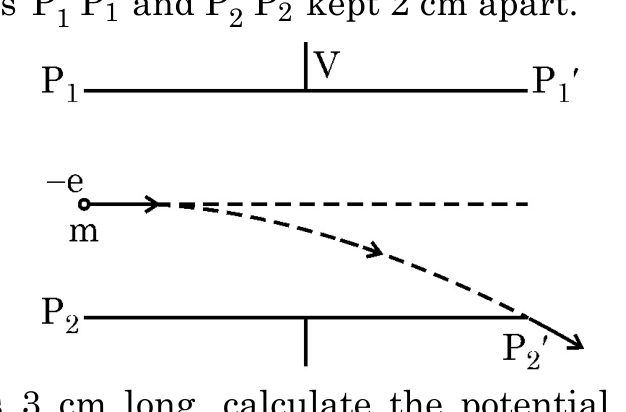 Figure shows a narrow beam of electrons entering with a velocity of $3 \times 10^7 \mathrm{~m} / \mathrm{s}$, symmetrically through the space between two parallel horizontal plates $P_1 P_1^{\prime}$ and $P_2 P_2^{\prime}$ kept $2 \mathrm{~cm}$ apart.
If each plate is $3 \mathrm{~cm}$ long, calculate the potential difference $V$ applied between the plates so that the beam just strikes the end $P_2^{\prime}$.CBSE 12th Physics 2026 Set 55/1/13 marks · Notebook›16A $12.0 \mu \mathrm{F}$ capacitor is charged to a potential difference of $150 \mathrm{~V}$. The terminals of the charged capacitor are then connected to those of an uncharged $6.0 \mu \mathrm{F}$ capacitor. Calculate final potential difference across and charge on, each capacitor.CBSE 12th Physics 2026 Set 55/1/23 marks · Notebook›17
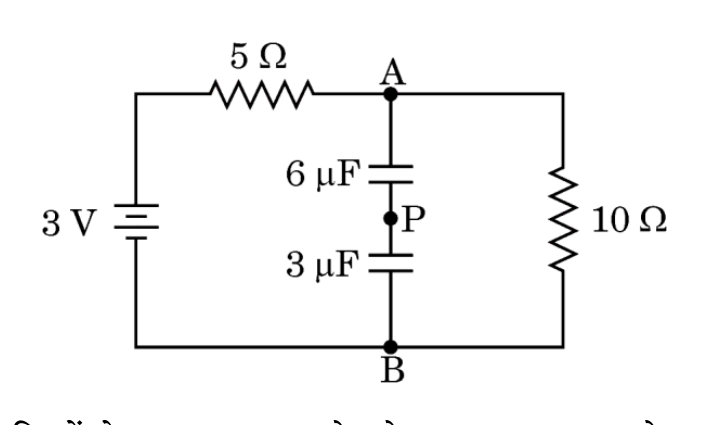 Capacitors are manufactured with certain standard capacitances and working voltages. However, these standard values may not be the ones that are actually needed in a particular application. Two or more capacitors can be grouped in series or in parallel to achieve desired capacitance and voltage. When connected in series, the total capacitance decreases while the voltage rating increases, whereas in parallel connections, the total capacitance increases and maintains the same voltage rating. A capacitor stores energy in the electric field between its plates and stored energy is proportional to the square of the voltage and capacitance $U=\frac{1}{2} C V^2$, where symbols have their usual meanings.
Two capacitors, one of $3 \mu \mathrm{F}$ and the other of $6 \mu \mathrm{F}$, are connected in series in the circuit as shown in the figure, for a long time.
(i) The total capacitance of the circuit is :
(A) $6 \mu \mathrm{F}$
(B) $3 \mu \mathrm{F}$
(C) $9 \mu \mathrm{F}$
(D) $2 \mu \mathrm{F}$
(ii) The current in the $10 \Omega$ resistor is :
(A) $0.3 \mathrm{~A}$
(B) $0.6 \mathrm{~A}$
(C) $0.2 \mathrm{~A}$
(D) 0
(iii) The potential difference between point A and B is :
(A) $2 \mathrm{~V}$
(B) $0.3 \mathrm{~V}$
(C) $0.2 \mathrm{~V}$
(D) $3 \mathrm{~V}$
(iv) (a) The value of charge on the plates of the $6 \mu \mathrm{F}$ capacitor is :
(A) $6 \mu \mathrm{C}$
(B) $4 \mu \mathrm{C}$
(C) $12 \mu \mathrm{C}$
(D) $8 \mu \mathrm{C}$
OR
(b) The wire between two capacitors is cut at point P. The current in the circuit will :
(A) increase
(B) decrease
(C) remain the same
(D) first increase then become stableCBSE 12th Physics 2026 Set 55/3/14 marks · Notebook›18(a) Derive an expression for the capacitance of a parallel plate capacitor of plate area $A$ and plate separation $d$ with air present between the plates.
(b) Two air-filled capacitors of capacitances $C_1$ and $C_2$ are connected in parallel with a dc battery. After the capacitors are fully charged, a slab of dielectric constant $K$ is inserted between the plates of each capacitor. How will the (i) charge on each capacitor and (ii) energy stored in the capacitor affected after the slab is introduced.
OR
(a) An electric field $\vec{E}$ is established across the ends of a cylindrical conductor of length $L$ and area of cross-section $A$. Discuss how electrons attain an average velocity, independent of time. Hence, obtain a relation between current in the conductor and this ‘average velocity’ of electrons.
(b) (i) This ‘average velocity’ is found be few $\mathrm{mm} / \mathrm{s}$ for currents in range of a few amperes. How then is current established almost the instant a circuit is closed ?
(ii) Two copper wires having their radii in the ratio of $3: 2$ are connected in series across a battery. Find the ratio of the drift velocities of the electrons in the wires.CBSE 12th Physics 2026 Set 55/2/15 marks · Notebook›19A parallel plate capacitor of capacitance $\mathrm{C}$ is charged to $\mathrm{V}$ volt by a battery. After sometime the battery is disconnected and the distance between the plates is doubled. A slab of dielectric constant $\mathrm{k}=1.8$ is then introduced to completely fill the space between the plates. How will the following be affected ?
(a) The capacitance of the capacitor.
(b) The electric field between the plates of the capacitor.
(c) The energy stored in the capacitor.
Justify your answer in each case.CBSE 12th Physics 2026 Set 55/1/33 marks · Notebook›20(a) Briefly explain the process of charging a parallel plate capacitor, when it is connected across a dc source.
(b) A capacitor, of capacitance $C$, plate area $A$ and plate separation $d$ is charged to $V$ volts by a battery. The energy stored in it is $U$. After some time, the battery is disconnected and a slab of dielectric constant $K$, is inserted to fill the space between the plates of the capacitor. Let $V^{\prime}$ and $U^{\prime}$ now be the potential difference across the plates of the capacitor and the energy stored in it respectively. Find $\left(\frac{V^{\prime}}{V}\right)$ and $\left(\frac{U^{\prime}}{U}\right)$.CBSE 12th Physics 2026 Compartment Set 55/7/13 marks · Notebook›21Two parallel plate capacitors X and Y are connected in series to a $6 \mathrm{~V}$ battery. They have the same plate area and same plate separation but capacitor X has air between its plates, whereas capacitor Y contains a material of dielectric constant 4.
(a) Calculate the capacitances of X and Y, if the equivalent capacitance of the combination of X and Y is $4 \mu \mathrm{F}$.
(b) Calculate the potential difference across the plates of X and Y.CBSE 12th Physics 2026 Set 55/5/13 marks · Notebook›22(a) Find the expression for the induced charge on a surface of a linear dielectric slab (dielectric constant $K$) inserted between the parallel plates of a charged capacitor fully occupying the intervening region.
(b) Four capacitors, each of capacitance $1 \mu \mathrm{F}$ are to be connected to obtain a net capacitance of $0.75 \mu \mathrm{F}$. Draw a diagram to show the required combination.CBSE 12th Physics 2026 Compartment Set 55/7/23 marks · Notebook›23A parallel plate capacitor of capacitance $C$ has a dielectric slab between its plates. It is charged to a potential difference $V$ by connecting it across a battery. The battery is then disconnected. If the dielectric slab is now withdrawn from the capacitor, how will the following be affected ?
(a) Capacitance of the capacitor,
(b) Energy stored in the capacitor, and
(c) The potential difference between the plates of the capacitor.
Justify your answer in each case.CBSE 12th Physics 2026 Set 55/1/13 marks · Notebook›
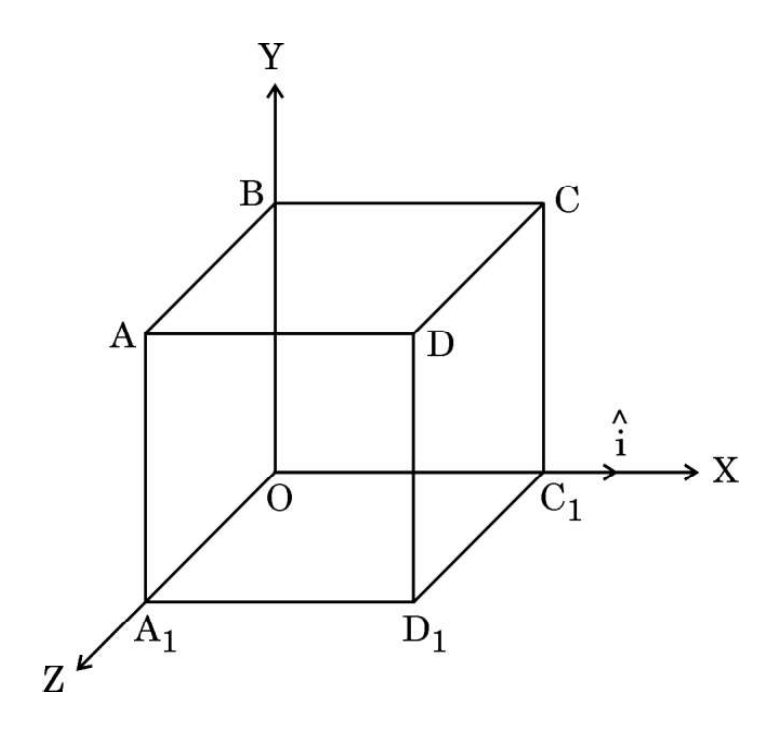 (a) (i) The electric field in a region is given by $\vec{E}=40 x \hat{i} \mathrm{~N} / \mathrm{C}$. Find the amount of work done in taking a unit positive charge from a point $(0,3 \mathrm{~m})$ to the point $(5 \mathrm{~m}, 0)$.
(ii) A charge $Q$ is distributed over two concentric hollow spheres of radii $r$ and $R(>r)$ such that their surface charge densities are equal. Find :
(I) the electric field, and
(II) the potential
at their common centre.
OR
(b) (i) Obtain an expression for the electric field $\vec{E}$ due to a dipole of dipole moment $\vec{p}$ at a point on its equatorial plane and specify its direction. Hence, find the value of electric field :
(I) at the centre of the dipole $(r=0)$, and
(II) at a point $r>>a$,
where $2 a$ is the length of the dipole.
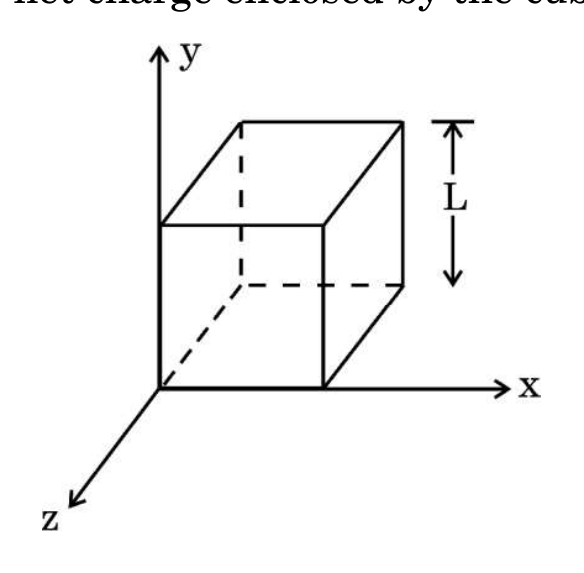
(ii) An electric field $\vec{E}=(10 x+5) \hat{i} \mathrm{~N} / \mathrm{C}$ exists in a region in which a cube of side $L$ is kept as shown in the figure. Here $x$ and $L$ are in metres. Calculate the net flux through the cube.CBSE 12th Physics 2025 Set 55/6/15 marks · Notebook›27The electric field at a point in a region is given by $\vec{E}=\alpha \frac{\vec{r}}{|\vec{r}|^3}$, where $\alpha$ is a constant and $r$ is the distance of the point from the origin. The magnitude of potential of the point is :CBSE 12th Physics 2025 Set 55/5/1MCQ›28(a) (i) Two point charges $+q$ and $-q$ are held at $(a, 0)$ and $(-a, 0)$ in x-y plane. Obtain an expression for the net electric field due to the charges at a point $(0, y)$. Hence, find electric field at a far off point $(y \gg a)$.
(ii) Three point charges of $-2 \mathrm{~nC},-1 \mathrm{~nC}$, and $+5 \mathrm{~nC}$ are kept at the vertices A, B and C of an equilateral triangle of side $0.2 \mathrm{~m}$. Find the total amount of work done in shifting the charges from A to $\mathrm{A}_1$, B to $\mathrm{B}_1$ and C to $\mathrm{C}_1$. Here $\mathrm{A}_1, \mathrm{~B}_1$ and $\mathrm{C}_1$ are the midpoints of sides AB, BC and CA, respectively.
OR
(b) (i) Show that Gauss’s theorem is consistent with Coulomb’s law. Using it, derive an expression for the electric field due to a uniformly charged thin spherical shell of radius $r$ at a point at a distance $y$ from the centre of the shell such that (I) $y>r$, and (II) $y < r$.
(ii) A point charge of $+2 \mathrm{~nC}$ is kept at the origin of a three-dimensional coordinate system. Find the type and magnitude of the charge which should be kept at $(0,0,-6 \mathrm{~m})$ so that the potential due to the system becomes zero at $(0,0,2 \mathrm{~m})$.CBSE 12th Physics 2025 Set 55/4/15 marks · Notebook›29In the figure curved lines represent equipotential surfaces. A charge $Q$ is moved along different paths A, B, C and D. The work done on the charge will be maximum along the pathCBSE 12th Physics 2025 Set 55/1/2MCQ›30(a) (i) A parallel plate capacitor A of capacitance $C$ is charged by a battery to a potential '$V$'. The battery is disconnected and an uncharged identical capacitor B is connected across it. Calculate for the capacitor A the new value of the :
(I) charge
(II) potential difference
(III) energy stored
Justify your answers.
(ii) Draw the pattern of electric field lines due to :
(I) positively charged conducting sphere, and
(II) an electric dipole.
OR
(b) (i) Write Coulomb's law of electrostatics in vector form. Apply it to determine the electric field at a point due to a system of point charges.
(ii) ABC is an equilateral triangle of side $l$. Two point charges $+2 \mu \mathrm{C}$ each, are located at points B and C. Find the sign and magnitude of the point charge $q$ to be kept at the midpoint M of the side BC, so that the net electric field at point A becomes zero.CBSE 12th Physics 2025 Compartment Set 55/S/15 marks · Notebook›31A point charge of $10 \mathrm{~nC}$ is fixed at the origin of x-y plane. A second point charge of $-20 \mathrm{~nC}$ is moved from point $(5 \mathrm{~cm}, 0)$ to point $(0,5 \mathrm{~cm})$. The change in the potential energy of the system of the two charges is :CBSE 12th Physics 2025 Compartment Set 55/S/2MCQ›32The electric field (E) and electric potential (V) at a point inside a charged hollow metallic sphere are respectively :CBSE 12th Physics 2025 Set 55/7/2MCQ›33Two point charges of $-5 \mu \mathrm{C}$ and $2 \mu \mathrm{C}$ are located in free space at $(-4 \mathrm{~cm}, 0)$ and $(6 \mathrm{~cm}, 0)$ respectively.
(a) Calculate the amount of work done to separate the two charges at infinite distance.
(b) If this system of charges was initially kept in an electric field $\mathrm{E}=\frac{\mathrm{A}}{\mathrm{r}^2}$, where $\mathrm{A}=8 \times 10^4 \mathrm{~N} \mathrm{C}^{-1} \mathrm{~m}^2$, calculate the electrostatic potential energy of the system.CBSE 12th Physics 2025 Set 55/7/23 marks · Notebook›34Two horizontal plates, separated by $1 \mathrm{~cm}$, are arranged one above the other. A particle of mass $5 \mathrm{~mg}$ and charge $2 \mathrm{~nC}$ is released in air between the plates. The potential difference that should be applied to the plates so that the particle remains suspended between them, is :CBSE 12th Physics 2025 Set 55/7/1MCQ›35A parallel plate capacitor has two parallel plates which are separated by an insulating medium like air, mica, etc. When the plates are connected to the terminals of a battery, they get equal and opposite charges and an electric field is set up in between them. This electric field between the two plates depends upon the potential difference applied, the separation of the plates and nature of the medium between the plates.
(i) The electric field between the plates of a parallel plate capacitor is $E$. Now the separation between the plates is doubled and simultaneously the applied potential difference between the plates is reduced to half of its initial value. The new value of the electric field between the plates will be :
(A) $E$
(B) $2 E$
(C) $\frac{E}{4}$
(D) $\frac{E}{2}$
(ii) A constant electric field is to be maintained between the two plates of a capacitor whose separation $d$ changes with time. Which of the graphs correctly depict the potential difference $(V)$ to be applied between the plates as a function of separation between the plates $(d)$ to maintain the constant electric field ?
(A)
(B)
(C)
(D)
(iii)
In the above figure P, Q are the two parallel plates of a capacitor. Plate Q is at positive potential with respect to plate P. MN is an imaginary line drawn perpendicular to the plates. Which of the graphs shows correctly the variations of the magnitude of electric field strength E along the line MN ?
(A)
(B)
(C)
(D)
(iv) Three parallel plates are placed above each other with equal displacement $\vec{d}$ between neighbouring plates. The electric field between the first pair of the plates is $\vec{E}_1$ and the electric field between the second pair of the plates is $\vec{E}_2$. The potential difference between the third and the first plate is –
(A) $\left(\vec{E}_1+\vec{E}_2\right) \cdot \vec{d}$
(B) $\left(\vec{E}_1-\vec{E}_2\right) \cdot \vec{d}$
(C) $\left(\vec{E}_2-\vec{E}_1\right) \cdot \vec{d}$
(D) $\frac{d\left(E_1+E_2\right)}{2}$
OR
(iv) A material of dielectric constant $K$ is filled in a parallel plate capacitor of capacitance $C$. The new value of its capacitance becomes
(A) $C$
(B) $\frac{C}{K}$
(C) $C K$
(D) $C\left(1+\frac{1}{K}\right)$CBSE 12th Physics Outside Delhi Set 1 - 20254 marks · Notebook›36(a) A parallel plate capacitor is charged by an ac source. Show that the sum of conduction current $\left(I_c\right)$ and the displacement current $\left(I_d\right)$ has the same value at all points of the circuit.
(b) In case (a) above, is Kirchhoff's first rule (junction rule) valid at each plate of the capacitor? Explain.CBSE 12th Physics Delhi Set 1 - 20253 marks · Notebook›37A circuit consisting of a capacitor $C$, a resistor of resistance $R$ and an ideal battery of emf $V$, as shown in figure is known as $R C$ series circuit.
As soon as the circuit is completed by closing key $S_1$ (keeping $S_2$ open) charges begin to flow between the
capacitor plates and the battery terminals. The charge on the capacitor increases and consequently the potential difference $V_c(=q / C)$ across the capacitor also increases with time. When this potential difference equals the potential difference across the battery, the capacitor is fully charged $(Q=V C)$. During this process of charging, the charge $q$ on the capacitor changes with time $t$ as $q=Q \left[1-e^{-t / R C}\right]$
The charging current can be obtained by differentiating it and using $\frac{d}{d x}\left(e^{m x}\right)=m e^{m x}$
Consider the case when $R=20 \mathrm{k} \Omega, C=500 \mu \mathrm{~F}$ and $V=10$ V.
(i) The final charge on the capacitor, when key $S_1$ is closed and $S_2$ is open, is
(A) $5 \mu \mathrm{C}$
(B) 5 mC
(C) 25 mC
(D) 0.1 C
(ii) For sufficient time the key $S_1$ is closed and $S_2$ is open. Now key $S_2$ is closed and $S_1$ is open. What is the final charge on the capacitor?
(A) Zero
(B) 5 mC
(C) 2.5 mC
(D) $5 \mu \mathrm{C}$
(iii) The dimensional formula for $R C$ is
(A) $\left[M L^2 T^{-3} A^{-2}\right]$
(B) $\left[M^0 L^0 T^{-1} A^0\right]$
(C) $\left[M^{-1} L^{-2} T^4 A^2\right]$
(D) $\left[M^0 L^0 T A^0\right]$
(iv) The key $S_1$ is closed and $S_2$ is open. The value of current in the resistor after 5 seconds, is
(A) $\frac{1}{2 \sqrt{e}} \mathrm{~mA}$
(B) $\sqrt{e} \mathrm{~mA}$
(C) $\frac{1}{\sqrt{e}} \mathrm{~mA}$
(D) $\frac{1}{2 e} \mathrm{~mA}$CBSE 12th Physics Delhi Set 1 - 20254 marks · Notebook›38A capacitor is a system of two conductors separated by an insulator. In practice, the two conductors have charges $Q$ and $-Q$ with potential difference $V=V_1-V_2$ between them. The ratio $\frac{Q}{V}$ is a constant, denoted by $C$ and is called the capacitance of the capacitor. It is independent of $Q$ or $V$. It depends only on the geometrical configuration (shape, size, separation) of the two conductors and the medium separating the conductors. When a parallel plate capacitor is charged, the electric field $E_0$ is localised between the plates and is uniform throughout. When a slab of a dielectric is inserted between the charged plates (charge density $\sigma$), the dielectric is polarised by the field. Consequently opposite charges appear on the faces of the slab, near the plates, with surface charge density of magnitude $\sigma_p$. For a linear dielectric $\sigma_p$ is proportional to $E_0$. Introduction of a dielectric changes the electric field, and hence, the capacitance of a capacitor, and hence, the energy stored in the capacitor.
Like resistors, capacitors can also be arranged in series or in parallel or in a combination of series and parallel.
(i) Consider a capacitor of capacitance $C$, with plate area $A$ and plate separation $d$, filled with air [Fig. (a)]. The distance between the plates is increased to $2 d$ and one of the plates is shifted as shown in Fig. (b). The capacitance of the new system now is :
(A) $\frac{C}{4}$
(B) $\frac{C}{2}$
(C) $2 C$
(D) $4 C$
(ii) A slab (area $A$ and thickness $d_1$) of a linear dielectric of dielectric constant $K$ is inserted between charged plates (charge density $\sigma$) of a parallel plate capacitor [plate area $A$ and plate separation $d\left(>d_1\right)$] and opposite charges with charge density of magnitude $\sigma_p$ appear on the faces of the slab. The dielectric constant $K$ is given by :
(A) $\frac{\sigma+\sigma_p}{\sigma}$
(B) $\frac{\sigma}{\sigma-\sigma_p}$
(C) $\frac{\sigma+\sigma_p}{\sigma_p}$
(D) $\frac{\sigma}{\sigma_p}$
(iii) An electric field $E$ is established between the plates of an air filled parallel plate capacitor, with charges $Q$ and $-Q$. $V$ is the volume of the space enclosed between the plates. The energy stored in the capacitor is :
(A) $\frac{1}{2} \varepsilon_0 E^2$
(B) $\varepsilon_0 Q^2 E$
(C) $\frac{1}{2} \varepsilon_0 E^2 V$
(D) $\varepsilon_0 E Q V$
(iv) (a) Three capacitors A, B and M, each of capacitance $C$ are connected to a capacitor N of capacitance $2 C$ and a battery as shown in the figure. If the charges on A and N are $Q$ and $Q'$ respectively, then $\frac{Q'}{Q}$ is :
(A) $\frac{1}{6}$
(B) $\frac{1}{3}$
(C) $3$
(D) $6$
OR
(b) A slab (area $A$ and thickness $\frac{d}{2}$) of dielectric constant $K$ is inserted in a parallel plate capacitor of plate area $A$ and plate separation $d$. If $C$ and $C_0$ are the capacitances of the capacitors with and without the dielectric, then $\frac{C}{C_0}$ is :
(A) $\frac{K+1}{2 K}$
(B) $\frac{2 K}{K+1}$
(C) $\frac{K}{K-1}$
(D) $\frac{K-1}{K}$CBSE 12th Physics 2025 Set 55/6/14 marks · Notebook›39(a) “There is a limit to the amount of charge that can be stored on a given capacitor.” Explain.
(b) A capacitor is charged by a battery to a potential difference $V$. It is disconnected from the battery and connected across another identical uncharged capacitor. Calculate the ratio of total energy stored in the combination to the initial energy stored in the capacitor.CBSE 12th Physics 2025 Set 55/5/33 marks · Notebook›40A metal sheet is inserted between the plates of a parallel plate capacitor of capacitance $C$. If the sheet partly occupies the space between the plates, the capacitance :CBSE 12th Physics 2025 Set 55/5/1MCQ›41
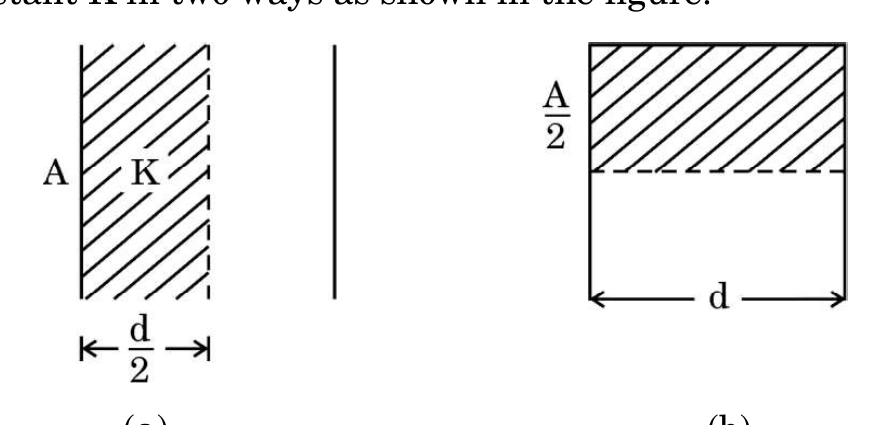 A parallel plate capacitor has plate area $A$ and plate separation $d$. Half of the space between the plates is filled with a material of dielectric constant $K$ in two ways as shown in the figure.
Find the values of the capacitance of the capacitors in the two cases.CBSE 12th Physics 2025 Set 55/5/13 marks · Notebook›42
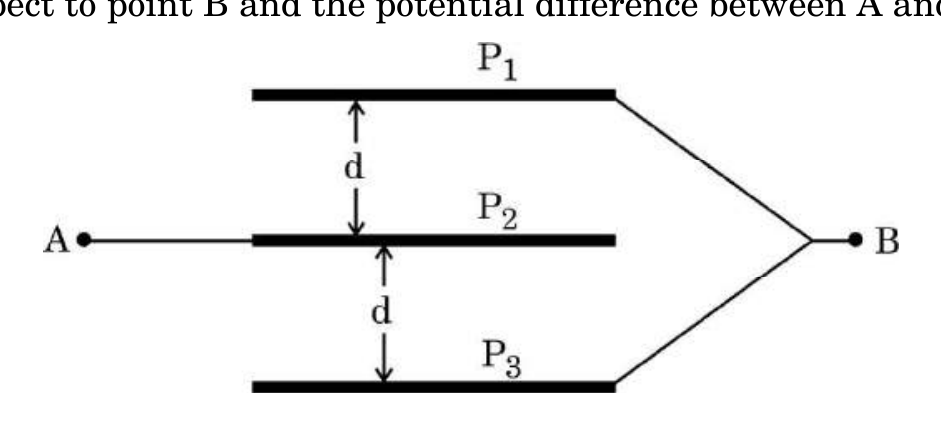 A parallel plate capacitor consists of two conducting plates kept generally parallel to each other at a distance. When the capacitor is charged, the charge resides on the inner surfaces of the plates and an electric field is set up between them. Thus, electrostatic energy is stored in the capacitor. The figure shows three large square metallic plates, each of side ‘$L$’ held parallel and equidistant from each other. The space between $P_1$ and $P_2$ and $P_2$ and $P_3$ is completely filled with mica sheets of dielectric constant ‘$K$’. The plate $P_2$ is connected to point A and other plates $P_1$ and $P_3$ are connected to point B. Point A is maintained at a positive potential with respect to point B and the potential difference between A and B is $V$.
(i) The capacitance of the system between A and B will be :
(A) $\frac{\varepsilon_0 K L^2}{d}$
(B) $\frac{\varepsilon_0 K L^2}{2 d}$
(C) $\frac{2 \varepsilon_0 K L^2}{d}$
(D) $\frac{2 \varepsilon_0 K d}{L^2}$
(ii) The charge on plate $P_1$ is :
(A) $\frac{\varepsilon_0 V K L^2}{2 d}$
(B) $\frac{\varepsilon_0 V K L^2}{d}$
(C) $\frac{2 \varepsilon_0 V K L^2}{d}$
(D) $\frac{\varepsilon_0 V K L^2}{4 d}$
(iii) The electric field in the region between $P_1$ and $P_2$ is :
(A) $\frac{V}{d}$
(B) $\frac{2 V}{d}$
(C) $\frac{V}{2 d}$
(D) $\frac{d}{V}$
(iv) (a) The separation between the plates of same area $\left(L^2\right)$ of a parallel plate air capacitor having capacitance equal to that of this system, will be :
(A) $\frac{d}{K}$
(B) $\frac{2 d}{K}$
(C) $\frac{d}{2 K}$
(D) $\frac{d}{4 K}$
OR
(b) If the source of potential difference applied between A and B is removed, and then A and B are connected by a conducting wire, the net charge on the system will be :
(A) $\frac{\varepsilon_0 V K L^2}{4 d}$
(B) $\frac{\varepsilon_0 V K L^2}{2 d}$
(C) $\frac{\varepsilon_0 V K L^2}{d}$
(D) ZeroCBSE 12th Physics 2025 Set 55/4/14 marks · Notebook›43
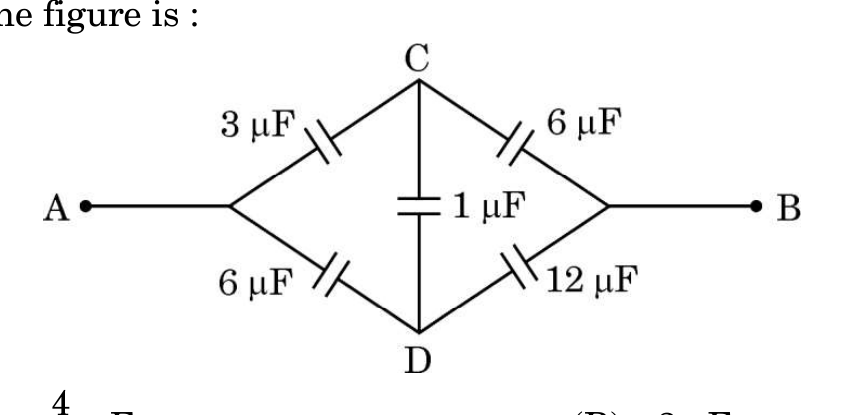 The effective capacitance of the network between points A and B shown in the figure is :CBSE 12th Physics 2025 Set 55/5/2MCQ›44A capacitor of plate area $A$ and plate separation $d$ is charged by a battery to voltage $V$. The battery is disconnected and plates are slowly pulled apart till the separation becomes $2 d$. Find the value of :
(a) potential difference between the plates,
(b) electric field between the plates,
(c) work done in pulling the plates apart.CBSE 12th Physics 2025 Set 55/5/23 marks · Notebook›45
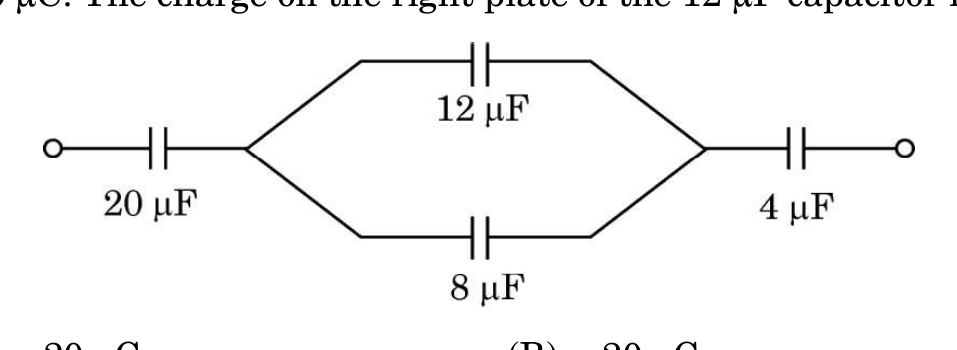 In the circuit shown, the charge on the left plate of $20 \mu \mathrm{F}$ capacitor is $-50 \mu \mathrm{C}$. The charge on the right plate of the $12 \mu \mathrm{F}$ capacitor is :CBSE 12th Physics 2025 Set 55/7/3MCQ›46(a) (i) A parallel plate capacitor with plate area $A$ and plate separation $d$ has a capacitance $C_0$. A slab of dielectric constant $K$ having area $A$ and thickness $\left(\frac{d}{4}\right)$ is inserted in the capacitor, parallel to the plates. Find the new value of its capacitance.
(ii) You are provided with a large number of $1 \mu \mathrm{F}$ identical capacitors and a power supply of $1200 \mathrm{~V}$. The dielectric medium used in each capacitor can withstand up to $200 \mathrm{~V}$ only. Find the minimum number of capacitors and their arrangement, required to build a capacitor system of equivalent capacitance of $2 \mu \mathrm{F}$ for use with this supply.
OR
(b) (i) An electric dipole of dipole moment $p$ consists of point charges $q$ and $-q$, separated by $2 a$. Derive an expression for electric potential in terms of its dipole moment at a point at a distance $x(\gg a)$ from its centre and lying (I) along its axis, and (II) along its bisector line.
(ii) An electric dipole of dipole moment $\vec{p}=(0.8 \hat{i}+0.6 \hat{j}) 10^{-29} \mathrm{~C} \mathrm{~m}$ is placed in an electric field $\vec{E}=1.0 \times 10^7 \hat{k} \frac{\mathrm{V}}{\mathrm{m}}$. Calculate the magnitude of the torque acting on it and the angle it makes with the x-axis, at this instant.CBSE 12th Physics 2025 Set 55/7/15 marks · Notebook›
 (a) (i) Draw equipotential surfaces for an electric dipole.
(ii) Two point charges $q_1$ and $q_2$ are located at $\overrightarrow{r_1}$ and $\vec{r}_2$ respectively in an external electric field $\vec{E}$. Obtain an expression for the potential energy of the system.
(iii) The dipole moment of a molecule is $10^{-30} \mathrm{Cm}$. It is placed in an electric field $\vec{E}$ of $10^5 \mathrm{~V} / \mathrm{m}$ such that its axis is along the electric field. The direction of $\vec{E}$ is suddenly changed by $60^{\circ}$ at an instant. Find the change in the potential energy of the dipole, at that instant.
OR
(b) (i) A thin spherical shell of radius R has a uniform surface charge density $\sigma$. Using Gauss' law, deduce an expression for electric field (i) outside and (ii) inside the shell.
(ii) Two long straight thin wires AB and CD have linear charge densities $10 \mu \mathrm{C} / \mathrm{m}$ and $-20 \mu \mathrm{C} / \mathrm{m}$, respectively. They are kept parallel to each other at a distance 1 m . Find magnitude and direction of the net electric field at a point midway between them.CBSE 12th Physics Delhi Set 1 - 20245 marks · Notebook›49Three point charges, each of charge $q$ are placed on vertices of a triangle $\mathrm{ABC}$, with $\mathrm{AB}=\mathrm{AC}=5 \mathrm{~L}$, $\mathrm{BC}=6 \mathrm{~L}$. The electrostatic potential at midpoint of side $\mathrm{BC}$ will beCBSE 12th Physics 2024 Set 55/4/2MCQ›50A thin spherical conducting shell of radius $R$ has a charge $q$. A point charge $Q$ is placed at the centre of the shell. Find (i) The charge density on the outer surface of the shell and (ii) the potential at a distance of $(R / 2)$ from the centre of the shell.CBSE 12th Physics 2024 Set 55/4/23 marks · Notebook›51Two charges $+q$ each are kept ‘$2 a$’ distance apart. A third charge $-2 q$ is placed midway between them. The potential energy of the system is –CBSE 12th Physics 2024 Set 55/4/1MCQ›52
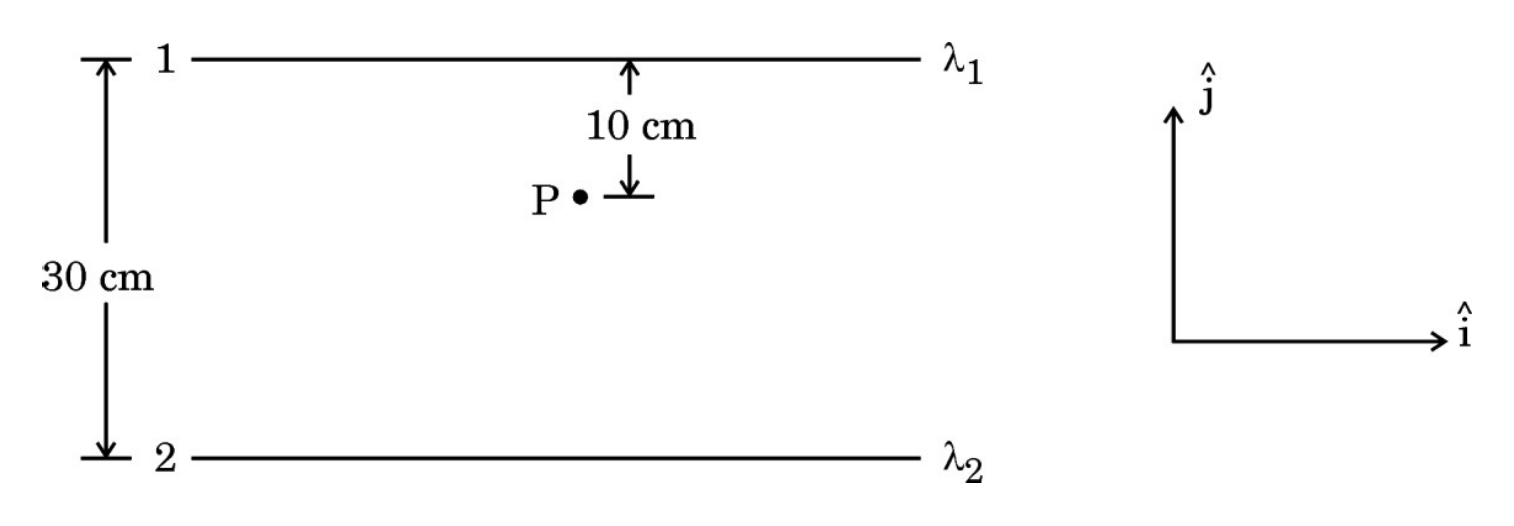 (a) (i) Obtain an expression for the electric potential due to a small dipole of dipole moment $\vec{p}$, at a point $\vec{r}$ from its centre, for much larger distances compared to the size of the dipole.
(ii) Three point charges $q$, $2 q$ and $n q$ are placed at the vertices of an equilateral triangle. If the potential energy of the system is zero, find the value of $n$.
OR
(b) (i) State Gauss’s Law in electrostatics. Apply this to obtain the electric field $\vec{E}$ at a point near a uniformly charged infinite plane sheet.
(ii) Two long straight wires 1 and 2 are kept as shown in the figure. The linear charge density of the two wires are $\lambda_1=10 \mu \mathrm{C} / \mathrm{m}$ and $\lambda_2=-20 \mu \mathrm{C} / \mathrm{m}$. Find the net force $\vec{F}$ experienced by an electron held at point P.CBSE 12th Physics 2024 Set 55/2/15 marks · Notebook›53Three point charges $Q_1, Q_2$ and $Q_3$ are located in $x-y$ plane at points $(-d, 0),(0,0)$ and $(d, 0)$ respectively. $Q_1$ and $Q_3$ are identical and $Q_2$ is positive. What will be the nature and value of $Q_1$ so that the potential energy of the system is zero ?CBSE 12th Physics 2024 Set 55/1/23 marks · Notebook›54(a) (i) Derive an expression for potential energy of an electric dipole $\vec{p}$ in an external uniform electric field $\vec{E}$. When is the potential energy of the dipole (1) maximum, and (2) minimum ?
(ii) An electric dipole consists of point charges $-1.0 \mathrm{~pC}$ and $+1.0 \mathrm{~pC}$ located at $(0,0)$ and $(3 \mathrm{~mm}, 4 \mathrm{~mm})$ respectively in $x-y$ plane. An electric field $\vec{E}=\left(\frac{1000 \mathrm{~V}}{\mathrm{~m}}\right) \hat{i}$ is switched on in the region. Find the torque $\vec{\tau}$ acting on the dipole.
OR
(b) (i) An electric dipole (dipole moment $\vec{p}=p \hat{i}$), consisting of charges $-q$ and $q$, separated by distance $2 a$, is placed along the x-axis, with its centre at the origin. Show that the potential $V$, due to this dipole, at a point $x$, $(x \gg a)$ is equal to $\frac{1}{4 \pi \varepsilon_0} \cdot \frac{\vec{p} \cdot \hat{i}}{x^2}$.
(ii) Two isolated metallic spheres $S_1$ and $S_2$ of radii $1 \mathrm{~cm}$ and $3 \mathrm{~cm}$ respectively are charged such that both have the same charge density $\left(\frac{2}{\pi} \times 10^{-9}\right) \mathrm{C} / \mathrm{m}^2$. They are placed far away from each other and connected by a thin wire. Calculate the new charge on sphere $S_1$.CBSE 12th Physics 2024 Set 55/1/15 marks · Notebook›55Consider a group of charges $q_1, q_2, q_3 \ldots$ such that $\Sigma q \neq 0$. Then equipotentials at a large distance, due to this group are approximately :CBSE 12th Physics 2024 Set 55/3/1MCQ›56A proton is taken from point $\mathrm{P}_1$ to point $\mathrm{P}_2$, both located in an electric field. The potentials at points $\mathrm{P}_1$ and $\mathrm{P}_2$ are $-5 \mathrm{~V}$ and $+5 \mathrm{~V}$ respectively. Assuming that kinetic energies of the proton at points $\mathrm{P}_1$ and $\mathrm{P}_2$ are zero, the work done on the proton is :CBSE 12th Physics 2024 Set 55/3/1MCQ›57
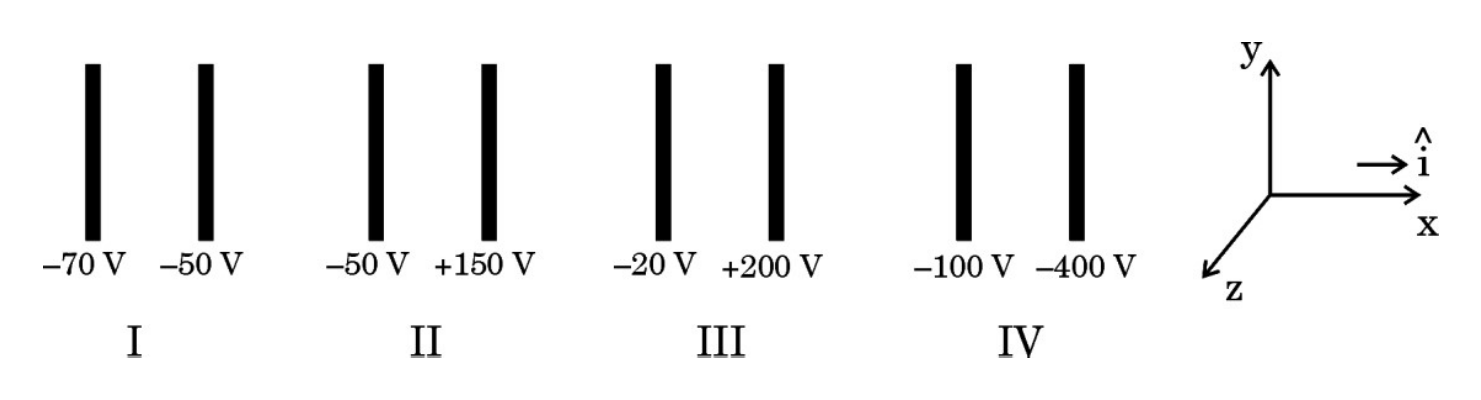 The figure shows four pairs of parallel identical conducting plates, separated by the same distance $2.0 \mathrm{~cm}$ and arranged perpendicular to x-axis. The electric potential of each plate is mentioned. The electric field between a pair of plates is uniform and normal to the plates.
(i) For which pair of the plates is the electric field $\vec{E}$ along $\hat{i}$ ?
(A) I
(B) II
(C) III
(D) IV
(ii) An electron is released midway between the plates of pair IV. It will :
(A) move along $\hat{i}$ at constant speed
(B) move along $-\hat{i}$ at constant speed
(C) accelerate along $\hat{i}$
(D) accelerate along $-\hat{i}$
(iii) Let $V_0$ be the potential at the left plate of any set, taken to be at $x=0 \mathrm{~m}$. Then potential $V$ at any point $(0 \leq x \leq 2 \mathrm{~cm})$ between the plates of that set can be expressed as :
(A) $V=V_0+\alpha x$
(B) $V=V_0+\alpha x^2$
(C) $V=V_0+\alpha x^{1 / 2}$
(D) $V=V_0+\alpha x^{3 / 2}$
where $\alpha$ is a constant, positive or negative.
(iv) (a) Let $E_1, E_2, E_3$ and $E_4$ be the magnitudes of the electric field between the pairs of plates, I, II, III and IV respectively. Then :
(A) $E_1>E_2>E_3>E_4$
(B) $E_3>E_4>E_1>E_2$
(C) $E_4>E_3>E_2>E_1$
(D) $E_2>E_3>E_4>E_1$
OR
(b) An electron is projected from the right plate of set I directly towards its left plate. It just comes to rest at the plate. The speed with which it was projected is about :
(Take $(e / m)=1.76 \times 10^{11} \mathrm{~C} / \mathrm{kg}$)
(A) $1.3 \times 10^5 \mathrm{~m} / \mathrm{s}$
(B) $2.6 \times 10^6 \mathrm{~m} / \mathrm{s}$
(C) $6.5 \times 10^5 \mathrm{~m} / \mathrm{s}$
(D) $5.2 \times 10^7 \mathrm{~m} / \mathrm{s}$CBSE 12th Physics 2024 Set 55/3/14 marks · Notebook›58(a) (i) Obtain the expression for the capacitance of a parallel plate capacitor with a dielectric medium between its plates.
(ii) A charge of $6 \mu \mathrm{C}$ is given to a hollow metallic sphere of radius $0.2 \mathrm{~m}$. Find the potential at (i) the surface and (ii) the centre of the sphere.
OR
(b) (i) A charge $+Q$ is placed on a thin conducting spherical shell of radius $R$. Use Gauss’s theorem to derive an expression for the electric field at a point lying (i) inside and (ii) outside the shell.
(ii) Show that the electric field for same charge density $(\sigma)$ is twice in case of a conducting plate or surface than in a nonconducting sheet.CBSE 12th Physics 2024 Set 55/3/15 marks · Notebook›59A conducting sphere of radius R is given a charge Q. Consider three points A, B and C — A at the centre, B at a distance $R/2$ from the centre and C on the surface of the sphere. The electric potentials at these points are such that :CBSE 12th Physics 2024 Compartment Set 55/S/2MCQ›60Two conducting spherical shells A and B of radii $R$ and $2 R$ are kept far apart and charged to the same charge density $\sigma$. They are connected by a wire. Obtain an expression for final potential of shell A.CBSE 12th Physics 2024 Set 55/4/33 marks · Notebook›61Two particles A and B of the same mass but having charges $q$ and $4 q$ respectively, are accelerated from rest through different potential differences $V_A$ and $V_B$ such that they attain same kinetic energies. The value of $\left(\frac{V_A}{V_B}\right)$ is :CBSE 12th Physics 2024 Compartment Set 55/S/1MCQ›62Two point charges of $10 \mu \mathrm{C}$ and $20 \mu \mathrm{C}$ are located at points $(-4 \mathrm{~cm}, 0,0)$ and $(5 \mathrm{~cm}, 0,0)$ respectively, in a region with electric field $E=\frac{A}{r^2}$, where $A=2 \times 10^6 \mathrm{~NC}^{-1} \mathrm{~m}^2$ and $\vec{r}$ is the position vector of the point under consideration. Calculate the electrostatic potential energy of the system.CBSE 12th Physics 2024 Compartment Set 55/S/13 marks · Notebook›63Dielectrics play an important role in design of capacitors. The molecules of a dielectric may be polar or non-polar. When a dielectric slab is placed in an external electric field, opposite charges appear on the two surfaces of the slab perpendicular to electric field. Due to this an electric field is established inside the dielectric.
The capacitance of a capacitor is determined by the dielectric constant of the material that fills the space between the plates. Consequently, the energy storage capacity of a capacitor is also affected. Like resistors, capacitors can also be arranged in series and/or parallel.
(i) Which of the following is a polar molecule?
(A) $\mathrm{O}_2$
(B) $\mathrm{H}_2$
(C) $\mathrm{N}_2$
(D) HCl
(ii) Which of the following statements about dielectrics is correct?
(A) A polar dielectric has a net dipole moment in absence of an external electric field which gets modified due to the induced dipoles.
(B) The net dipole moments of induced dipoles is along the direction of the applied electric field.
(C) Dielectrics contain free charges.
(D) The electric field produced due to induced surface charges inside a dielectric is along the external electric field.
(iii) When a dielectric slab is inserted between the plates of an isolated charged capacitor, the energy stored in it
(A) increases and the electric field inside it also increases.
(B) decreases and the electric field also decreases.
(C) decreases and the electric field increases.
(D) increases and the electric field decreases.
(iv) (a) An air-filled capacitor with plate area A and plate separation $d$ has capacitance $\mathrm{C}_0$. A slab of dielectric constant K, area A and thickness $\left(\frac{d}{5}\right)$ is inserted between the plates. The capacitance of the capacitor will become
(A) $\left[\frac{4 \mathrm{~K}}{5 \mathrm{~K}+1}\right] \mathrm{C}_0$
(B) $\left[\frac{K+5}{4}\right] C_0$
(C) $\left[\frac{5 \mathrm{~K}}{4 \mathrm{~K}+1}\right] \mathrm{C}_0$
(D) $\left[\frac{K+4}{5 K}\right] C_0$
OR
(b) Two capacitors of capacitances $2 \mathrm{C}_0$ and $6 \mathrm{C}_0$ are first connected in series and then in parallel across the same battery. The ratio of energies stored in series combination to that in parallel is
(A) $\frac{1}{4}$
(B) $\frac{1}{6}$
(C) $\frac{2}{15}$
(D) $\frac{3}{16}$CBSE 12th Physics Delhi Set 1 - 20244 marks · Notebook›64(a) (i) A dielectric slab of dielectric constant ‘$K$’ and thickness ‘$t$’ is inserted between plates of a parallel plate capacitor of plate separation $d$ and plate area $A$. Obtain an expression for its capacitance.
(ii) Two capacitors of different capacitances are connected first (1) in series and then (2) in parallel across a dc source of $100 \mathrm{~V}$. If the total energy stored in the combination in the two cases are $40 \mathrm{~mJ}$ and $250 \mathrm{~mJ}$ respectively, find the capacitance of the capacitors.
OR
(b) (i) Using Gauss’s law, show that the electric field $\vec{E}$ at a point due to a uniformly charged infinite plane sheet is given by $\vec{E}=\frac{\sigma}{2 \varepsilon_0} \hat{n}$ where symbols have their usual meanings.
(ii) Electric field $\vec{E}$ in a region is given by
$\vec{E}=\left(5 x^2+2\right) \hat{i}$
where $E$ is in $\mathrm{N} / \mathrm{C}$ and $x$ is in meters.
A cube of side $10 \mathrm{~cm}$ is placed in the region as shown in figure.
Calculate (1) the electric flux through the cube, and (2) the net charge enclosed by the cube.CBSE 12th Physics 2024 Set 55/4/15 marks · Notebook›65The capacitance of a parallel plate capacitor having a medium of dielectric constant $K=4$ in between the plates is $C$. If this medium is removed, then the capacitance of the capacitor becomes :CBSE 12th Physics 2024 Set 55/2/2MCQ›66An air-filled parallel plate capacitor with plate separation $1 \mathrm{~mm}$ has a capacitance of $20 \mathrm{pF}$. It is charged to $4.0 \mu \mathrm{C}$. Calculate the amount of work done to pull its plates to a separation of $5 \mathrm{~mm}$. Assume the charge on the plates remains the same.CBSE 12th Physics 2024 Set 55/1/33 marks · Notebook›67Ten capacitors, each of capacitance $1 \mu \mathrm{F}$, are connected in parallel to a source of $100 \mathrm{~V}$. The total energy stored in the system is equal to :CBSE 12th Physics 2024 Set 55/1/1MCQ›68The plates $\mathrm{P}_1$ and $\mathrm{P}_2$ of a $2 \mu \mathrm{F}$ capacitor are at potentials $25 \mathrm{~V}$ and $-25 \mathrm{~V}$ respectively. The charge on plate $\mathrm{P}_1$ will be :CBSE 12th Physics 2024 Set 55/3/3MCQ›69The capacitance of a parallel plate capacitor is $10 \mu \mathrm{F}$ when the distance between its plates is $8 \mathrm{~cm}$. If the distance between the plates is halved, the capacitance will become :CBSE 12th Physics 2024 Compartment Set 55/S/2MCQ›70A parallel plate capacitor is charged by a battery. The battery is then disconnected and the plates of the charged capacitor are then moved farther apart. In the process :CBSE 12th Physics 2024 Compartment Set 55/S/1MCQ›
 Depict the orientation of an electric dipole in (a) stable and (b) unstable equilibrium in an external uniform electric field. Write the potential energy of the dipole in each case.CBSE 12th Physics Delhi Set 1 - 20232 marks · Notebook›72A point $$P$$ lies at a distance $$x$$ from the mid point of an electric dipole on its axis. The electric potential at point $$\mathrm{P}$$ is proportional toCBSE 12th Physics Outside Delhi Set 1 - 2023MCQ›73(a) (i) Use Gauss' law to obtain an expression for the electric field due to an infinitely long thin straight wire with uniform linear charge density $$\lambda$$.
(ii) An infinitely long positively charged straight wire has a linear charge density $$\lambda$$. An electron is revolving in a circle with a constant speed $$v$$ such that the wire passes through the centre, and is perpendicular to the plane, of the circle. Find the kinetic energy of the electron in terms of magnitudes of its charge and linear charge density $$\lambda$$ on the wire.
(iii) Draw a graph of kinetic energy as a function of linear charge density $$\lambda$$.
OR
(b) (i) Consider two identical point charges located at points $$(0,0)$$ and $$(a, 0)$$.
(1) Is there a point on the line joining them at which the electric field is zero?
(2) Is there a point on the line joining them at which the electric potential is zero?
Justify your answers for each case.
(ii) State the significance of negative value of electrostatic potential energy of a system of charges.
Three charges are placed at the corners of an equilateral triangle $$A B C$$ of side $$2.0 \mathrm{~m}$$ as shown in figure. Calculate the electric potential energy of the system of three charges.CBSE 12th Physics Outside Delhi Set 1 - 20235 marks · Notebook›74Three point charges $Q_1(-15 \mu \mathrm{C}), Q_2(10 \mu \mathrm{C})$ and $Q_3(16 \mu \mathrm{C})$ are located at $(0 \mathrm{~cm}, 0 \mathrm{~cm}),(0 \mathrm{~cm}, 3 \mathrm{~cm})$ and $(4 \mathrm{~cm}, 3 \mathrm{~cm})$ respectively. Calculate the electrostatic potential energy of this system of charges.CBSE 12th Physics 2023 Set 55/1/33 marks · Notebook›75(a) A uniform electric field E of $500 \mathrm{~N} / \mathrm{C}$ is directed along +x axis. O, B and A are three points in the field having x and y coordinates (in cm ) $(0,0),(4,0)$ and $(0,3)$ respectively. Calculate the potential difference between the points (i) O and A, and (ii) O and B.
OR
(b) Three point charges $1 \mu \mathrm{C},-1 \mu \mathrm{C}$ and $2 \mu \mathrm{C}$ are kept at the vertices A, B and C respectively of an equilateral triangle of side $1 \mathrm{~m}$. $A_1, B_1$ and $C_1$ are the midpoints of the sides AB, BC and CA respectively. Calculate the net amount of work done in displacing the charge from A to $A_1$, from B to $B_1$ and from C to $C_1$.CBSE 12th Physics 2023 Compartment Set 55/C/12 marks · Notebook›76(a) Twelve negative charges of same magnitude are equally spaced and fixed on the circumference of a circle of radius $R$ as shown in Fig. (i). Relative to potential being zero at infinity, find the electric potential and electric field at the centre C of the circle.
(b) If the charges are unequally spaced and fixed on an arc of $120^{\circ}$ of radius $R$ as shown in Fig. (ii), find electric potential at the centre C.CBSE 12th Physics 2023 Set 55/1/13 marks · Notebook›77Three point charges $Q, q$ and $-q$ are kept at the vertices of an equilateral triangle of side $L$ as shown in figure. What is
(i) the electrostatic potential energy of the arrangement ? and
(ii) the potential at point D ?CBSE 12th Physics 2023 Set 55/5/32 marks · Notebook›78
 (a) (i) Define electric flux and write its SI unit.
(ii) Use Gauss’ law to obtain the expression for the electric field due to a uniformly charged infinite plane sheet.
(iii) A cube of side $L$ is kept in space, as shown in the figure. An electric field $\vec{E}=(A x+B) \hat{i} \frac{\mathrm{N}}{\mathrm{C}}$ exists in the region. Find the net charge enclosed by the cube.
OR
(b) (i) Define electric potential at a point and write its SI unit.
(ii) Two capacitors are connected in series. Derive an expression of the equivalent capacitance of the combination.
(iii) Two point charges $+q$ and $-q$ are located at points $(3 a, 0)$ and $(0,4 a)$ respectively in x-y plane. A third charge $Q$ is kept at the origin. Find the value of $Q$, in terms of $q$ and $a$, so that the electrostatic potential energy of the system is zero.CBSE 12th Physics 2023 Set 55/3/15 marks · Notebook›79
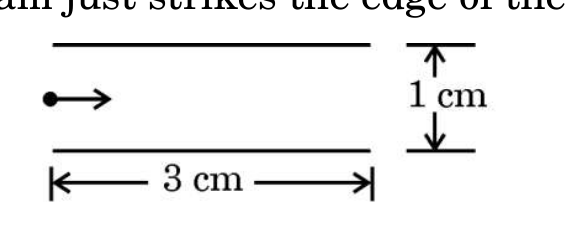 A beam of electrons moving horizontally with a velocity of $3 \times 10^7 \mathrm{~m} / \mathrm{s}$ enters a region between two plates as shown in the figure. A suitable potential difference is applied across the plates such that the electron beam just strikes the edge of the lower plate.
Answer the following questions based on the above :
(a) How long does an electron take to strike the edge ?
(b) What is the shape of the path followed by the electron and why ?
(c) Find the potential difference applied.
OR
(c) Find the magnitude and direction of the magnetic field which should be created in the space between the plates so that the electron beam goes straight undeviated.CBSE 12th Physics 2023 Set 55/3/14 marks · Notebook›80(a) Obtain an expression for electrostatic potential energy of a system of three charges $q, 2 q$ and $-3 q$ placed at the vertices of an equilateral triangle of side $a$.
OR
(b) Two small conducting balls A and B of radius $r_1$ and $r_2$ have charges $q_1$ and $q_2$ respectively. They are connected by a wire. Obtain the expression for charges on A and B, in equilibrium.CBSE 12th Physics 2023 Set 55/4/12 marks · Notebook›81
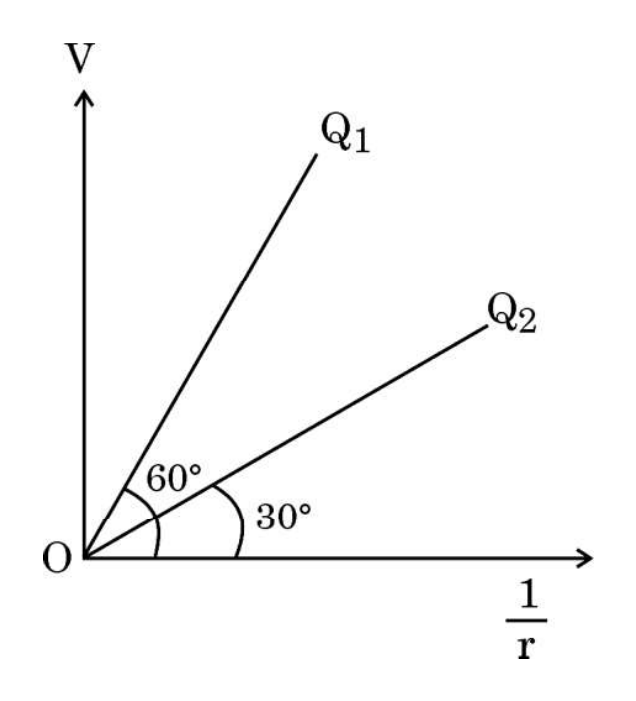 Electrostatics deals with the study of forces, fields and potentials arising from static charges. Force and electric field, due to a point charge is basically determined by Coulomb’s law. For symmetric charge configurations, Gauss’s law, which is also based on Coulomb’s law, helps us to find the electric field. A charge/a system of charges like a dipole experience a force/torque in an electric field. Work is required to be done to provide a specific orientation to a dipole with respect to an electric field.
Answer the following questions based on the above :
(a) Consider a uniformly charged thin conducting shell of radius $R$. Plot a graph showing the variation of $|\vec{E}|$ with distance $r$ from the centre, for points $0 \leq r \leq 3 R$.
(b) The figure shows the variation of potential $V$ with $\frac{1}{r}$ for two point charges $Q_1$ and $Q_2$, where $V$ is the potential at a distance $r$ due to a point charge. Find $\frac{Q_1}{Q_2}$.
(c) An electric dipole of dipole moment of $6 \times 10^{-7} \mathrm{C}-\mathrm{m}$ is kept in a uniform electric field of $10^4 \mathrm{~N} / \mathrm{C}$ such that the dipole moment and the electric field are parallel. Calculate the potential energy of the dipole.
OR
(c) An electric dipole of dipole moment $\vec{p}$ is initially kept in a uniform electric field $\vec{E}$ such that $\vec{p}$ is perpendicular to $\vec{E}$. Find the amount of work done in rotating the dipole to a position at which $\vec{p}$ becomes antiparallel to $\vec{E}$.CBSE 12th Physics 2023 Set 55/4/14 marks · Notebook›82Three capacitors, each of $$4 \mu \mathrm{F}$$ are to be connected in such a way that the effective capacitance of the combination is $$6 \mu \mathrm{F}$$. This can be achieved by connectingCBSE 12th Physics Delhi Set 1 - 2023MCQ›83A capacitor is a system of two conductors separated by an insulator. The two conductors have equal and opposite charges with a potential difference between them. The capacitance of a capacitor depends on the geometrical configuration (shape, size and separation) of the system and also on the nature of the insulator separating the two conductors. They are used to store charges. Like resistors, capacitors can be arranged in series or parallel or a combination of both to obtain desired value of capacitance.
(i) Find the equivalent capacitance between points A and B in the given diagram.
(ii) A dielectric slab is inserted between the plates of a parallel plate capacitor. The electric field between the plates decreases. Explain.
(iii) A capacitor A of capacitance C, having charge Q is connected across another uncharged capacitor B of capacitance $$2 C$$. Find an expression for (a) the potential difference across the combination and (b) the charge lost by capacitor A.
OR
(iii) Two slabs of dielectric constants $$2 \mathrm{~K}$$ and $$\mathrm{K}$$ fill the space between the plates of a parallel plate capacitor of plate area A and plate separation $$d$$ as shown in figure. Find an expression for capacitance of the system.CBSE 12th Physics Delhi Set 1 - 20234 marks · Notebook›84(a) Two charged conducting spheres of radii $$a$$ and $$b$$ are connected to each other by a wire. Find the ratio of the electric fields at their surfaces.
OR
(b) A parallel plate capacitor (A) of capacitance C is charged by a battery to voltage $$V$$. The battery is disconnected and an uncharged capacitor (B) of capacitance $$2 \mathrm{C}$$ is connected across $$\mathrm{A}$$. Find the ratio of
(i) final charges on A and B.
(ii) total electrostatic energy stored in A and B finally and that stored in A initially.CBSE 12th Physics Outside Delhi Set 1 - 20233 marks · Notebook›85A $100 \mu \mathrm{F}$ capacitor is charged by a $12 \mathrm{~V}$ battery.
(a) How much electrostatic energy is stored by the capacitor ?
(b) The capacitor is disconnected from the battery and connected in parallel to another uncharged $100 \mu \mathrm{F}$ capacitor. What is the electrostatic energy stored by the system ?CBSE 12th Physics 2023 Set 55/1/23 marks · Notebook›86A parallel plate capacitor is an arrangement of two identical metal plates kept parallel, a small distance apart. The capacitance of a capacitor depends on the size and separation of the two plates and also on the dielectric constant of the medium between the plates. Like resistors, capacitors can also be arranged in series or parallel or a combination of both. By virtue of electric field between the plates, charged capacitors store energy.
(a) The capacitance of a parallel plate capacitor increases from $10 \mu \mathrm{F}$ to $80 \mu \mathrm{F}$ on introducing a dielectric medium between the plates. Find the dielectric constant of the medium.
(b) n capacitors, each of capacitance C, are connected in series. Find the equivalent capacitance of the combination.
(c) A capacitor is charged to a potential (V) by connecting it to a battery. After some time, the battery is disconnected and a dielectric is introduced between the plates. How will the potential difference between the plates, and the energy stored in it be affected ? Justify your answer.
OR
(c) Find the equivalent capacitance between points A and B, if capacitance of each capacitor is C.CBSE 12th Physics 2023 Compartment Set 55/C/14 marks · Notebook›