
ExamQuark
Getting things ready
Your next step is almost ready.
Your progress
0
Correct
0
Wrong
0%
Accuracy
0 s
Time spent
—
Percentile
Questions by year
 Derive an expression for the magnetic field $\vec{B}$, due to a circular coil of $N$ turns, each of radius $r$ carrying current $I$, at a distance ‘$x$’ from the centre along its axis.CBSE 12th Physics 2026 Set 55/2/13 marks · Notebook›11
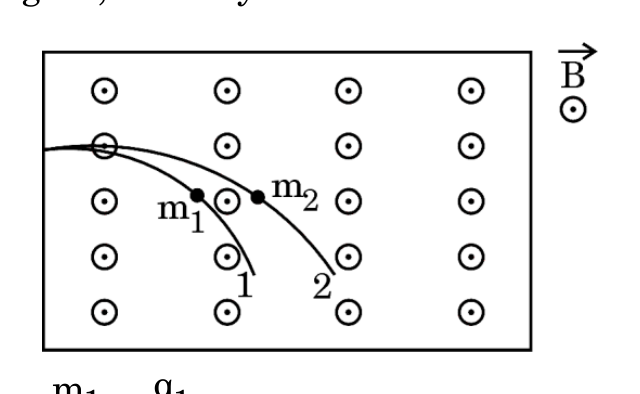 Two particles of masses $m_1$ and $m_2$ having charges $q_1$ and $q_2$ respectively are projected with the same velocity in a region of uniform magnetic field $\vec{B}$ pointing vertically upward. If they describe circular paths as shown in the figure, one may conclude that :CBSE 12th Physics 2026 Set 55/4/1MCQ›12
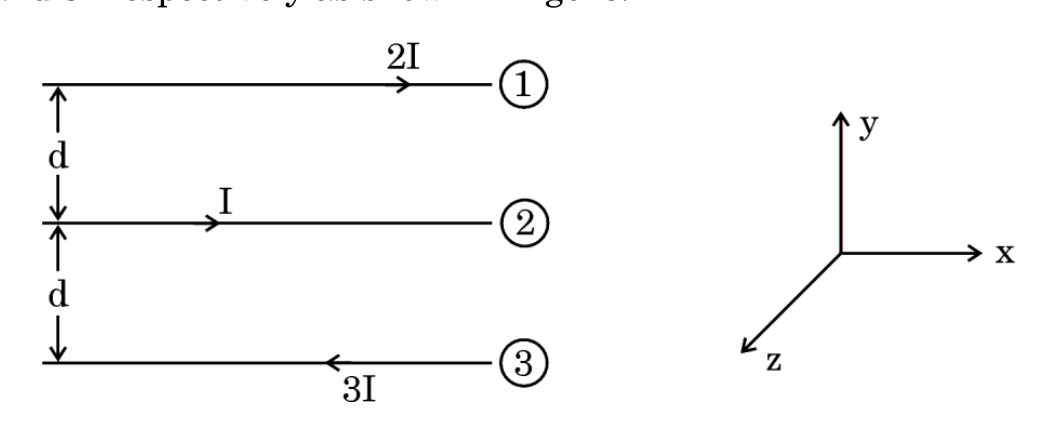 (a) The figure given below shows three straight long parallel conductors ①, ② and ③ kept in x-y plane, carrying currents $2 I$, $I$ and $3 I$ respectively as shown in figure.
Find the magnitude and direction of :
(i) net magnetic field at a point on conductor ① and
(ii) net magnetic force acting on unit length of conductor ①, due to conductors ② and ③.
OR
(b) A rectangular loop of sides $l$ and $b$ and resistance ‘$R$’ is kept in a region in which the magnetic field varies as $B=B_0 \sin \omega t$.
(i) Derive expression for the emf induced in the loop.
(ii) Find the effective value of current that flows in the loop.CBSE 12th Physics 2026 Set 55/4/13 marks · Notebook›13
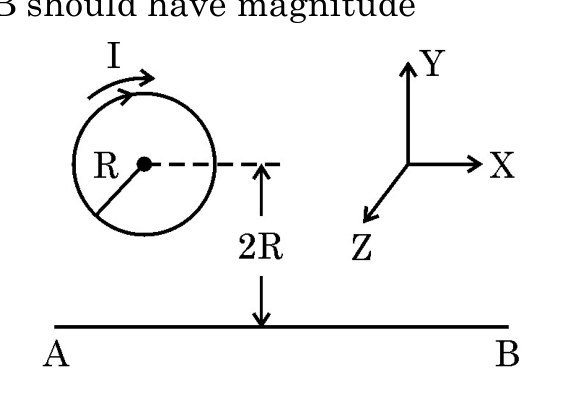 A circular loop has radius $\mathrm{R}$ and carries current $\mathrm{I}$ as shown in figure. In order that the net magnetic field at the centre of the loop is zero, the current in wire $\mathrm{AB}$ should have magnitudeCBSE 12th Physics 2026 Set 55/1/3MCQ›14Two infinitely long straight conductors lie along x-axis and y-axis in the plane of the page. If they carry current $I$ each along +x-axis and +y-axis respectively, the net magnetic field at a point with position vector $\vec{r}=(3 \hat{i}+4 \hat{j}) \mathrm{~m}$ will be :CBSE 12th Physics 2026 Compartment Set 55/7/1MCQ›15Assertion (A) : If $\vec{B}$ be the magnetic field at a small patch of vector area $\overrightarrow{d S}$, then the magnetic flux through the patch will be $\vec{B} \cdot \overrightarrow{d S}$.
Reason (R) : The magnetic flux is a scalar quantity.CBSE 12th Physics 2026 Compartment Set 55/7/1MCQ›16Two identical circular coils A and B of radius $10 \mathrm{~cm}$ each are placed concentrically and mutually perpendicular in XY and YZ planes respectively. Currents of $1 \mathrm{~A}$ and $\sqrt{3} \mathrm{~A}$ flow anticlockwise in the coils as seen from YZ plane. Find the magnitude of the net magnetic field at the common centre of the coils.CBSE 12th Physics 2026 Compartment Set 55/7/12 marks · Notebook›17(a) Derive the expression for the magnetic field (near its centre) due to an air-filled long solenoid carrying a current $I$ and having $n$ number of turns per unit length.
(b) A charged particle moving with velocity $\vec{v}$ enters a region of uniform magnetic field $\vec{B}$. The force acting on it is non-zero. Would the particle gain any energy ? Explain.CBSE 12th Physics 2026 Compartment Set 55/7/13 marks · Notebook›18A particle of mass $m$ and charge $q$ experiences a force $\overrightarrow{F_e}$ in an electric field $\vec{E}$ and it is directed along the field. When the particle is moving with velocity $\vec{v}$ in a magnetic field $\vec{B}$, it experiences a force $\overrightarrow{F_B}$, that is perpendicular to both $\vec{v}$ and $\vec{B}$.
In presence of both fields, the force acting on the particle is the vector sum of that due to $\vec{E}$ and that due to $\vec{B}$.
A current-carrying conductor also experiences a force in presence of a magnetic field. The force $\overrightarrow{d F}$ acting on a current-element $I \overrightarrow{d l}$ is perpendicular to both the current element, and the magnetic field $\vec{B}$. The net force acting on a conductor of a given length is the vector sum of all $\overrightarrow{d F}$s.
(i) A negative ion enters a region of uniform magnetic field $\vec{B}$ as shown in the figure.
It will :
(A) go straight, undeviated
(B) describe a circular path
(C) describe a semicircular path
(D) describe a helical path
(ii) (a) An electron is moving in a circular path in a uniform magnetic field of $3.14 \times 10^{-4} \mathrm{~T}$. Its period of revolution will be approximately :
(A) $0.11 \mu \mathrm{s}$
(B) $0.28 \mu \mathrm{s}$
(C) $0.014 \mu \mathrm{s}$
(D) $0.024 \mu \mathrm{s}$
OR
(b) An alpha particle (mass $6.4 \times 10^{-27} \mathrm{~kg}$) moves in a circular path with a speed of $6.28 \times 10^5 \mathrm{~m} / \mathrm{s}$ in a uniform magnetic field of $3.14 \times 10^{-3} \mathrm{~T}$. The radius of the path is :
(A) $1.00 \mathrm{~m}$
(B) $2.00 \mathrm{~m}$
(C) $3.00 \mathrm{~m}$
(D) $4.00 \mathrm{~m}$
(iii) A charged particle enters with a velocity $v=\left(6 \times 10^6 \mathrm{~m} / \mathrm{s}\right) \hat{i}$ in a region of magnetic field $\vec{B}=(0.5 \mathrm{~G}) \hat{j}$ and an electric field $\vec{E}$. If the particle goes straight undeviated in the region, then $\vec{E}$ equals :
(A) $\left(120 \frac{\mathrm{N}}{\mathrm{C}}\right) \hat{k}$
(B) $-\left(300 \frac{\mathrm{N}}{\mathrm{C}}\right) \hat{k}$
(C) $\left(600 \frac{\mathrm{N}}{\mathrm{C}}\right) \hat{j}$
(D) $-\left(150 \frac{\mathrm{N}}{\mathrm{C}}\right) \hat{i}$
(iv) A current-element $(I \overrightarrow{d l})$ of mass per unit length $(m)$ is held in air as shown in the figure. After withdrawing the support, it will remain suspended in its position, when subjected to an external magnetic field $\vec{B}$ equal to :
(A) $\frac{m g d l}{I} \hat{k}$
(B) $\frac{m g}{I} \hat{j}$
(C) $-\frac{m g}{I d l} \hat{i}$
(D) $-\left(\frac{I d l}{m g}\right) \hat{k}$CBSE 12th Physics 2026 Compartment Set 55/7/14 marks · Notebook›19A coil having 100 closely wound turns and area of cross-section $300 \mathrm{~mm}^2$ carries a current of $5 \mathrm{~mA}$. The magnitude of the magnetic moment associated with the coil is :CBSE 12th Physics 2026 Set 55/4/2MCQ›20A galvanometer of resistance $G$ is converted into a voltmeter of range $(0-V)$ by connecting a resistor of $250 \Omega$ with it. If resistor of $250 \Omega$ is replaced by another resistor of $900 \Omega$, its range becomes $(0-3 \mathrm{~V})$. The resistance $G$ of the galvanometer is :CBSE 12th Physics 2026 Set 55/4/3MCQ›21
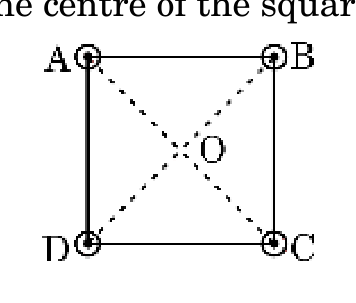 Four long straight thin wires are held vertically at the corners A, B, C and D of a square of side ‘a’, kept on a table and carry equal current ‘I’. The wire at A carries current in upward direction whereas the current in the remaining wires flows in downward direction. The net magnetic field at the centre of the square will have the magnitude :CBSE 12th Physics 2026 Set 55/5/1MCQ›22Write the expression for the magnetic field due to a current element in vector form. Consider a $1 \mathrm{~cm}$ segment of a wire, centered at the origin, carrying a current of $10 \mathrm{~A}$ in positive x-direction. Calculate the magnetic field $\vec{B}$ at a point $(1 \mathrm{~m}, 1 \mathrm{~m}, 0)$.CBSE 12th Physics 2026 Set 55/5/13 marks · Notebook›23
 (a) (i) A rectangular loop of sides a and b carrying current I is placed in a magnetic field $\vec{B}$ such that its area vector $\vec{A}$ makes an angle $\theta$ with $\vec{B}$. With the help of a suitable diagram, show that the torque $\vec{\tau}$ acting on the loop is given by $\vec{\tau}=\vec{m} \times \vec{B}$, where $\vec{m}(=I \vec{A})$ is the magnetic dipole moment of the loop.
(ii) A circular coil of 100 turns and radius $\left(\frac{10}{\sqrt{\pi}}\right) \mathrm{cm}$ carrying current of $5.0 \mathrm{~A}$ is suspended vertically in a uniform horizontal magnetic field of $2.0 \mathrm{~T}$. The field makes an angle $30^{\circ}$ with the normal to the coil. Calculate :
(I) the magnetic dipole moment of the coil, and
(II) the magnitude of the counter torque that must be applied to prevent the coil from turning.
OR
(b) (i) Derive an expression for the force $\vec{F}$ acting on a conductor of length L and area of cross-section A carrying current I and placed in a magnetic field $\vec{B}$.
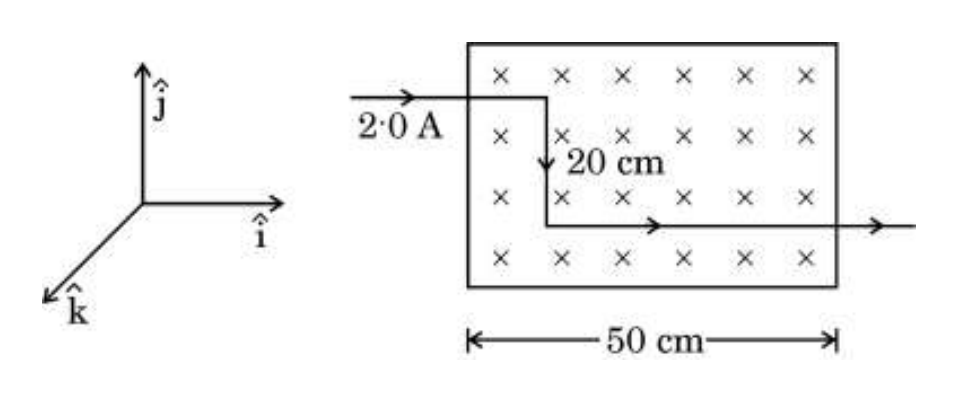
(ii) A part of a wire carrying $2.0 \mathrm{~A}$ current and bent at $90^{\circ}$ at two points is placed in a region of uniform magnetic field $\vec{B}=-(0.50 \mathrm{~T}) \hat{k}$, as shown in the figure. Calculate the magnitude of the net force acting on the wire.CBSE 12th Physics 2026 Set 55/5/15 marks · Notebook›24A charged particle of mass m having kinetic energy K passes undeflected through a region with electric field $\vec{E}$ and magnetic field $\vec{B}$ acting perpendicular to each other. The mass m of the particle will be :CBSE 12th Physics 2026 Set 55/5/2MCQ›25(a) A long straight wire carries a steady current $I$ along the positive y-axis in a three-dimensional coordinate system. A particle of charge $+Q$ is moving with a velocity $\vec{v}=v_0 \hat{i}$. Find the magnitude and direction of the magnetic force experienced by the particle at the instant it is at $(x, 0,0)$.
(b) A galvanometer of resistance $100 \Omega$ shows full scale deflection for a current of $5 \mathrm{~mA}$. Explain how you will convert it into a voltmeter of range $(0-1 \mathrm{~V})$. Obtain the value of the resistance required.CBSE 12th Physics 2026 Compartment Set 55/7/23 marks · Notebook›26A long straight wire of circular cross-section (radius $a$) carries a steady current $I$. The current is uniformly distributed across this cross-section. The magnitude of the magnetic field produced at a point at a distance $(a / 2)$ from the axis of the wire will beCBSE 12th Physics 2026 Set 55/1/1MCQ›27A wire of length $L$ is bent round into (i) a square coil having $N$ turns and (ii) a circular coil having $N$ turns. The coil in both cases is free to turn about a vertical axis coinciding with the plane of the coil, in a uniform, horizontal magnetic field and carry the same currents. Find the ratio of the maximum value of the torque acting on the square coil to that on the circular coil.CBSE 12th Physics 2026 Set 55/1/12 marks · Notebook›28A galvanometer is used to detect or/and measure small currents in an electrical circuit. It essentially works on the fact that a current-carrying coil experiences a deflecting torque when placed in a magnetic field. This deflection in the coil can be measured and it is related to the current flowing in the coil, the number of turns in the coil, area of the coil and the magnetic field. A hair spring attached to the coil provides a counter torque and helps in measuring the deflection. A galvanometer can be converted to an ammeter or a voltmeter of desired range by using suitable resistances.
(I) The torque on the coil remains constant irrespective of the coil’s orientation during rotation due to
(A) use of soft iron core which increases the magnetic field.
(B) radial magnetic field
(C) hair spring which provides the counter torque
(D) eddy current in the iron core which causes damping.
(II) The best way to increase current sensitivity of a galvanometer is by
(A) increasing number of turns of the coil
(B) increasing area of coil and magnitic field strength
(C) decreasing area of coil and magnetic field strength
(D) increasing torsional constant of the hair spring
(III) A moving coil galvanometer has a coil with area of cross-section $4.0 \times 10^{-3} \mathrm{~m}^2$ and number of turns 50. The coil is rotating in a magnetic field of $0.25 \mathrm{~T}$. The torque acting on the coil when a current of $5 \mathrm{~A}$ passes through it is
(A) $1.0 \mathrm{~N} \mathrm{~m}$
(B) $2.0 \mathrm{~N} \mathrm{~m}$
(C) $0.50 \mathrm{~N} \mathrm{~m}$
(D) $0.25 \mathrm{~N} \mathrm{~m}$
OR
A galvanometer coil has a resistance of $15 \Omega$ and the meter shows full scale deflection for a current of $3 \mathrm{~mA}$. The value of resistance required to convert it into a voltmeter of range $(0-12 \mathrm{~V})$ is
(A) $4015 \Omega$
(B) $3985 \Omega$
(C) $415 \Omega$
(D) $385 \Omega$
(IV) A galvanometer with coil of resistance $20 \Omega$ shows full scale deflection for a current of $5 \mathrm{~mA}$. To convert it into an ammeter of range $(0-10 \mathrm{~A})$, a resistance of
(A) $0.05 \Omega$ should be connected in series with it.
(B) $0.05 \Omega$ should be connected in parallel with it.
(C) $0.01 \Omega$ should be connected in parallel with it.
(D) $0.01 \Omega$ should be connected in series with it.CBSE 12th Physics 2026 Set 55/1/14 marks · Notebook›29
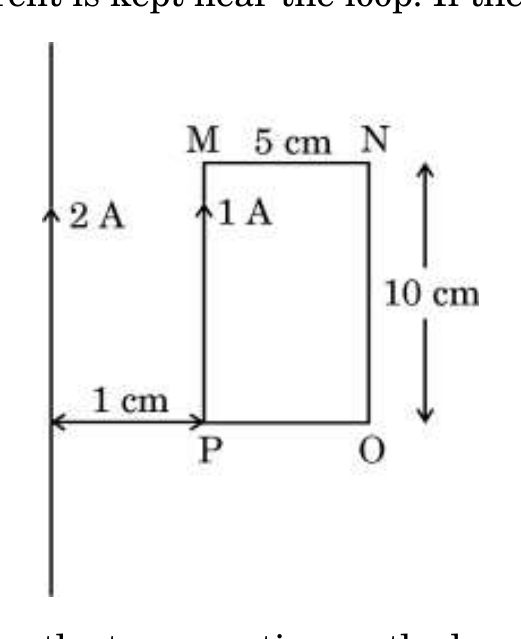 The figure shows rectangular loop MNOP of wire of size $5 \mathrm{~cm} \times 10 \mathrm{~cm}$ carrying a steady current of $1.0 \mathrm{~A}$. A straight long wire carrying $2.0 \mathrm{~A}$ current is kept near the loop. If the loop and the wire are coplanar, find :
(i) the torque acting on the loop, and
(ii) the magnitude and direction of the net force on the loop.CBSE 12th Physics 2026 Compartment Set 55/7/33 marks · Notebook›
 (a) In a region of a uniform electric field $\vec{E}$, a negatively charged particle is moving with a constant velocity $\vec{v}=-v_0 \hat{i}$ near a long straight conductor coinciding with $\mathrm{XX}^{\prime}$ axis and carrying current $I$ towards $-\mathrm{X}$ axis. The particle remains at a distance $d$ from the conductor.
(i) Draw diagram showing direction of electric and magnetic fields.
(ii) What are the various forces acting on the charged particle ?
(iii) Find the value of $v_0$ in terms of $E$, $d$ and $I$.
OR
(b) Two infinitely long conductors kept along $\mathrm{XX}^{\prime}$ and $\mathrm{YY}^{\prime}$ axes are carrying current $I_1$ and $I_2$ along $-\mathrm{X}$ axis and $-\mathrm{Y}$ axis respectively. Find the magnitude and direction of the net magnetic field produced at point $\mathrm{P}(\mathrm{X}, \mathrm{Y})$.CBSE 12th Physics Outside Delhi Set 1 - 20253 marks · Notebook›33A 1 cm segment of a wire lying along $x$-axis carries current of 0.5 A along $+x$ direction. A magnetic field $\vec{B}=(0.4 \mathrm{mT}) \hat{j}+(0.6 \mathrm{mT}) \hat{k}$ is switched on, in the region. The force acting on the segment isCBSE 12th Physics Delhi Set 1 - 2025MCQ›34You are required to design an air-filled solenoid of inductance 0.016 H having a length 0.81 m and radius 0.02 m . The number of turns in the solenoid should beCBSE 12th Physics Delhi Set 1 - 2025MCQ›35Assertion (A) : The deflection in a galvanometer is directly proportional to the current passing through it.
Reason (R) : The coil of a galvanometer is suspended in a uniform radial magnetic field.CBSE 12th Physics Delhi Set 1 - 2025MCQ›36(a) (i) A proton moving with velocity $\vec{V}$ in a non. uniform magnetic field traces a path as shown in the figure.
The path followed by the proton is always in the plane of the paper. What is the direction of the magnetic field in the region near points $P, Q$ and $R$ ? What can you say about relative magnitude of magnetic fields at these points?
(ii) A current carrying circular loop of area $A$ produces a magnetic field $B$ at its centre. Show that the magnetic moment of the loop is $\frac{2 B A}{\mu_0} \sqrt{\frac{A}{\pi}}$
OR
(b) (i) Derive an expression for the torque acting on a rectangular current loop suspended in a uniform magnetic field.
(ii) A charged particle is moving in a circular path with velocity $\vec{V}$ in a uniform magnetic field $\vec{B}$. It is made to pass through a sheet of lead and as a consequence, it looses one half of its kinetic energy without change in its direction. How will (1) the radius of its path (2) its time period of revolution change?CBSE 12th Physics Delhi Set 1 - 20255 marks · Notebook›37
 Using Biot-Savart law, derive expression for the magnetic field $(B)$ due to a circular current carrying loop at a point on its axis and hence at its centre.CBSE 12th Physics Delhi Set 1 - 20253 marks · Notebook›38
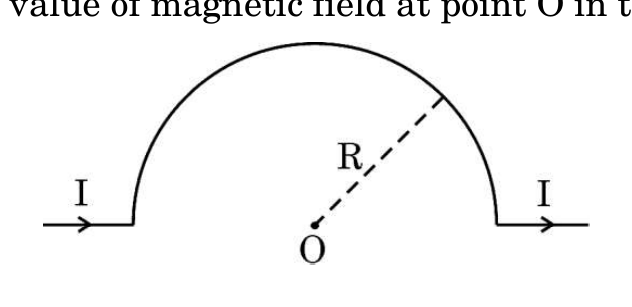 The value of magnetic field at point O in the given figure is :CBSE 12th Physics 2025 Set 55/6/1MCQ›39A galvanometer can be converted into an ammeter of desired range by connecting a :CBSE 12th Physics 2025 Set 55/6/1MCQ›40A proton and an $\alpha$-particle enter with the same velocity $\vec{v}$ in a uniform magnetic field $\vec{B}$ such that $\vec{v} \perp \vec{B}$. The ratio of the radii of their paths is :CBSE 12th Physics 2025 Set 55/6/1MCQ›41
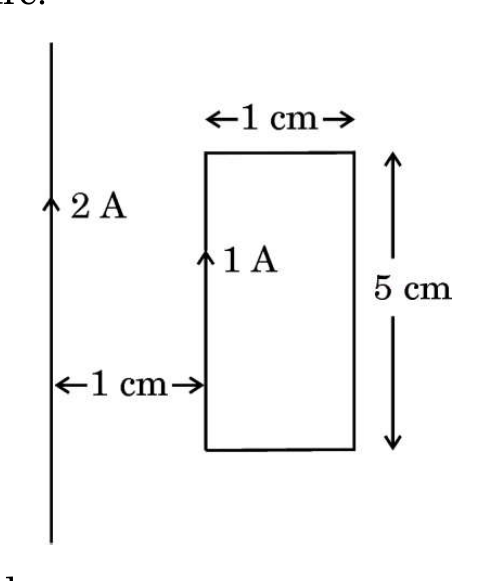 A rectangular loop carries a current of $1 \mathrm{~A}$. A straight long wire carrying $2 \mathrm{~A}$ current is kept near the loop in the same plane as shown in the figure.
Find :
(i) the torque acting on the loop, and
(ii) the magnitude and direction of the net force on the loop.CBSE 12th Physics 2025 Set 55/6/13 marks · Notebook›42A current of $5 \mathrm{~A}$ is passing along $+\mathrm{X}$ direction through a wire lying along X-axis. Find the magnetic field $\vec{B}$ at a point $\vec{r}=(3 \hat{i}+4 \hat{j}) \mathrm{m}$ due to $1 \mathrm{~cm}$ element of the wire, centered at origin.CBSE 12th Physics 2025 Set 55/5/32 marks · Notebook›43A charged particle gains a speed of $10^6 \mathrm{~ms}^{-1}$, when accelerated from rest through a potential difference $10 \mathrm{~kV}$. It enters a region of magnetic field of $0.4 \mathrm{~T}$ such that $\vec{v} \perp \vec{B}$. The radius of circular path described by it is :CBSE 12th Physics 2025 Set 55/5/1MCQ›44A current of $\left(\frac{10}{\pi}\right) \mathrm{A}$ is maintained in a circular loop of radius $14 \mathrm{~cm}$. The value of dipole moment associated with the loop is :CBSE 12th Physics 2025 Set 55/5/1MCQ›45A galvanometer is an instrument used to show the direction and strength of the current passing through it. In a galvanometer, a coil placed in a magnetic field experiences a torque and hence gets deflected when a current passes through it. The name is derived from the surname of Italian scientist L. Galvani, who in 1791 discovered that electric current makes a dead frog’s leg jerk. A spring attached with the coil provides a counter torque.
In equilibrium, the deflecting torque is balanced by the restoring torque of the spring and we have :
$N B A I=k \phi$
where $N$ is the total number of turns in the coil
$A$ is the area of cross-section of each turn
$B$ is the radial magnetic field
$k$ is the torsional constant of the spring
$\phi$ is the angular deflection of the coil
As the current $\left(I_g\right)$ which produces full scale deflection in the galvanometer is very small, the galvanometer cannot as such be used to measure current in electric circuits. A small resistance, called shunt, of a suitable value is connected with the galvanometer to convert it into an ammeter of desired range. By using a higher resistance, a galvanometer can also be converted into a voltmeter.
(i) The value of the current sensitivity of a galvanometer is given by :
(A) $\frac{k}{N B A}$
(B) $\frac{N B A}{k}$
(C) $\frac{k B A}{N}$
(D) $\frac{k N B}{A}$
(ii) A galvanometer of resistance $6 \Omega$ shows full scale deflection for a current of $0.2 \mathrm{~A}$. The value of shunt to be used with this galvanometer to convert it into an ammeter of range $(0-5 \mathrm{~A})$ is :
(A) $0.25 \Omega$
(B) $0.30 \Omega$
(C) $0.50 \Omega$
(D) $6.0 \Omega$
(iii) The value of resistance of the ammeter in case (ii) will be :
(A) $0.20 \Omega$
(B) $0.24 \Omega$
(C) $6.0 \Omega$
(D) $6.25 \Omega$
(iv) (a) A galvanometer is converted into a voltmeter of range $(0-V)$ by connecting with it, a resistance $R_1$. If $R_1$ is replaced by $R_2$, the range becomes $(0-2 V)$. The resistance of the galvanometer is :
(A) $\left(R_2-2 R_1\right)$
(B) $\left(R_2-R_1\right)$
(C) $\left(R_1+R_2\right)$
(D) $\left(R_1-2 R_2\right)$
OR
(b) A current of $5 \mathrm{~mA}$ flows through a galvanometer. Its coil has 100 turns, each of area of cross-section $18 \mathrm{~cm}^2$ and is suspended in a magnetic field $0.20 \mathrm{~T}$. The deflecting torque acting on the coil will be :
(A) $3.6 \times 10^{-3} \mathrm{~Nm}$
(B) $1.8 \times 10^{-4} \mathrm{~Nm}$
(C) $2.4 \times 10^{-3} \mathrm{~Nm}$
(D) $1.2 \times 10^{-4} \mathrm{~Nm}$CBSE 12th Physics 2025 Set 55/5/14 marks · Notebook›46A particle of mass $m$ and charge $q$ moves along y-axis in a region in which a uniform magnetic field $\vec{B}$ is pointing along x-axis. The Lorentz force acting on the charge will point along :CBSE 12th Physics 2025 Set 55/4/3MCQ›47
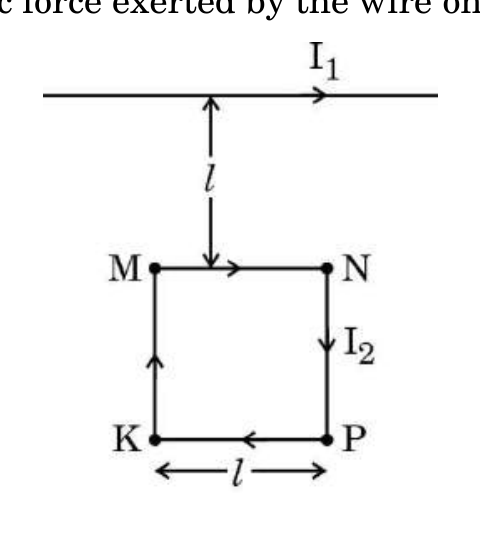 (a) In which cases does a charged particle not experience a force in a magnetic field ?
(b) A square loop MNPK of side ‘$l$’ carrying a current ‘$I_2$’ is kept close to a long straight wire in the same plane and the wire carries a steady current $I_1$ as shown in the figure. Obtain the magnitude of magnetic force exerted by the wire on the loop.CBSE 12th Physics 2025 Set 55/4/33 marks · Notebook›48A particle with charge $q$ moving with velocity $\vec{v}=v_0 \hat{i}$ enters a region with magnetic field $\vec{B}=B_1 \hat{j}+B_2 \hat{k}$. The magnitude of force experienced by the particle is :CBSE 12th Physics 2025 Set 55/4/2MCQ›49
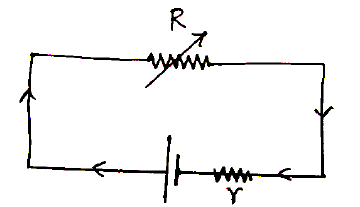 (a) A charged particle $q$ moving with a velocity $\vec{v}$ is subjected to a uniform magnetic field $\vec{B}$ acting perpendicular to $\vec{v}$. If a uniform electric field $\vec{E}$ is also set up in the region along the direction of $\vec{B}$, describe the path followed by the particle and draw its shape.
(b) How will the magnetic field inside a long solenoid be affected when :
(i) the radius of the turns of the solenoid is increased,
(ii) the length of solenoid as well as the total number of its turns are doubled ?CBSE 12th Physics 2025 Set 55/4/23 marks · Notebook›50
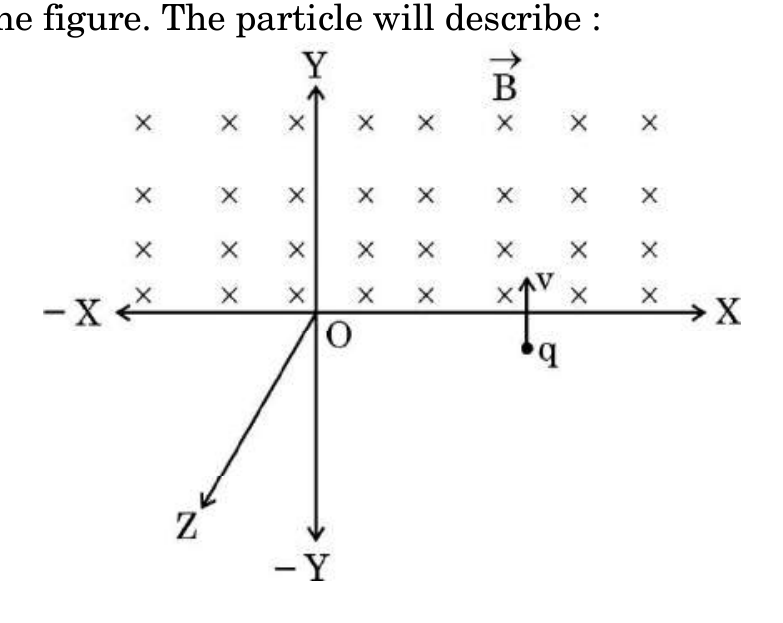 A particle having charge $+q$ enters a uniform magnetic field $\vec{B}$ as shown in the figure. The particle will describe :CBSE 12th Physics 2025 Set 55/4/1MCQ›51A long straight wire is held vertically and carries a steady current in upward direction. The shape of magnetic field lines produced by the current-carrying wire are :CBSE 12th Physics 2025 Set 55/4/1MCQ›52
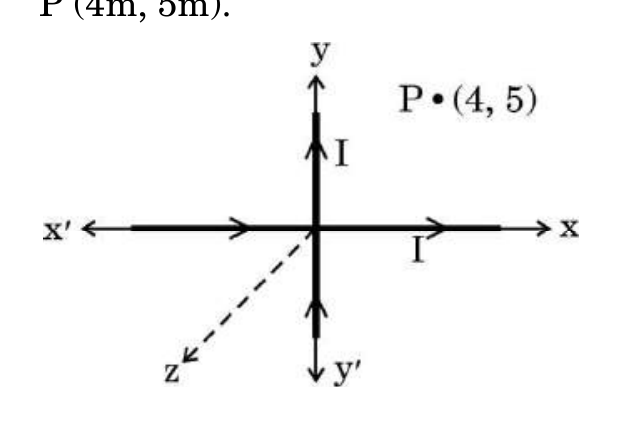 (a) Write vector form of Biot-Savart law.
(b) Two insulated long straight wires, each carrying $2.0 \mathrm{~A}$ current are kept along $x x^{\prime}$ and $y y^{\prime}$ axis as shown in the figure. Find the magnitude and direction of resultant magnetic field at point $\mathrm{P}(4 \mathrm{~m}, 5 \mathrm{~m})$.CBSE 12th Physics 2025 Set 55/4/13 marks · Notebook›53A circular coil of wire having 200 turns, each of radius $4.0 \mathrm{~cm}$ is placed in a horizontal plane. It carries a current of $0.40 \mathrm{~A}$ in clockwise direction. Find the magnitude and direction of the magnetic field at the centre of the coil.CBSE 12th Physics 2025 Set 55/5/22 marks · Notebook›54(a) Use Ampere’s law to derive the expression for the magnetic field due to a long straight current carrying wire of infinite length.
(b) Why is Ampere’s law used for the derivation in (a) above and not Biot-Savart’s law ? Explain.CBSE 12th Physics 2025 Set 55/5/23 marks · Notebook›55(a) Define magnetic moment of a current-carrying coil. Write its SI unit.
(b) A coil of 60 turns and area $1.5 \times 10^{-3} \mathrm{~m}^3$ carrying $2 \mathrm{~A}$ current lies in a vertical plane. It experiences a torque of $0.12 \mathrm{~Nm}$ when placed in a uniform horizontal magnetic field. The torque acting on the coil changes to $0.05 \mathrm{~Nm}$ after the coil is rotated about its diameter by $90^{\circ}$, in the magnetic field. Find the magnitude of the magnetic field.CBSE 12th Physics 2025 Set 55/1/23 marks · Notebook›56A galvanometer having a coil resistance of $48 \Omega$ shows full-scale deflection for a current of $2.0 \mathrm{~A}$. It can be converted into an ammeter of range $(0-10 \mathrm{~A})$ by connecting :CBSE 12th Physics 2025 Compartment Set 55/S/1MCQ›57Two parallel beams of protons moving in the same direction will :CBSE 12th Physics 2025 Compartment Set 55/S/1MCQ›58A rectangular loop $(4 \mathrm{~cm} \times 5 \mathrm{~cm})$ of wire carrying current of $0.25 \mathrm{~A}$ is placed in a magnetic field $\vec{B}=[(0.20 \mathrm{~T}) \hat{j}+(0.50 \mathrm{~T}) \hat{k}]$ such that outward unit vector normal to the plane of the loop is $(0.80 \hat{i}-0.60 \hat{j})$.
Calculate :
(a) the magnetic moment $\vec{m}$ of the loop, and
(b) the torque $\vec{\tau}$ acting on the loop.CBSE 12th Physics 2025 Compartment Set 55/S/13 marks · Notebook›59Consider two long, straight, parallel conductors A and B separated by a distance $d$. They carry steady current $I$ in the same direction. The force acting on unit length of conductor B due to conductor A is :CBSE 12th Physics 2025 Compartment Set 55/S/2MCQ›60A circular loop of wire of radius $7.0 \mathrm{~cm}$ carrying a current of $1.0 \mathrm{~A}$ is placed in a magnetic field $\vec{B}=(0.5 \hat{i}+0.4 \hat{k}) \mathrm{T}$ such that the outward unit vector normal to the plane of the loop is $[0.60 \hat{i}+0.80 \hat{j}]$. Calculate :
(a) the magnetic moment $\vec{m}$ of the loop, and
(b) the torque $\vec{\tau}$ acting on the loop. (Take $\pi=\frac{22}{7}$)CBSE 12th Physics 2025 Compartment Set 55/S/23 marks · Notebook›61Two long, straight, parallel conductors carry the same current and attract each other with a force $F$ per unit length. If the current is doubled in each conductor and their separation is made half, the force per unit length becomes :CBSE 12th Physics 2025 Compartment Set 55/S/3MCQ›62A rectangular loop $(1 \mathrm{~cm} \times 5 \mathrm{~cm})$ of wire carrying current of $0.4 \mathrm{~A}$ is placed in a magnetic field $\vec{B}=\left(0.03 \hat{i}+0.04 \hat{k}\right) \mathrm{T}$ such that the outward unit vector normal to the plane of the loop is $(0.60 \hat{i}-0.80 \hat{j})$. Calculate :
(a) the magnetic moment $\vec{m}$ of the loop, and
(b) the torque $\vec{\tau}$ acting on the loop.CBSE 12th Physics 2025 Compartment Set 55/S/33 marks · Notebook›63A straight conductor is carrying a current of $2 \mathrm{~A}$ in $+x$ direction along it. A uniform magnetic field $\vec{B}=(0.6 \hat{j}+0.8 \hat{k}) \mathrm{T}$ is switched on, in the region. The force acting on $10 \mathrm{~cm}$ length of the conductor is :CBSE 12th Physics 2025 Set 55/6/2MCQ›64
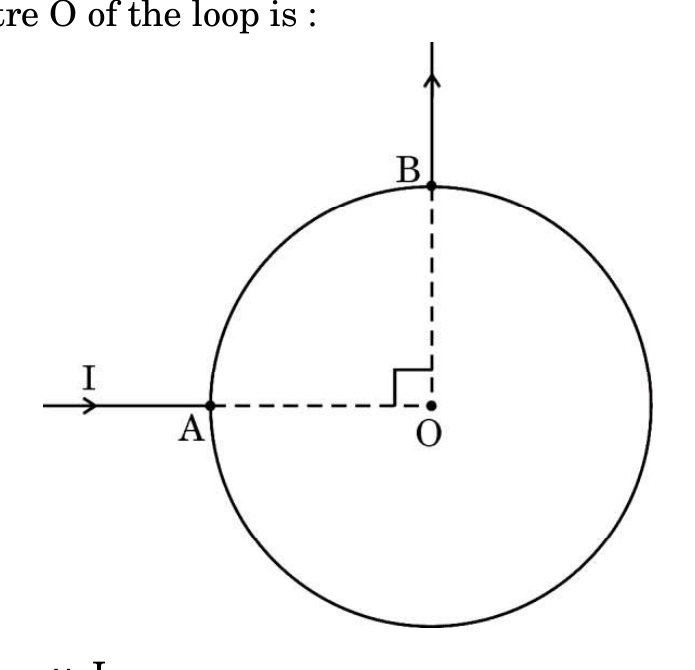 In a circular loop of radius R, current I enters at point A and exits at point B, as shown in the figure. The value of the magnetic field at the centre O of the loop is :CBSE 12th Physics 2025 Set 55/7/2MCQ›65A particle of mass $m$ and charge $q$ moving with velocity $v \hat{i}$ is subjected to a uniform electric field $E \hat{j}$. The particle will initially have a tendency to move in a circle of radius :CBSE 12th Physics 2025 Set 55/6/3MCQ›66A particle of charge $q$ is moving with a velocity $\vec{v}$ at a distance ‘$d$’ from a long straight wire carrying a current ‘$I$’ as shown in figure. At this instant, it is subjected to a uniform electric field $\vec{E}$ such that the particle keeps moving undeviated. In terms of unit vectors $\hat{i}, \hat{j}$ and $\hat{k}$, find -
(a) the magnetic field $\vec{B}$,
(b) the magnetic force $\vec{F}_m$, and
(c) the electric field $\vec{E}$, acting on the charge.CBSE 12th Physics 2025 Set 55/1/33 marks · Notebook›67Assertion (A) : A charged particle is moving with velocity $v$ in x-y plane, making an angle $\theta\left(0 < \theta < \frac{\pi}{2}\right)$ with x-axis. If a uniform magnetic field $\vec{B}$ is applied in the region, along y-axis, the particle will move in a helical path with its axis parallel to x-axis.
Reason (R) : The direction of the magnetic force acting on a charged particle moving in a magnetic field is along the velocity of the particle.CBSE 12th Physics 2025 Set 55/7/1MCQ›68
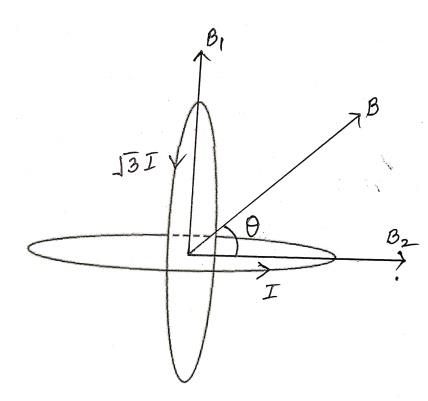 (a) (i) Write Biot-Savart’s law in vector form.
(ii) Two identical circular coils A and B, each of radius $R$, carrying currents $I$ and $\sqrt{3} I$ respectively, are placed concentrically in XY and YZ planes respectively. Find the magnitude and direction of the net magnetic field at their common centre.
OR
(b) (i) A rectangular loop of sides $l$ and $b$ carries a current $I$ clockwise. Write the magnetic moment $\vec{m}$ of the loop and show its direction in a diagram.
(ii) The loop is placed in a uniform magnetic field $\vec{B}$ and is free to rotate about an axis which is perpendicular to $\vec{B}$. Prove that the loop experiences no net force, but a torque $\vec{\tau}=\vec{m} \times \vec{B}$.CBSE 12th Physics 2025 Set 55/7/13 marks · Notebook›69(a) (i) With the help of a labelled diagram, explain the principle of working of a moving coil galvanometer. Write the purpose of using (i) radial magnetic field, and (ii) soft iron core, in it.
(ii) Define current sensitivity of a galvanometer. “Increasing the current sensitivity may not necessarily increase the voltage sensitivity.” Give reason.
OR
(b) (i) (I) Write Ampere’s circuital law in mathematical form and explain the terms used.
(II) As the current carrying solenoid is made longer, the magnetic field produced outside it approaches zero. Why ?
(III) A flexible loop of irregular shape carrying current when located in an external magnetic field, changes to a circular shape. Give reason.
(ii) A galvanometer of resistance $G$ is converted into a voltmeter to measure up to $V$ volts, by connecting a resistance $R_1$ in series with the coil. If $R_1$ is replaced by $R_2$, then it can only measure up to $\frac{V}{2}$ volt. Find the value of the resistance $R_3$ (in terms of $R_1$ and $R_2$) needed to convert it into a voltmeter that can read up to $2 V$.CBSE 12th Physics 2025 Set 55/7/15 marks · Notebook›
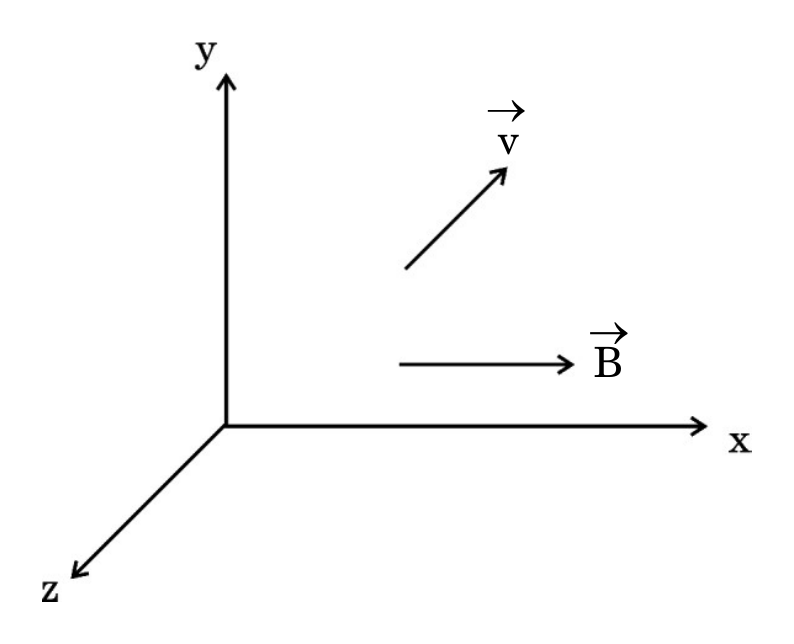 (a) (i) A particle of mass $m$ and charge $q$ is moving with a velocity $\vec{v}$ in a magnetic field $\vec{B}$ as shown in the figure. Show that it follows a helical path. Hence, obtain its frequency of revolution.
(ii) In a hydrogen atom, the electron moves in an orbit of radius $2 \mathring{\mathrm{A}}$ making $8 \times 10^{14}$ revolutions per second. Find the magnetic moment associated with the orbital motion of the electron.
OR
(b) (i) What is current sensitivity of a galvanometer ? Show how the current sensitivity of a galvanometer may be increased. “Increasing the current sensitivity of a galvanometer may not necessarily increase its voltage sensitivity.” Explain.
(ii) A moving coil galvanometer has a resistance $15 \Omega$ and takes $20 \mathrm{~mA}$ to produce full scale deflection. How can this galvanometer be converted into a voltmeter of range 0 to $100 \mathrm{~V}$ ?CBSE 12th Physics 2024 Set 55/2/15 marks · Notebook›87A piece of wire bent in the form of a circular loop A carries a current $I$. The wire is then bent into a circular loop B of two turns and carries the same current. The ratio of magnetic fields at the centre of loop A to that of loop B will be :CBSE 12th Physics 2024 Set 55/1/2MCQ›88A loop carrying a current $I$ clockwise is placed in $x-y$ plane, in a uniform magnetic field directed along z-axis. The tendency of the loop will be to :CBSE 12th Physics 2024 Set 55/1/1MCQ›89A $10 \mathrm{~cm}$ long wire lies along y-axis. It carries a current of $1.0 \mathrm{~A}$ in positive y-direction. A magnetic field $\vec{B}=(5 \mathrm{~mT}) \hat{j}-(8 \mathrm{~mT}) \hat{k}$ exists in the region. The force on the wire is :CBSE 12th Physics 2024 Set 55/1/1MCQ›90A galvanometer of resistance $G\, \Omega$ is converted into an ammeter of range 0 to $I \mathrm{~A}$. If the current through the galvanometer is $0.1 \%$ of $I \mathrm{~A}$, the resistance of the ammeter is :CBSE 12th Physics 2024 Set 55/1/1MCQ›91Assertion (A) : Two long parallel wires, freely suspended and connected in series to a battery, move apart.
Reason (R) : Two wires carrying current in opposite directions repel each other.CBSE 12th Physics 2024 Set 55/1/1MCQ›92A proton with kinetic energy $1.3384 \times 10^{-14} \mathrm{~J}$ moving horizontally from north to south, enters a uniform magnetic field $B$ of $2.0 \mathrm{~mT}$ directed eastward. Calculate :
(a) the speed of the proton
(b) the magnitude of acceleration of the proton
(c) the radius of the path traced by the proton
[Take $(q / m)$ for proton $=1.0 \times 10^8 \mathrm{~C} / \mathrm{kg}$]CBSE 12th Physics 2024 Set 55/1/13 marks · Notebook›93A $2.0 \mathrm{~cm}$ segment of wire, carrying $5.0 \mathrm{~A}$ current in positive y-direction lies along y-axis, as shown in the figure. The magnetic field at a point $(3 \mathrm{~m}, 4 \mathrm{~m}, 0)$ due to this segment (part of a circuit) is :CBSE 12th Physics 2024 Set 55/3/1MCQ›94A circular loop of wire, carrying a current ‘$I$’ is lying in xy-plane with its centre coinciding with the origin. It is subjected to a uniform magnetic field pointing along + z-axis. The loop will :CBSE 12th Physics 2024 Set 55/3/1MCQ›95A current carrying circular loop of magnetic moment $\vec{M}$ is suspended in a vertical plane in an external magnetic field $\vec{B}$ such that its plane is normal to $\vec{B}$. The work done in rotating this loop by $45^{\circ}$ about an axis perpendicular to $\vec{B}$ is closest to :CBSE 12th Physics 2024 Set 55/3/1MCQ›96Assertion (A) : A proton and an electron enter a uniform magnetic field $\vec{B}$ with the same momentum $\vec{p}$ such that $\vec{p}$ is perpendicular to $\vec{B}$. They describe circular paths of the same radius.
Reason (R) : In a magnetic field, orbital radius $r$ is equal to $\frac{p}{q B}$.CBSE 12th Physics 2024 Set 55/3/1MCQ›97Two long straight parallel conductors carrying currents, exert a force on each other. Why ? Derive an expression for the force per unit length between two long straight parallel conductors carrying currents in opposite directions. Explain the nature of the force between these conductors.CBSE 12th Physics 2024 Set 55/3/13 marks · Notebook›98(a) (i) (1) What is meant by current sensitivity of a galvanometer ? Mention the factors on which it depends.
(2) A galvanometer of resistance $G$ is converted into a voltmeter of range $(0-V)$ by using a resistance $R$. Find the resistance, in terms of $R$ and $G$, required to convert it into a voltmeter of range $\left(0-\frac{V}{2}\right)$.
(ii) The magnetic flux through a coil of resistance $5 \Omega$ increases with time as :
$$\phi=\left(2.0 t^3+5.0 t^2+6.0 t\right) \mathrm{mWb}$$
Find the magnitude of induced current through the coil at $t=2 \mathrm{~s}$.
OR
(b) (i) A rectangular coil of $N$ turns and area of cross-section $A$ is rotated at a steady angular speed $\omega$ in a uniform magnetic field. Obtain an expression for the emf induced in the coil at any instant of time.
(ii) Two coplanar and concentric circular loops $\mathrm{L}_1$ and $\mathrm{L}_2$ are placed coaxially with their centres coinciding. The radii of $\mathrm{L}_1$ and $\mathrm{L}_2$ are $1 \mathrm{~cm}$ and $100 \mathrm{~cm}$ respectively. Calculate the mutual inductance of the loops. (Take $\pi^2=10$)CBSE 12th Physics 2024 Set 55/3/15 marks · Notebook›99Two thin long parallel wires separated by a distance ‘a’ carry current ‘I’ in opposite directions. The wires will :CBSE 12th Physics 2024 Set 55/3/2MCQ›100A rectangular loop of area $\vec{A}$, carrying current $\mathrm{I}$, is placed in a uniform magnetic field $\vec{B}$. With the help of a suitable diagram, derive an expression, in vector form, for the torque acting on the loop.CBSE 12th Physics 2024 Set 55/3/23 marks · Notebook›101Two circular loops of areas A and 4A carry currents 2I and I respectively. The magnetic fields at their centres will be in the ratio of :CBSE 12th Physics 2024 Compartment Set 55/S/2MCQ›102The current sensitivity of a galvanometer does not depend on the :CBSE 12th Physics 2024 Compartment Set 55/S/2MCQ›103A particle of mass $m$ and charge $q$ is moving in a magnetic field $\vec{B}$ with a velocity $\vec{v}$. Discuss, giving reasons, the shape of its trajectory when the angle between $\vec{v}$ and $\vec{B}$ is :
(a) $0^{\circ}$
(b) $90^{\circ}$
(c) $120^{\circ}$CBSE 12th Physics 2024 Compartment Set 55/S/23 marks · Notebook›104Two circular coils of radius $R$ each and having equal number of turns $N$, carry equal currents $I$ in the same direction. They are placed coaxially at a distance $2 \sqrt{3} R$. Find the magnitude and direction of the net magnetic field produced at the midpoint of the line joining their centres.CBSE 12th Physics 2024 Compartment Set 55/S/23 marks · Notebook›105Two long straight parallel conductors A and B, kept at a distance $r$, carry current $I$ in opposite directions. A third identical conductor C, kept at a distance $\left(\frac{r}{3}\right)$ from A carry current $I_1$ in the same direction as in A. The net magnetic force on unit length of C isCBSE 12th Physics 2024 Set 55/4/31 marks · Notebook›106An infinite straight conductor is kept along $\mathrm{X}'\mathrm{X}$ axis and carries a current $I$. A charge $q$ at point $\mathrm{P}(0, r)$ starts moving with velocity $\vec{v}=v_0 \hat{j}$ as shown in figure. Find the direction and magnitude of force initially experienced by the charge.CBSE 12th Physics 2024 Set 55/4/33 marks · Notebook›107A galvanometer shows full scale deflection for a current $I_g$. If a shunt of resistance $S_1$ is connected to the galvanometer, it gets converted into an ammeter of range $(0-I)$. When resistance of the shunt is made $S_2$, its range becomes $(0-2 I)$. Then $\left(\frac{S_1}{S_2}\right)$ isCBSE 12th Physics 2024 Set 55/5/2MCQ›108A straight wire of length $1.0 \mathrm{~m}$ is placed along $x$-axis, in a region with magnetic field $\vec{B}=(3 \hat{i}+2 \hat{j}) \mathrm{~T}$. A current of $2.0 \mathrm{~A}$ flows in the wire along $+x$ direction. The magnetic force acting on the wire is :CBSE 12th Physics 2024 Compartment Set 55/S/1MCQ›109Assertion (A) : The torque acting on a current carrying coil is maximum when it is suspended in a radial magnetic field.
Reason (R) : The torque tends to rotate the coil on its own axis.CBSE 12th Physics 2024 Compartment Set 55/S/1MCQ›110A long straight horizontal wire is carrying a current $I$. At an instant, an alpha particle at a distance $r$ from it, is travelling with speed $v$ parallel to the wire in a direction opposite to the current. Find the magnitude and direction of the force experienced by the particle at this instant.CBSE 12th Physics 2024 Compartment Set 55/S/12 marks · Notebook›111A galvanometer is converted into a voltmeter of range $(0-V)$ volt using a resistor of $9900 \Omega$. If a resistor of $4900 \Omega$ is used, the range becomes half, i.e. $\left(0-\frac{V}{2}\right)$ volt. Calculate :
(a) resistance of the galvanometer
(b) resistance required to convert it into a voltmeter of range $(0-2 V)$ volt.CBSE 12th Physics 2024 Compartment Set 55/S/13 marks · Notebook›112Two insulated concentric coils, each of radius $R$, placed at right angles to each other, carry currents $I$ and $\sqrt{3} I$ respectively. The magnitude of the net magnetic field at their common centre will beCBSE 12th Physics 2024 Set 55/5/3MCQ›113A galvanometer of resistance $100 \Omega$ gives full scale deflection for a current of $1.0 \mathrm{~mA}$. It is converted into an ammeter of range $(0-1 \mathrm{~A})$. The resistance of the ammeter will be close toCBSE 12th Physics 2024 Set 55/5/3MCQ›114An electron is moving with a velocity $\vec{v}=\left(3 \times 10^6 \frac{\mathrm{m}}{\mathrm{s}}\right) \hat{i}$. It enters a region of magnetic field $\vec{B}=(91 \mathrm{~mT}) \hat{k}$.
(a) Calculate the magnetic force $\vec{F}_B$ acting on electron and the radius of its path.
(b) Trace the path described by it.CBSE 12th Physics 2024 Set 55/5/33 marks · Notebook›
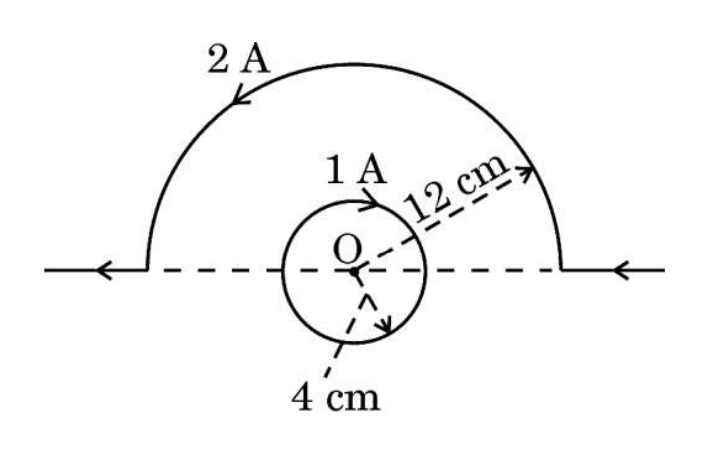 A current carrying circular loop and a straight wire bent partly in the form of a semicircle are placed as shown in the figure. Find the magnitude and direction of net magnetic field at point O.CBSE 12th Physics 2023 Set 55/4/33 marks · Notebook›121Two infinitely long parallel conductors A and B, separated by $2 \mathrm{~cm}$, carry $6 \mathrm{~A}$ and $2 \mathrm{~A}$ currents in opposite directions respectively. Find :
(a) the net magnetic field at a point midway between A and B.
(b) the force acting per unit length on B.CBSE 12th Physics 2023 Set 55/4/23 marks · Notebook›122An electron with velocity $\vec{v}=\left(v_x \hat{i}+v_y \hat{j}\right)$ moves through a magnetic field $\vec{B}=\left(B_x \hat{i}-B_y \hat{j}\right)$. The force $\vec{F}$ on the electron is : (e is the magnitude of its charge)CBSE 12th Physics 2023 Compartment Set 55/C/1MCQ›123Assertion (A) : A planar loop of irregular shape carrying current is subjected to a magnetic field acting perpendicular to the plane of the loop. If the wire is flexible, the loop takes a circular shape.
Reason (R) : The force acting on each point of a current carrying loop, in a magnetic field perpendicular to its plane, is radially outward.CBSE 12th Physics 2023 Compartment Set 55/C/1MCQ›124(a) It is not advisable to use a galvanometer as such to measure current directly. Why ?
(b) Why should the value of resistance connected in parallel to a galvanometer be low ?
(c) Is the reading shown by an ammeter in a circuit less than or more than the actual value of current flowing in the circuit ? Why ?CBSE 12th Physics 2023 Compartment Set 55/C/13 marks · Notebook›125Assertion (A) : The magnetic field produced by a current carrying solenoid is independent of its length and cross-sectional area.
Reason (R): The magnetic field inside the solenoid is uniform.CBSE 12th Physics 2023 Compartment Set 55/C/2MCQ›126The current I flowing through a conductor of radius r is uniformly distributed across its cross-section. Which of the following graphs represents the variation of magnitude of magnetic field $\vec{B}$ with distance x from the axis of the conductor ?CBSE 12th Physics 2023 Compartment Set 55/C/3MCQ›127Assertion (A) : A proton and an alpha particle having same kinetic energy are moving in circular paths in a uniform magnetic field. The radii of their circular paths will be equal.
Reason (R) : The centripetal force required to move a charged particle in a circle does not depend on the magnitude of the magnetic field.CBSE 12th Physics 2023 Compartment Set 55/C/3MCQ›128An alpha particle is projected with velocity $\vec{v}=\left(3.0 \times 10^5 \mathrm{~m} / \mathrm{s}\right) \hat{i}$ into a region in which magnetic field $\vec{B}=[(0.4 \mathrm{~T}) \hat{i}+(0.3 \mathrm{~T}) \hat{j}]$ exists. Calculate the acceleration of the particle in the region. $\hat{i}, \hat{j}$ and $\hat{k}$ are unit vectors along x, y and z axis respectively and charge to mass ratio for alpha particle is $4.8 \times 10^7 \mathrm{~C} / \mathrm{kg}$.CBSE 12th Physics 2023 Set 55/1/12 marks · Notebook›129(a) (i) State Biot-Savart’s law for the magnetic field due to a current carrying element. Use this law to obtain an expression for the magnetic field at the centre of a circular loop of radius ‘$a$’ and carrying a current ‘$I$’. Draw the magnetic field lines for a current loop indicating the direction of magnetic field.
(ii) An electron is revolving around the nucleus in a circular orbit with a speed of $10^7 \mathrm{~m} \mathrm{~s}^{-1}$. If the radius of the orbit is $10^{-10} \mathrm{~m}$, find the current constituted by the revolving electron in the orbit.
OR
(b) (i) Derive an expression for the force acting on a current carrying straight conductor kept in a magnetic field. State the rule which is used to find the direction of this force. Give the condition under which this force is (1) maximum, and (2) minimum.
(ii) Two long parallel straight wires A and B are $2.5 \mathrm{~cm}$ apart in air. They carry $5.0 \mathrm{~A}$ and $2.5 \mathrm{~A}$ currents respectively in opposite directions. Calculate the magnitude of the force exerted by wire A on a $10 \mathrm{~cm}$ length of wire B.CBSE 12th Physics 2023 Set 55/1/15 marks · Notebook›130Two horizontal thin long parallel wires, separated by a distance $r$ carry current $I$ each in the opposite directions. The net magnetic field at a point midway between them, will beCBSE 12th Physics 2023 Set 55/5/31 marks · Notebook›131(a) Two identical circular loops $P$ and $Q$, each of radius $R$ carrying current $I$ are kept in perpendicular planes such that they have a common centre $O$ as shown in the figure.
Find the magnitude and direction of the net magnetic field at point $O$.
OR
(b) A long straight conductor kept along $X^{\prime} X$ axis, carries a steady current $I$ along $+x$ direction. At an instant $t$, a particle of mass $m$ and charge $q$ at point $(x, y)$ moves with a velocity $\vec{v}$ along $+y$ direction. Find the magnitude and direction of the force on the particle due to the conductor.CBSE 12th Physics 2023 Set 55/5/32 marks · Notebook›132Which of the following graphs correctly represents the variation of the magnitude of the magnetic field outside a straight infinite current carrying wire of radius ‘a’, as a function of distance ‘r’ from the centre of the wire ?CBSE 12th Physics 2023 Set 55/3/1MCQ›133A particle of mass $m$ and charge $q$ moving with a uniform velocity $\vec{v}=v_{0 x} \hat{i}+v_{0 y} \hat{j}$ enters a region with a magnetic field $\vec{B}=B_0 \hat{j}$. After some time, an electric field $\vec{E}=E_0 \hat{j}$ is also switched on in the region. The resulting path described by the particle will be :CBSE 12th Physics 2023 Set 55/3/1MCQ›134Assertion (A) : When radius of a circular loop carrying a steady current is doubled, its magnetic moment becomes four times.
Reason (R) : The magnetic moment of a circular loop carrying a steady current is proportional to the area of the loop.CBSE 12th Physics 2023 Set 55/3/1MCQ›135A wire of length $l$ is in the form of a circular loop A of one turn. This loop is reshaped into loop B of three turns. Find the ratio of the magnetic fields at the centres of loop A and loop B for the same current through them.CBSE 12th Physics 2023 Set 55/3/12 marks · Notebook›136(a) (i) Write the principle and explain the working of a moving coil galvanometer. A galvanometer as such cannot be used to measure the current in a circuit. Why ?
(ii) Why is the magnetic field made radial in a moving coil galvanometer ? How is it achieved ?
OR
(b) (i) Derive an expression for magnetic field on the axis of a current carrying circular loop.
(ii) Write any two points of difference between a diamagnetic and a paramagnetic substance.CBSE 12th Physics 2023 Set 55/3/15 marks · Notebook›137In a moving coil galvanometer, the deflecting torque $\tau$ acting on the coil is related to the current $I$ flowing through it as :CBSE 12th Physics 2023 Set 55/3/2MCQ›138Two wires of equal lengths are shaped in the form of a square loop and a circular loop. Both loops are suspended in a uniform magnetic field. Prove that for the same current, the circular loop will experience larger torque.CBSE 12th Physics 2023 Set 55/3/22 marks · Notebook›139Two thin long parallel wires A and B are separated by a distance r and carry current I each in the same direction. The force per unit length exerted by A on wire B is :CBSE 12th Physics 2023 Set 55/3/3MCQ›140A wire of length $L$ is bent round in the form of (i) a square, and then (ii) an equilateral triangle. If current $I$ is passed through each of them, find the ratio of magnetic moment of the square loop to that of the triangle.CBSE 12th Physics 2023 Set 55/3/32 marks · Notebook›141An electron enters a uniform magnetic field with speed $v$. It describes a semicircular path and comes out of the field. The final speed of the electron is :CBSE 12th Physics 2023 Set 55/4/1MCQ›142Assertion (A) : A current carrying square loop made of a wire of length $L$ is placed in a magnetic field. It experiences a torque which is greater than the torque on a circular loop made of the same wire carrying the same current in the same magnetic field.
Reason (R) : A square loop occupies more area than a circular loop, both made of wire of the same length.CBSE 12th Physics 2023 Set 55/4/1MCQ›143Two circular loops A and B, each of radius $3 \mathrm{~m}$, are placed coaxially at a distance of $4 \mathrm{~m}$. They carry currents of $3 \mathrm{~A}$ and $2 \mathrm{~A}$ in opposite directions respectively. Find the net magnetic field at the centre of loop A.CBSE 12th Physics 2023 Set 55/4/13 marks · Notebook›