
ExamQuark
Getting things ready
Your next step is almost ready.
Your progress
0
Correct
0
Wrong
0%
Accuracy
0 s
Time spent
—
Percentile
Questions by year
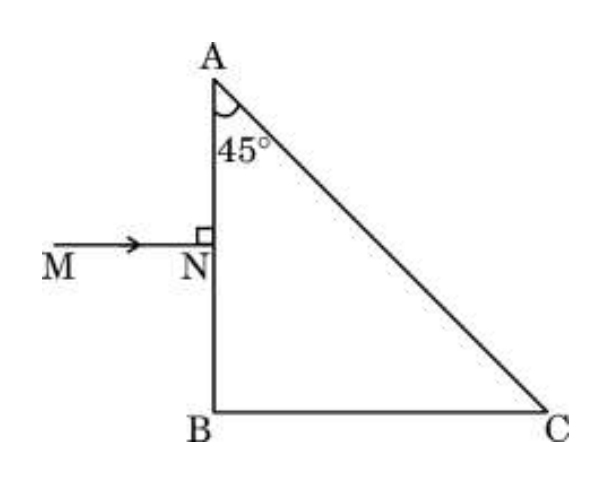 A ray of light MN is incident normally on the face corresponding with side AB of a prism with an isosceles right-angled triangular base ABC. Trace the path of the ray as it passes through the prism when the refractive index of the prism material is (i) $\sqrt{2}$, and (ii) $\sqrt{3}$.CBSE 12th Physics 2026 Set 55/5/32 marks · Notebook›2A concave lens of focal length $40 \mathrm{~cm}$ is coaxially in contact with two convex lenses, each of focal length $20 \mathrm{~cm}$, on each side. The focal length of the combination isCBSE 12th Physics 2026 Set 55/1/2MCQ›3Draw a labelled ray diagram showing the formation of image by a compound microscope when final image is formed at least distance of distinct vision. Derive an expression for its magnifying power for this case.CBSE 12th Physics 2026 Set 55/1/23 marks · Notebook›4An equiconvex lens of focal length $15 \mathrm{~cm}$ is cut into two equal plano-convex halves. The focal length of each half will be :CBSE 12th Physics 2026 Set 55/3/2MCQ›5A plano-convex lens, made of glass $(n=1.5)$ has a curved surface whose radius is $40 \mathrm{~cm}$. The image formed of an object is of the same size as that of the object. The distance of the object from the lens is :CBSE 12th Physics 2026 Set 55/3/2MCQ›6
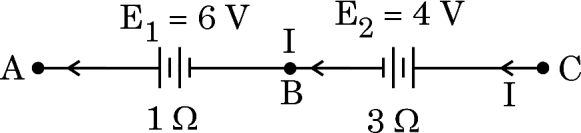 Draw a labelled ray diagram of an astronomical telescope when final image is formed at infinity. Write the expression for its magnifying power.CBSE 12th Physics 2026 Set 55/3/22 marks · Notebook›7Define the term ‘critical angle’. A small bulb is placed at the bottom of a tank containing a liquid of refractive index $\mu$ at a depth $H$. It is observed that the light emerges from a circular area of radius $r$ of the surface. Obtain the expression for $r$ in terms of $H$ and $\mu$.CBSE 12th Physics 2026 Set 55/3/23 marks · Notebook›8
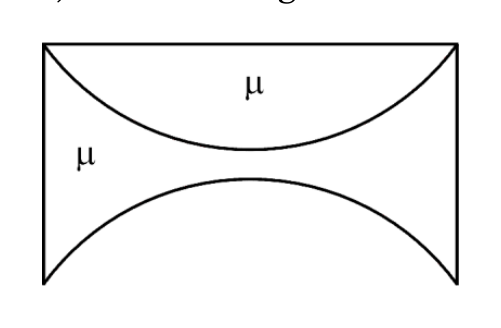 A thin plano-convex lens and a thin equi-concave lens are kept coaxially in contact as shown in the figure. Assuming both the lenses are made of glass of refractive index $\mu$, and $R$ is the radius of curvature of each curved surface, the focal length of the combination is :CBSE 12th Physics 2026 Set 55/3/1MCQ›9A telescope has an objective lens of focal length $144 \mathrm{~cm}$ and an eyepiece of focal length $6.0 \mathrm{~cm}$. The magnifying power and the length of telescope tube will be respectively :CBSE 12th Physics 2026 Set 55/3/1MCQ›10In which of the following, total internal reflection does not occur ?CBSE 12th Physics 2026 Set 55/3/1MCQ›11A ray of light is travelling through a rectangular glass slab (refractive index $\frac{3}{2}$) and is incident on the horizontal glass-air surface at the critical angle for the two media. The slab is then brought in contact with water (refractive index $\frac{4}{3}$) such that a thin horizontal layer of water is formed on the surface of the slab. Find the angle at which the ray will emerge into air from the water-air surface.CBSE 12th Physics 2026 Set 55/3/13 marks · Notebook›12(a) (i) A point object is kept in front of a convex spherical surface of radius of curvature $R$. Draw the ray diagram to show the formation of image and derive the relation between the object and image distance ($u$ and $v$) in terms of refractive index $n$ of the medium and $R$.
(ii) A convex lens of focal length of $20 \mathrm{~cm}$ is used to form the image of an object placed $30 \mathrm{~cm}$ away from the lens. Find the position and nature of the image formed.
OR
(b) (i) Two thin converging lenses of focal length $f_1$ and $f_2$ are placed coaxially in contact. Derive expression for the focal length of the combination.
(ii) A beam of coherent light of wavelength $550 \mathrm{~nm}$ is incident normal to the plane of a pair of two slits $S_1$ and $S_2$ each of width $1.2 \times 10^{-6} \mathrm{~m}$ separated by $1.1 \mathrm{~mm}$. Dark and bright fringes are observed on a screen $2.2 \mathrm{~m}$ away from the plane of the slits.
Calculate :
(I) fringe width.
(II) distance of the second dark fringe from the central maximum.
(III) what will happen when the entire apparatus is immersed in water.CBSE 12th Physics 2026 Set 55/3/15 marks · Notebook›13
 A ray of light is incident at an angle $2 A$ on one of the faces of a glass prism of refracting angle $A$. After refraction from this face, the ray strikes the opposite face which is silvered. The reflected ray from this face retraces on its path.
Trace the ray diagram and find the relation between the refractive index of material of prism and the angle of prism.CBSE 12th Physics 2026 Set 55/2/32 marks · Notebook›14A ray of light is incident on the face of a triangular prism of refracting angle $60^{\circ}$ and it just suffers total internal reflection at the other face. Find the angle of incidence for the ray if the refractive index of the material of the prism is $\sqrt{2}$.CBSE 12th Physics 2026 Set 55/2/22 marks · Notebook›15A ray of light in air is incident at angle $\angle i$ on a face of an equilateral glass prism and is refracted through the prism. As $\angle i$ is varied, it is observed that the ray undergoes minimum deviation, when the $\angle i$ is three-fourth of the angle of the prism. Calculate the speed of light in the prism.CBSE 12th Physics 2026 Set 55/2/12 marks · Notebook›16A $5 \mathrm{~cm}$ long pencil is placed along the principal axis of a concave mirror of focal length $20 \mathrm{~cm}$ such that its nearest end is at a distance of $25 \mathrm{~cm}$ from the mirror. Calculate the length of the image of the pencil.
OR
In a Young’s double-slit experiment, a beam of light consisting of two wavelengths $500 \mathrm{~nm}$ and $600 \mathrm{~nm}$ is used. The interference fringes are observed at a screen placed $1.8 \mathrm{~m}$ away from the plane of slits (slit separation $0.3 \mathrm{~mm}$). Calculate the least distance from the central maximum where the bright fringes due to both the wavelengths coincide.CBSE 12th Physics 2026 Set 55/2/12 marks · Notebook›17In an experiment with convex lens of focal length $f$, the screen is fixed at a distance $D$ from the object. A student slowly moves the lens away from the object towards the screen and finds that she is able to form sharp image of the object for two positions of the lens. The distance between these two positions of the lens is $d$.
(i) The value of $d$ is
(A) $\sqrt{D(D-4 f)}$
(B) $\sqrt{D(D-2 f)}$
(C) $2 \sqrt{D f}$
(D) $\sqrt{D(D-f)}$
(ii) Compared to the size of the object, the images formed in the two positions of the lens are respectively
(A) reduced, enlarged
(B) reduced, reduced
(C) enlarged, enlarged
(D) enlarged, reduced
(iii) If the distance between object and screen is $80.00 \mathrm{~cm}$ and the lens forms sharp images at two positions separated by $20.00 \mathrm{~cm}$., the focal length of convex lens is
(A) $15.50 \mathrm{~cm}$
(B) $18.75 \mathrm{~cm}$
(C) $20.50 \mathrm{~cm}$
(D) $22.75 \mathrm{~cm}$
(iv) Consider a convex lens of focal length $15 \mathrm{~cms}$. For which of the following values of object-screen distance, two positions of the object can be found to obtain sharp image on the screen ?
(A) $45 \mathrm{~cm}$
(B) $50 \mathrm{~cm}$
(C) $55 \mathrm{~cm}$
(D) $65 \mathrm{~cm}$
OR
(iv) A thin convex lens of focal length $10 \mathrm{~cm}$ and another thin lens of focal length ‘$f$’ are placed coaxially in contact. If the power of their combination is $\frac{10}{3} \mathrm{D}$, the value of ‘$f$’ is
(A) $-15 \mathrm{~cm}$
(B) $-10 \mathrm{~cm}$
(C) $-20 \mathrm{~cm}$
(D) $-30 \mathrm{~cm}$CBSE 12th Physics 2026 Set 55/2/14 marks · Notebook›18A ray of yellow light undergoes total internal reflection when it is incident at the interface of two media. This ray is successively replaced by the ray of blue, green and red lights. Which of the following statements is true if the angle of incidence is same in all cases ?CBSE 12th Physics 2026 Set 55/3/3MCQ›19A ray of light is incident at angle of $45^{\circ}$ on one face of a prism with an equilateral triangular base. If it passes symmetrically through the prism, find the :
(a) angle of minimum deviation for the prism, and
(b) refractive index of the material of the prism.CBSE 12th Physics 2026 Set 55/3/33 marks · Notebook›20Assertion (A) : When a convex lens made of glass is immersed in water, its converging power increases.
Reason (R) : The focal length of a lens depends only on the radii of curvature of its two faces.CBSE 12th Physics 2026 Set 55/4/1MCQ›21A small bulb is placed at the bottom of a tank, containing a transparent liquid of refractive index $\sqrt{2}$, to a depth of $1 \mathrm{~m}$. Calculate the area of the surface of the liquid through which light from the bulb emerges.CBSE 12th Physics 2026 Set 55/4/12 marks · Notebook›22An astronomical telescope consists of two converging lenses. One of them of large aperture and large focal length is called objective lens and the other one, of smaller focal length and smaller aperture is called the eyepiece. It is used to see distant objects which are not seen clearly with naked eyes. The image formed by the objective lens acts as an object for the eyepiece and the final image produced by the eyepiece is magnified.
(i) The images formed by the objective lens and the eyepiece are respectively :
(A) virtual, real
(B) real, virtual
(C) virtual, virtual
(D) real, real
(ii) The magnification produced by the telescope does not depend upon the :
(A) colour of light
(B) focal length of objective lens
(C) focal length of eyepiece
(D) apertures of objective lens and eyepiece
(iii) Which of the following statements is not correct for this telescope ?
(A) The focal length of objective lens $\left(f_o\right)$ is larger than the focal length of eyepiece $\left(f_e\right)$.
(B) Its magnifying power can be increased by increasing the focal length of objective lens $\left(f_o\right)$.
(C) The distance between two lenses is more than $\left(f_o+f_e\right)$.
(D) The magnifying power can be decreased by increasing the focal length of eyepiece.
(iv) (a) An astronomical telescope has objective lens and eyepiece of focal lengths $80 \mathrm{~cm}$ and $4 \mathrm{~cm}$ respectively. To view the image in normal adjustment, the lenses must be separated by a distance of :
(A) $84 \mathrm{~cm}$
(B) $76 \mathrm{~cm}$
(C) $20 \mathrm{~cm}$
(D) $320 \mathrm{~cm}$
OR
(b) Consider the telescope described in question (iv) (a). Its magnifying power in normal adjustment will be :
(A) 320
(B) 84
(C) 76
(D) 20CBSE 12th Physics 2026 Set 55/4/14 marks · Notebook›23
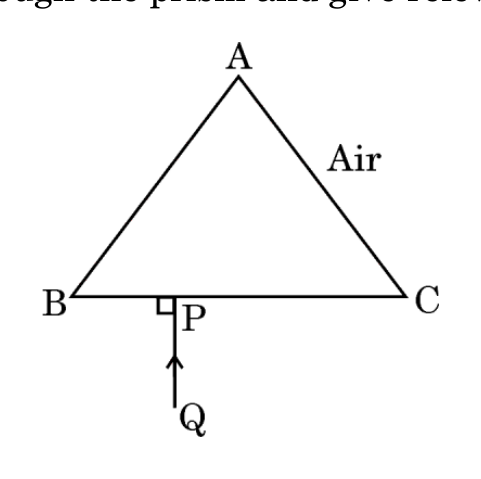 (a) (i) Define refractive index of a medium in terms of speed of light.
(ii) Derive the relation for the refractive index $(\mu)$ of a prism in terms of angle of minimum derivation $\left(\delta_m\right)$ and angle of prism $(A)$.
(iii) A ray of light QP is incident normally on the face BC of a triangular prism ABC of refractive index $1.5$ kept in air, as shown in the figure. Trace the path of the ray as it passes through the prism and give relevant explanation.
OR
(b) (i) What is the difference between a ray and a wavefront ?
(ii) A plane wave is incident on a reflecting surface. Using Huygens principle, show how it is reflected from the surface. Hence, verify the law of reflection.
(iii) Depict refraction of a plane wave by a convex lens.CBSE 12th Physics 2026 Set 55/4/15 marks · Notebook›24Light from a small object in air falls on a spherical glass surface $(\mathrm{n}=1.5)$ of radius of curvature $\mathrm{R}$. A real image of the object will be formed if the object distance $\mathrm{u}$ is related to $\mathrm{R}$ as :CBSE 12th Physics 2026 Set 55/1/3MCQ›25(a) Why does one prefer to view the image formed at infinity than that formed at near point in microscope/telescope ?
(b) Consider lenses $\mathrm{L}_1, \mathrm{~L}_2$ and $\mathrm{L}_3$ as specified in the following table. Which of them will you select as objective and eyepiece for constructing best possible (i) telescope (ii) compound microscope ? Give reason for your answer.
Lens $\mathrm{L}_1$ $\mathrm{L}_2$ $\mathrm{L}_3$
Power $6 \mathrm{D}$ $3 \mathrm{D}$ $10 \mathrm{D}$
Aperture $1 \mathrm{~cm}$ $8 \mathrm{~cm}$ $1 \mathrm{~cm}$CBSE 12th Physics 2026 Set 55/1/33 marks · Notebook›26A ray of light is incident at an angle of $60^{\circ}$ on face AB of prism ABC with $\angle A=30^{\circ}$. The ray emerging out of the prism makes an angle of $30^{\circ}$ with the incident ray. The angle of emergence $(\angle e)$ is equal to :CBSE 12th Physics 2026 Compartment Set 55/7/1MCQ›27A point source in air is placed in front of convex spherical glass surface ($n=1.5$ and $R=10 \mathrm{~cm}$). Its real image is formed at the same distance as the surface from the source. The distance of the source from the surface is :CBSE 12th Physics 2026 Compartment Set 55/7/1MCQ›28(a) A monochromatic beam of light is travelling from a rarer to a denser medium. Giving reasons, explain the following :
(i) Is the frequency of the reflected and the refracted light the same as the frequency of incident light ?
(ii) Does the decrease in speed in denser medium imply a reduction in the energy carried by the light wave ?
OR
(b) (i) The lower half of a concave mirror’s reflecting surface is covered with an opaque non-reflecting material. What effect will this have on the image of an object placed in front of the mirror ?
(ii) A lens made of glass of refractive index $1.5$ disappears, when immersed in a trough of liquid. What is the refractive index of the liquid ?
Give reasons for your answer in each case.CBSE 12th Physics 2026 Compartment Set 55/7/12 marks · Notebook›29Derive an expression for refractive index of an equilateral prism in terms of the angle of minimum deviation and the angle of the prism. Plot a graph to show the variation of the angle of deviation as a function of angle of incidence.CBSE 12th Physics 2026 Compartment Set 55/7/13 marks · Notebook›30(a) Draw a labelled ray diagram of a refracting telescope in normal adjustment. Briefly explain its working.
(b) Why is the eyepiece of a telescope of short focal length, while the objective is of large focal length ? Explain.CBSE 12th Physics 2026 Compartment Set 55/7/13 marks · Notebook›31(a) A small bulb is placed at the bottom of a tank containing water to a depth of $1.00 \mathrm{~m}$. Find the area of the surface of water through which light from the bulb can emerge from. The refractive index of water is $(4 / 3)$.
(b) An object is placed at a distance of $15 \mathrm{~cm}$ from a convex lens of focal length $10 \mathrm{~cm}$. On the other side of the lens, a convex mirror is placed coaxially at a distance of $10 \mathrm{~cm}$ from the lens. If the image formed by this combination coincides with the object itself, draw the ray diagram and find the focal length of the convex mirror.
OR
(a) Differentiate between interference and diffraction of light.
Two coherent light waves, each of intensity $I_0$ produce interference pattern on a screen. Find the intensity at a point at which the path difference between them is (i) $\frac{\lambda}{3}$, and (ii) $\frac{\lambda}{4}$.
(b) In a Young’s double-slit experiment, fringes are obtained on a screen placed at a distance $D$ from the slits. It is observed that if the screen is moved $5 \mathrm{~cm}$ towards the slits, the fringe width changes by $0.03 \mathrm{~mm}$. If the distance between the slits is $1 \mathrm{~mm}$, calculate the wavelength of the light used.CBSE 12th Physics 2026 Compartment Set 55/7/15 marks · Notebook›32A concave mirror of radius of curvature $16 \mathrm{~cm}$ produces two-times enlarged real image of an object kept in front of it. Find the position of the object.CBSE 12th Physics 2026 Set 55/4/22 marks · Notebook›33A convex lens of refractive index $1.5$ has a focal length of $20 \mathrm{~cm}$ in air. Find its nature and focal length when it is immersed in a transparent liquid of refractive index $1.25$.CBSE 12th Physics 2026 Set 55/4/32 marks · Notebook›34A tank is filled with a liquid to a height of $12.5 \mathrm{~m}$. The apparent depth of a needle lying at the bottom of the tank is measured to be $9.0 \mathrm{~m}$. Calculate the speed of light in the liquid.CBSE 12th Physics 2026 Set 55/5/12 marks · Notebook›35Two thin lenses of focal length $f_1$ and $f_2$ are placed in contact with each other coaxially. Prove that the focal length $f$ of the combination is given by $f=\frac{f_1 f_2}{f_1+f_2}$.CBSE 12th Physics 2026 Set 55/5/12 marks · Notebook›36A point source, in air, is placed at a distance of $6 \mathrm{~cm}$ in front of a convex spherical surface $(\mathrm{n}=1.5$ and radius of curvature $=24 \mathrm{~cm})$. Find the position and nature of the image formed.CBSE 12th Physics 2026 Set 55/5/22 marks · Notebook›37The focal lengths of the objective and the eyepiece of a compound microscope are $2 \mathrm{~cm}$ and $3 \mathrm{~cm}$ respectively. If they are kept $25 \mathrm{~cm}$ apart, the tube length of the microscope is :CBSE 12th Physics 2026 Compartment Set 55/7/2MCQ›38(a) The distance of an object from a concave mirror is increased from $12 \mathrm{~cm}$ to $15 \mathrm{~cm}$. It is observed that the new image becomes $\left(\frac{2}{5}\right)^{\text {th }}$ the size of the initial image. Calculate the focal length of the mirror.
(b) A light ray is incident on the horizontal upper face of a glass cube making an angle of $45^{\circ}$ with the face. While emerging, the ray just grazes the vertical face of the cube. Find the refractive index of the glass.CBSE 12th Physics 2026 Compartment Set 55/7/23 marks · Notebook›39A thin convex lens with its two surfaces of radii of curvature $R_1$ and $R_2$ is made of a material of refractive $\mu_2$. A medium of refractive index $\mu_1\left(<\mu_2\right)$ surrounds it. Using a ray diagram, derive the Lens Maker’s formula when a point object placed on the principal axis in front of the surface of radius of curvature $R_1$ produces an image I on the other side of the lens.CBSE 12th Physics 2026 Compartment Set 55/7/23 marks · Notebook›40A concave lens of focal length $10 \mathrm{~cm}$ is cut into two identical plano-concave lenses. The focal length of each lens will beCBSE 12th Physics 2026 Set 55/1/1MCQ›41(a) Draw the ray diagram to show the image formation by a refracting telescope and write the expression for angular magnification for the telescope in normal adjustment.
(b) Give two reasons to explain why a reflecting telescope is preferred over a refracting telescope.CBSE 12th Physics 2026 Set 55/1/13 marks · Notebook›42
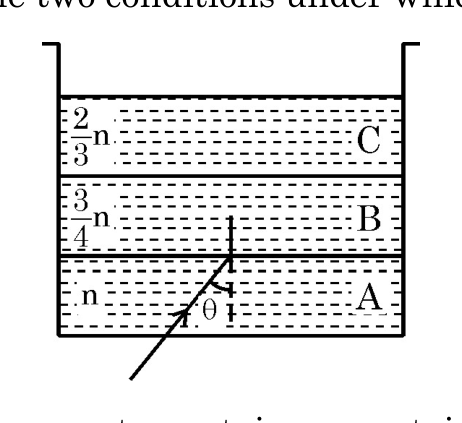 (a) State the two conditions under which total internal reflection occurs.
(b)
A transparent container contains layers of three immiscible transparent liquids A, B and C of refractive indices $n, \frac{3}{4} n$ and $\frac{2}{3} n$, respectively. A laser beam is incident at the interface between A and B at an angle $\theta$ as shown in figure. Prove that the beam does not enter region C at all for $\sin \theta \geq \frac{2}{3}$.CBSE 12th Physics 2026 Set 55/1/13 marks · Notebook›43(a) Using the relation for refraction at a curved spherical surface, derive the expression for lens maker’s formula.
(b) Three lenses $L_1, L_2$ and $L_3$, each of focal length $40 \mathrm{~cm}$, are placed coaxially. The distance between $L_1$ and $L_2$ and between $L_2$ and $L_3$ are $120 \mathrm{~cm}$ and $20 \mathrm{~cm}$ respectively. An object is kept at a distance of $80 \mathrm{~cm}$ to the left of lens $L_1$.
Find the distance of the final image formed from the object.
OR
(a) Draw a ray diagram to show the image formation by a concave mirror when the object is kept between its focus and the centre of curvature. Using this diagram, derive the mirror formula.
(b) A concave mirror produces a two times magnified virtual image of an object kept $10 \mathrm{~cm}$ in front of it. Calculate the focal length of the mirror.CBSE 12th Physics 2026 Set 55/1/15 marks · Notebook›44A ray of light passes from a medium of refractive index $\sqrt{2}$ into the medium of refractive index 1. For the ray to just graze along the surface of separation, the angle of incidence should be :CBSE 12th Physics 2026 Compartment Set 55/7/3MCQ›45Two thin converging lenses of focal lengths $f_1$ and $f_2$ are placed coaxially in contact. Draw a ray diagram to show the image formation by the combination. Hence, derive the expression for the focal length of the combination.CBSE 12th Physics 2026 Compartment Set 55/7/33 marks · Notebook›46Two converging lenses $L_1$ and $L_2$, of focal lengths $144 \mathrm{~cm}$ and $6 \mathrm{~cm}$ respectively, are arranged coaxially in a tube $147 \mathrm{~cm}$ apart. The arrangement is used to view a far off tree, keeping the eye close to $L_2$.
(i) Draw the ray diagram depicting image formation by the combination.
(ii) How far from $L_2$ will the final image be formed ?
(iii) Calculate the magnification produced by the combination.CBSE 12th Physics 2026 Compartment Set 55/7/33 marks · Notebook›
 (a) (i) A thin pencil of length $(f / 4)$ is placed coinciding with the principal axis of a mirror of focal length $f$. The image of the pencil is real and enlarged, just touches the pencil. Calculate the magnification produced by the mirror.
(ii) A ray of light is incident on a refracting face AB of a prism ABC at an angle of $45^{\circ}$. The ray emerges from face AC and the angle of deviation is $15^{\circ}$. The angle of prism is $30^{\circ}$. Show that the emergent ray is normal to the face AC from which it emerges out. Find the refraction index of the material of the prism.
OR
(b) (i) Light consisting of two wavelengths $600 \mathrm{~nm}$ and $480 \mathrm{~nm}$ is used to obtain interference fringes in a double slit experiment. The screen is placed $1.0 \mathrm{~m}$ away from slits which are $1.0 \mathrm{~nm}$ apart.
(1) Calculate the distance of the third bright fringe on the screen from the central maximum for wavelength $600 \mathrm{~nm}$.
(2) Find the least distance from the central maximum where the bright fringes due to both the wavelengths coincide.
(ii) (1) Draw the variation of intensity with angle of diffraction in single slit diffraction pattern. Write the expression for value of angle corresponding to zero intensity locations.
(2) In what way diffraction of light waves differs from diffraction of sound waves ?CBSE 12th Physics Outside Delhi Set 1 - 20255 marks · Notebook›50Two concave lenses A and B, each of focal length $8.0 \mathrm{~cm}$ are arranged coaxially $16 \mathrm{~cm}$ apart as shown in figure. An object P is placed at a distance of $4.0 \mathrm{~cm}$ from A. Find the position and nature of the final image formed.CBSE 12th Physics Outside Delhi Set 1 - 20252 marks · Notebook›51A beaker is filled with water (refractive index $\frac{4}{3}$ ) up to a height $H$. A coin is placed at its bottom. The depth of the coin, when viewed along the near ${ }^n$ ormal direction, will beCBSE 12th Physics Delhi Set 1 - 2025MCQ›52A transparent solid cylindrical rod (refractive index $\frac{2}{\sqrt{3}}$ ) is kept in air. A ray of light incident on its face travels along the surface of the rod, as shown in figure. Calculate the angle $\theta$.CBSE 12th Physics Delhi Set 1 - 20252 marks · Notebook›53A thin lens is a transparent optical medium bounded by two surfaces, at least one of which should be spherical. Applying the formula for image formation by a single spherical surface successively at the two surfaces of a lens, one can obtain the 'lens maker formula' and then the 'lens formula'. A lens has two foci - called 'first focal point' and 'second focal point' of the lens, one on each side. Consider the arrangement shown in figure. A black vertical arrow and a horizontal thick line with a ball are painted on a glass plate. It serves as the object. When the plate is illuminated, its real image is formed on the screen.
Which of the following correctly represents the image formed on the screen.
(ii) Which of the following statements is incorrect.
(A) For a convex mirror magnification is always negative.
(B) For all virtual images formed by a mirror magnification is positive.
(C) For a concave lens magnification is always positive.
(D) For real and inverted images, magnification is always negative.
(iii) A convex lens of focal length ' $f$ ' is cut into two equal parts perpendicular to the principal axis. The focal length of each part will be
(A) $f$
(B) $2 f$
(C) $\frac{f}{2}$
(D) $\frac{f}{4}$
OR
(iii) If an object in case (i) above is 20 cm from the lens and the screen is 50 cm away from the object, the focal length of the lens used is
(A) 10 cm
(B) 12 cm
(C) 16 cm
(D) 20 cm
(iv) The distance of an object from first focal point of a biconvex lens is $X_1$ and distance of the image from second focal point is $X_2$. The focal length of the lens is
(A) $X_1 X_2$
(B) $\sqrt{X_1+X_2}$
(C) $\sqrt{X_1 X_2}$
(D) $\sqrt{\frac{X_2}{X_1}}$CBSE 12th Physics Delhi Set 1 - 20254 marks · Notebook›54Assertion (A) : In a reflecting telescope, the image does not have chromatic aberration.
Reason (R) : Chromatic aberration occurs only due to refraction of light through an optical medium.CBSE 12th Physics 2025 Set 55/6/1MCQ›55
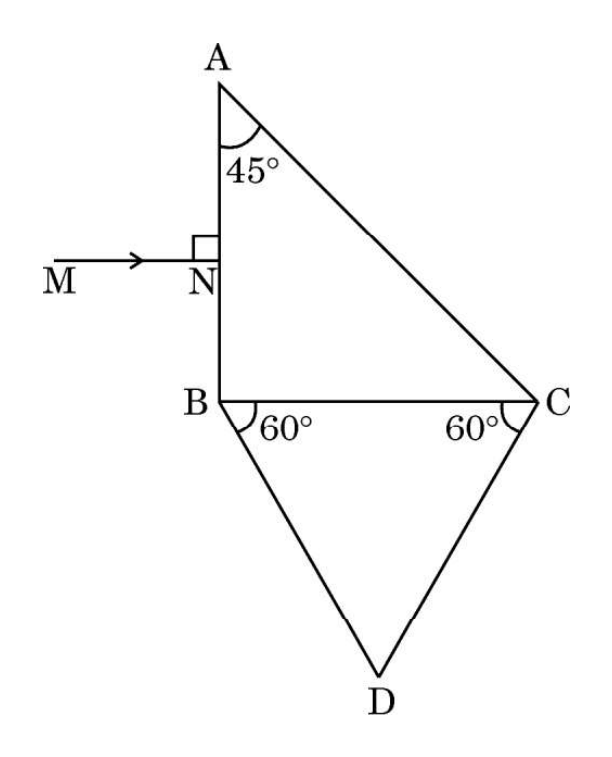 A right angled isosceles glass prism ABC is kept in contact with an equilateral triangular prism DBC as shown in the figure. Both prisms are made of the same glass of refractive index $1.6$. Trace the path of the ray MN incident normally on face AB as it passes through the combination.CBSE 12th Physics 2025 Set 55/6/12 marks · Notebook›56Draw a ray diagram showing the image formation when a concave mirror produces a real, inverted and magnified image of an object and hence obtain the mirror formula.CBSE 12th Physics 2025 Set 55/6/13 marks · Notebook›57(a) (i) Draw a ray diagram to show the image formation by a compound microscope. Obtain the expression for the total magnification of the microscope when the final image is formed at infinity.
(ii) In a compound microscope, an object is placed at a distance of $1.5 \mathrm{~cm}$ from the objective of focal length $1.25 \mathrm{~cm}$. The eyepiece has a focal length of $5 \mathrm{~cm}$. The final image is formed at infinity. Calculate the distance between the objective and the eyepiece.
OR
(b) (i) Using Huygens' principle, explain the refraction of a plane wavefront, propagating in air, at a plane interface between air and glass. Hence verify Snell's law.
(ii) Use mirror formula to deduce that a convex mirror always produces a virtual image of an object kept in front of it.CBSE 12th Physics 2025 Set 55/6/15 marks · Notebook›58
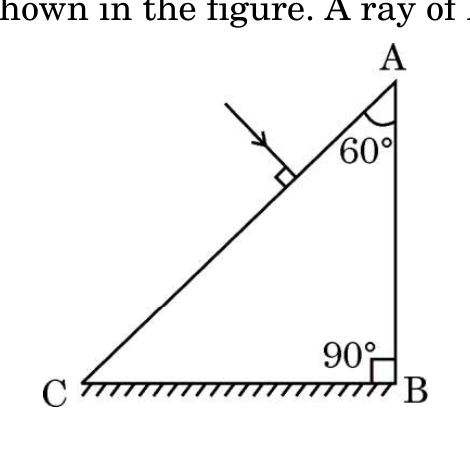 A right-angled prism ABC (refractive index $\sqrt{2}$) is kept on a plane mirror as shown in the figure. A ray of light is incident normally on the face AC.
(a) Trace the path of the ray as it passes through the prism.
(b) Find the angle of deviation produced by the prism.CBSE 12th Physics 2025 Set 55/5/33 marks · Notebook›59A compound microscope has an objective and an eyepiece of focal lengths $f_o$ and $f_e$, respectively. To obtain a large magnification of a small object, the microscope should have :CBSE 12th Physics 2025 Set 55/5/1MCQ›60(a) A point object is placed in air at a distance $R / 3$ in front of a convex surface of radius of curvature $R$, separating air from a medium of refractive index $n(<4)$. Find the nature and position of the image formed.
OR
(b) In Young’s double slit experimental set-up, the intensity of the central maximum is $I_0$. Calculate the intensity at a point where the path difference between two interfering waves is $\lambda / 3$.CBSE 12th Physics 2025 Set 55/5/12 marks · Notebook›61
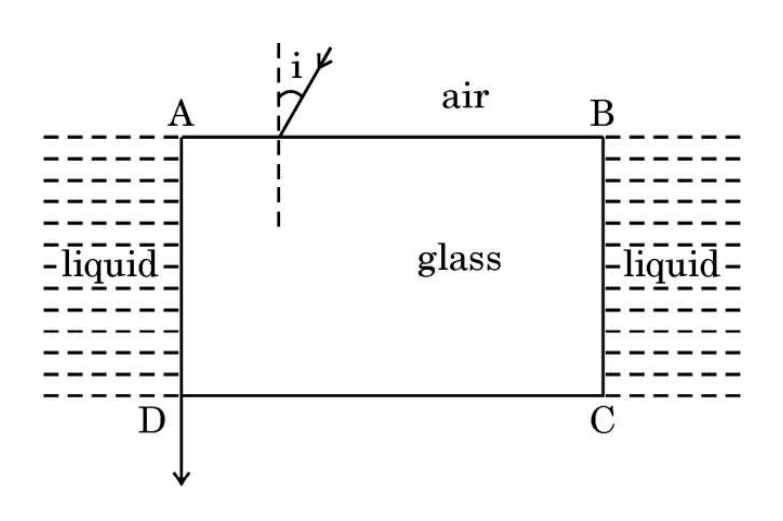 A rectangular glass slab ABCD (refractive index 1.5) is surrounded by a transparent liquid (refractive index 1.25) as shown in the figure. A ray of light is incident on face AB at an angle $i$ such that it is refracted out grazing the face AD. Find the value of angle $i$.CBSE 12th Physics 2025 Set 55/5/13 marks · Notebook›62(a) (i) Draw a ray diagram of a reflecting telescope (Cassegrain) and explain the formation of image. State two important advantages that a reflecting telescope has over a refracting telescope.
(ii) In a refracting telescope, the focal length of the objective is 50 times the focal length of the eyepiece. When the final image is formed at infinity, the length of the tube is $102 \mathrm{~cm}$. Find the focal lengths of the two lenses.
OR
(b) (i) Write any two advantages of a compound microscope over a simple microscope. Draw a ray diagram for the image formation at the near point by a compound microscope and explain it.
(ii) A thin planoconcave lens with its curved face of radius of curvature $R$ is made of glass of refractive index $n_1$. It is placed coaxially in contact with a thin equiconvex lens of same radius of curvature of refractive index $n_2$. Obtain the power of the combination lens.CBSE 12th Physics 2025 Set 55/5/15 marks · Notebook›63The two surfaces of a biconvex lens are of radius of curvature ‘$R$’ each. Obtain the condition under which its focal length ‘$f$’ be equal to ‘$R$’. If one of the two surfaces of this lens is made plane, what will be the new focal length of the lens ?CBSE 12th Physics 2025 Set 55/4/32 marks · Notebook›64Find the focal length of plano-convex lens of refractive index 1.5 and radius of curvature $10 \mathrm{~cm}$ when it is immersed in a liquid of refractive index 1.25.CBSE 12th Physics 2025 Set 55/4/22 marks · Notebook›65The magnification produced by a spherical mirror is $-2.0$. The mirror used and the nature of the image formed will beCBSE 12th Physics 2025 Set 55/4/1MCQ›66An equiconvex lens is made of glass of refractive index 1.55. If the focal length of the lens is $15.0 \mathrm{~cm}$, calculate the radius of curvature of its surfaces.CBSE 12th Physics 2025 Set 55/4/12 marks · Notebook›67(a) (i) An object is placed $30 \mathrm{~cm}$ from a thin convex lens of focal length $10 \mathrm{~cm}$. The lens forms a sharp image on a screen. If a thin concave lens is placed in contact with the convex lens, the sharp image on the screen is formed when the screen is moved by $45 \mathrm{~cm}$ from its initial position. Calculate the focal length of the concave lens.
(ii) Calculate the angle of minimum deviation of an equilateral prism. The refractive index of the prism is $\sqrt{3}$. Calculate the angle of incidence for this case of minimum deviation also.
OR
(b) (i) A physics teacher wants to demonstrate interference with the help of double slit experiment using a laser beam of $633 \mathrm{~nm}$ wavelength. Since the hall is large enough, interference pattern is formed on the wall $5.0 \mathrm{~m}$ from the slits. For clear and comfortable view by all the students they want the fringe width $5 \mathrm{~mm}$.
(I) Find the slit separation for obtaining the desired interference pattern.
(II) How far will the first minimum be from the central maximum ?
(ii) A parallel beam of light of wavelength $650 \mathrm{~nm}$ passes through a slit of width $0.6 \mathrm{~mm}$. The diffraction pattern is obtained on a screen kept $60 \mathrm{~cm}$ away from the slit. Find the distance between first order minima on both sides of the central maximum.CBSE 12th Physics 2025 Set 55/4/15 marks · Notebook›68A glass slab ($\mu=1.5$) of thickness $6 \mathrm{~cm}$ is placed over a paper. The shift in the letters printed on the paper will be :CBSE 12th Physics 2025 Set 55/5/2MCQ›69
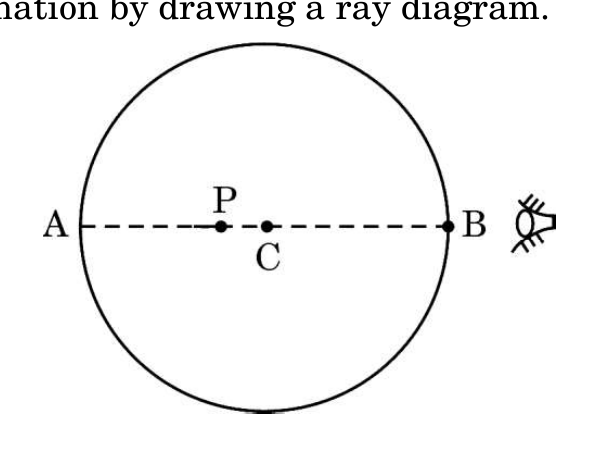 An air bubble is trapped at point P (CP = $1.75 \mathrm{~cm}$) in a spherical glass ball ($n=1.5$) of radius $7 \mathrm{~cm}$ as shown in the figure. Find the nature and position of the image when viewed from side B. Show the image formation by drawing a ray diagram.CBSE 12th Physics 2025 Set 55/5/23 marks · Notebook›70The speed of light in two media ‘1’ and ‘2’ are $v_1$ and $v_2\ (> v_1)$ respectively. For a ray of light to undergo total internal reflection at the interface of these two media, it must be incident fromCBSE 12th Physics 2025 Set 55/1/2MCQ›71A spherical convex surface of radius of curvature $R$ separates glass (refractive index 1.5) from air. Light from a point source placed in air at distance $R / 2$ from the surface falls on it. Find the position and nature of the image formed.CBSE 12th Physics 2025 Set 55/1/22 marks · Notebook›72The plane face of a planoconvex lens is silvered. The refractive index of material and radius of curvature of the curved surface of the lens are $n$ and $R$ respectively. This lens will behave as a concave mirror of focal lengthCBSE 12th Physics 2025 Set 55/2/3MCQ›73A light beam converges at a point O. In the path of this beam, a concave lens of focal length $15 \mathrm{~cm}$ is placed at a distance of $10 \mathrm{~cm}$ before point O. The beam now converges at a point O'. Find the magnitude and the direction of shift OO'.CBSE 12th Physics 2025 Set 55/2/32 marks · Notebook›74Assertion (A) : The image of an object placed between $f$ and $2 f$ from a convex lens can be seen on a screen. If the screen is removed, image is not formed.
Reason (R) : Rays from a given point on the object placed between $f$ and $2 f$, after passing through a convex lens, do not converge on a point in space.CBSE 12th Physics 2025 Compartment Set 55/S/1MCQ›75(a) A plano-convex lens of refractive index $\mu_1$ is placed coaxially in contact with a biconcave lens of refractive index $\mu_2$ as shown in the figure. All curved faces are of radius of curvature $R$ each. Obtain the expression for the focal length of the combined lens.
OR
(b) A convex lens is kept coaxially on the left side of a concave mirror at a distance of $5 f$ from it where $f$ is focal length of each of them. An object is kept at a distance of $2 f$ on the left side of the convex lens. Draw the ray diagram showing the formation of the image by the combination. Find the distance of the final image from the mirror.CBSE 12th Physics 2025 Compartment Set 55/S/12 marks · Notebook›76A compound microscope is an optical instrument used for observing highly magnified images of tiny objects. It consists of two convex lenses. The lens near the object is called the objective and the lens near the eye is called the eyepiece. The magnifying power of a compound microscope is given by $m=m_o m_e$, where $m_o$ is the magnification produced by objective lens and $m_e$ is the magnification produced by eyepiece. The expression for $m_e$ depends on whether the final image is formed at the near point or at infinity (normal adjustment).
(i) (a) A compound microscope consists of an objective lens of focal length $f_o=2.0 \mathrm{~cm}$ and an eyepiece of focal length $f_e=6.25 \mathrm{~cm}$ separated by a distance of $15 \mathrm{~cm}$. How far should an object be placed from the objective so that the final image is formed at infinity ?
(A) $3.45 \mathrm{~cm}$
(B) $5 \mathrm{~cm}$
(C) $1.29 \mathrm{~cm}$
(D) $2.59 \mathrm{~cm}$
OR
(b) A person with normal near point $25 \mathrm{~cm}$, using a compound microscope with an objective of focal length $0.8 \mathrm{~cm}$ and eyepiece of focal length $2.5 \mathrm{~cm}$ can bring an object placed at $0.9 \mathrm{~cm}$ from the objective in sharp focus. If the image formed by the objective is at a distance of $2.27 \mathrm{~cm}$ from the eyepiece, the separation between the lenses is :
(A) $7.47 \mathrm{~cm}$
(B) $8.47 \mathrm{~cm}$
(C) $9.47 \mathrm{~cm}$
(D) $10.47 \mathrm{~cm}$
(ii) A compound microscope consists of an objective of focal length $2 \mathrm{~cm}$ and an eyepiece of focal length $10 \mathrm{~cm}$. The eyepiece is kept $20 \mathrm{~cm}$ away from the objective. Find the magnifying power of the microscope if the final image is formed at infinity.
(A) $7$
(B) $10$
(C) $14$
(D) $16$
(iii) The intermediate image formed in a compound microscope is :
(A) real, inverted and magnified
(B) real, erect and magnified
(C) virtual, erect and magnified
(D) virtual, inverted and magnified
(iv) The focal lengths of the objective and the eyepiece of a compound microscope are $f_o$ and $f_e$ respectively. Which of the following statements is correct, in normal adjustment ?
(A) The object is at a distance less than $f_o$ from the objective.
(B) The object is at a distance more than $f_o$ and less than $2 f_o$ from the objective.
(C) The intermediate image is formed at a distance slightly more than $f_e$ from the eyepiece.
(D) The intermediate image is formed at $2 f_e$ from the eyepiece.CBSE 12th Physics 2025 Compartment Set 55/S/14 marks · Notebook›77(a) A ray of light is incident on one face of a triangular glass prism of refractive index $n$ and is refracted out from the opposite face. Deduce the expression for refractive index of glass prism in terms of the angle of minimum deviation and angle of the prism. Write the condition on $n$ for refraction to take place on the opposite face.
OR
(b) State Huygens principle. Using it, draw a diagram and discuss the case of refraction of plane wave of light from a rarer medium to a denser medium at their plane interface. Hence derive Snell's law.CBSE 12th Physics 2025 Compartment Set 55/S/15 marks · Notebook›78A ray of light is incident on face $AB$ of a prism $ABC$ with angle of prism $A$ and emerges out from face $AC$. The prism is set in the position of minimum deviation with angle of deviation $\delta$. Find (i) the angle of incidence and (ii) the angle of refraction on face $AB$.CBSE 12th Physics 2025 Set 55/6/22 marks · Notebook›79A ray of light is incident at an angle $i$ on a parallel sided glass slab of thickness 'd' and gets refracted into the slab at angle $r$. Draw a ray diagram to show its path as its emerges out of the slab. Hence, obtain an expression for the lateral shift of the ray. Under what condition will the shift be minimum ?CBSE 12th Physics 2025 Set 55/6/23 marks · Notebook›80The focal length of a concave mirror in air is $f$. When the mirror is immersed in a liquid of refractive index $\frac{5}{3}$, its focal length will becomeCBSE 12th Physics 2025 Set 55/2/2MCQ›81Two convex lenses A and B, each of focal length $10.0 \mathrm{~cm}$, are mounted on an optical bench at $50.0 \mathrm{~cm}$ and $70.0 \mathrm{~cm}$ respectively. An object is mounted at $20.0 \mathrm{~cm}$. Find the nature and position of the final image formed by the combination.CBSE 12th Physics 2025 Set 55/2/22 marks · Notebook›82A tank is filled with a liquid of refractive index $\sqrt{2}$, up to a height of $30 \mathrm{~cm}$. A tiny bulb is glowing at the bottom of the tank. Calculate the diameter of an opaque disc floating symmetrically on the liquid surface that can cut off completely the light from the bulb that comes out of the liquid surface.CBSE 12th Physics 2025 Set 55/6/32 marks · Notebook›83(a) A concave mirror has radius of curvature $20 \mathrm{~cm}$. Calculate the distance of an object from the mirror so as to form an image of magnification $-2$. Also find the location of the image.
(b) If the silver coating around the centre of a concave mirror is removed, will the mirror still form the image of an object ? Justify your answer.CBSE 12th Physics 2025 Set 55/6/33 marks · Notebook›84A point source is placed at the bottom of a tank containing a transparent liquid (refractive index $n$) to a depth $H$. The area of the surface of the liquid through which light from the source can emerge out isCBSE 12th Physics 2025 Set 55/1/3MCQ›85A double convex lens of glass has both faces of the same radius of curvature $17 \mathrm{~cm}$. Find its focal length if it is immersed in water. The refractive indices of glass and water are $1.5$ and $1.33$ respectively.CBSE 12th Physics 2025 Set 55/1/32 marks · Notebook›86Assertion (A) : A ray of light is incident normally on the face of a prism. The emergent ray will graze along the opposite face of the prism when the critical angle at glass-air interface is equal to the angle of the prism.
Reason (R) : The refractive index of a prism depends on angle of the prism.CBSE 12th Physics 2025 Set 55/7/1MCQ›87(a) Using the mirror equation and the formula of magnification, deduce that “the virtual image produced by a convex mirror is always diminished in size and is located between the pole and the focus.”
OR
(b) A convex lens of focal length $10 \mathrm{~cm}$, a concave lens of focal length $15 \mathrm{~cm}$ and a third lens of unknown focal length are placed coaxially in contact. If the focal length of the combination is $+12 \mathrm{~cm}$, find the nature and focal length of the third lens, if all lenses are thin. Will the answer change if the lenses were thick ?CBSE 12th Physics 2025 Set 55/7/12 marks · Notebook›88When light travels from an optically denser medium to an optically rarer medium, at the interface it is partly reflected back into the same medium and partly refracted to the second medium. The angle of incidence corresponding to an angle of refraction $90^{\circ}$ is called the critical angle $\left(i_c\right)$ for the given pair of media. This angle is related to the refractive index of medium 1 with respect to medium 2.
Refraction of light through a prism involves refraction at two plane interfaces. A relation for the refractive index of the material of the prism can be obtained in terms of the refracting angle of the prism and the angle of minimum deviation. For a thin prism, this relation reduces to a simple equation.
Laws of refraction are also valid for refraction of light at a spherical interface. When an object is placed in front of a spherical surface separating two media, its image is formed. A relation between object and image distance, in terms of refractive indices of two media and the radius of curvature of the spherical surface can be obtained. Using this relation for two surfaces of a lens, ‘lens maker formula’ is obtained.
(i) A small bulb is placed at the bottom of a tank containing a transparent liquid (refractive index $n$) to a depth $H$. The radius of the circular area of the surface of liquid, through which light from the bulb can emerge out, is $R$. Then $\left(\frac{R}{H}\right)$ is :
(A) $\frac{1}{\sqrt{n^2-1}}$
(B) $\sqrt{n^2-1}$
(C) $\frac{1}{\sqrt{n^2+1}}$
(D) $\sqrt{n^2+1}$
(ii) (a) A parallel beam of light is incident on a face of a prism with refracting angle $60^{\circ}$. The angle of minimum deviation is found to be $30^{\circ}$. The refractive index of the material of the prism is close to :
(A) $1.3$
(B) $1.4$
(C) $1.5$
(D) $1.6$
OR
(b) The angle of minimum deviation for a ray of light incident on a thin prism, made of crown glass $(n=1.52)$ is $D_m$. If the prism was made of dense flint glass $(n=1.62)$ instead of crown glass, the angle of minimum deviation will :
(A) decrease by $4 \%$
(B) increase by $4 \%$
(C) decrease by $19 \%$
(D) increase by $19 \%$
(iii) An object is placed in front of a convex spherical glass surface ($n=1.5$ and radius of curvature $R$) at a distance of $4 R$ from it. As the object is moved slowly close to the surface, the image formed is :
(A) always real
(B) always virtual
(C) first real and then virtual
(D) first virtual and then real
(iv) A double-convex lens, made of glass of refractive index $1.5$, has focal length $10 \mathrm{~cm}$. The radius of curvature of its each face, is :
(A) $10 \mathrm{~cm}$
(B) $15 \mathrm{~cm}$
(C) $20 \mathrm{~cm}$
(D) $40 \mathrm{~cm}$CBSE 12th Physics 2025 Set 55/7/14 marks · Notebook›89(a) (i) Explain with the help of a labelled ray diagram the formation of final image by an astronomical telescope at infinity. Write the expression for its magnifying power.
(ii) The total magnification produced by a compound microscope is 20. The magnification produced by the eyepiece is 5. When the microscope is focussed on a certain object, the distance between the objective and eyepiece is observed to be $14 \mathrm{~cm}$. Calculate the focal lengths of the objective and the eyepiece. (Given that the least distance of distinct vision $=25 \mathrm{~cm}$)
OR
(b) (i) Two coherent light waves, each of intensity $I_0$ superpose each other and produce interference pattern on a screen. Obtain the expression for the resultant intensity at a point where the phase difference between the waves is $\phi$. Write its maximum and minimum possible values.
(ii) In a single slit diffraction experiment, the aperture of the slit is $3 \mathrm{~mm}$ and the separation between the slit and the screen is $1.5 \mathrm{~m}$. A monochromatic light of wavelength $600 \mathrm{~nm}$ is normally incident on the slit. Calculate the distance of (I) first order minimum, and (II) second order maximum, from the centre of the screen.CBSE 12th Physics 2025 Set 55/7/15 marks · Notebook›
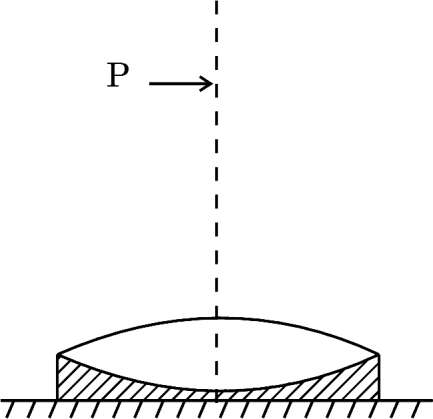 (a) Draw the shape of intensity distribution curve of the fringes due to diffraction at a single slit.
(b) Derive the relation for the power of combination of two lenses placed in contact co-axially.CBSE 12th Physics 2024 Compartment Set 55/S/33 marks · Notebook›94A ray of light is incident normally on one face of an equilateral glass prism of refractive index $\mu$. When the prism is completely immersed in a transparent medium, it is observed that the emergent ray just grazes the adjacent face. Find the refractive index of the medium.CBSE 12th Physics 2024 Set 55/4/12 marks · Notebook›95(a) An air bubble is trapped at point B $(\mathrm{CB}=20 \mathrm{~cm})$ in a glass sphere of radius $40 \mathrm{~cm}$ and refractive index $1.5$ as shown in figure. Find the nature and position of the image of the bubble as seen by an observer at point P.
OR
(b) In normal adjustment, for a refracting telescope, the distance between objective and eye piece lens is $1.00 \mathrm{~m}$. If the magnifying power of the telescope is 19, find the focal length of the objective and the eyepiece lens.CBSE 12th Physics 2024 Set 55/4/12 marks · Notebook›96A lens is a transparent optical medium bounded by two surfaces; at least one of which should be spherical. Applying the formula of image formation by a single spherical surface successively at the two surfaces of a thin lens, a formula known as lens maker’s formula and hence the basic lens formula can be obtained. The focal length (or power) of a lens depends on the radii of its surfaces and the refractive index of its material with respect to the surrounding medium. The refractive index of a material depends on the wavelength of light used. Combination of lenses helps us to obtain diverging or converging lenses of desired power and magnification.
(i) A thin converging lens of focal length $20 \mathrm{~cm}$ and a thin diverging lens of focal length $15 \mathrm{~cm}$ are placed coaxially in contact. The power of the combination is
(A) $\frac{-5}{6} \mathrm{D}$
(B) $\frac{-5}{3} \mathrm{D}$
(C) $\frac{4}{3} \mathrm{D}$
(D) $\frac{3}{2} \mathrm{D}$
(ii) The radii of curvature of two surfaces of a convex lens are $R$ and $2 R$. If the focal length of this lens is $\left(\frac{4}{3}\right) R$, the refractive index of the material of the lens is :
(A) $\frac{5}{3}$
(B) $\frac{4}{3}$
(C) $\frac{3}{2}$
(D) $\frac{7}{5}$
(iii) The focal length of an equiconvex lens
(A) increases when the lens is dipped in water.
(B) increases when the wavelength of incident light decreases.
(C) increases with decrease in radius of curvature of its surface.
(D) decreases when the lens is cut into two identical parts along its principal axis.
(iv) (a) A thin convex lens L of focal length $10 \mathrm{~cm}$ and a concave mirror M of focal length $15 \mathrm{~cm}$ are placed coaxially $40 \mathrm{~cm}$ apart as shown in figure. A beam of light coming parallel to the principal axis is incident on the lens. The final image will be formed at a distance of
(A) $10 \mathrm{~cm}$, left of lens
(B) $10 \mathrm{~cm}$, right of lens
(C) $20 \mathrm{~cm}$, left of lens
(D) $20 \mathrm{~cm}$, right of lens
OR
(b) A beam of light coming parallel to the principal axis of a convex lens $L_1$ of focal length $16 \mathrm{~cm}$ is incident on it. Another convex lens $L_2$ of focal length $12 \mathrm{~cm}$ is placed coaxially at a distance $40 \mathrm{~cm}$ from $L_1$. The nature and distance of the final image from $L_2$ will be
(A) real, $24 \mathrm{~cm}$
(B) virtual, $12 \mathrm{~cm}$
(C) real, $32 \mathrm{~cm}$
(D) virtual, $18 \mathrm{~cm}$CBSE 12th Physics 2024 Set 55/4/14 marks · Notebook›97(a) (i) Draw a ray diagram for the formation of the image of an object by a convex mirror. Hence, obtain the mirror equation.
(ii) Why are multi-component lenses used for both the objective and the eyepiece in optical instruments ?
(iii) The magnification of a small object produced by a compound microscope is 200. The focal length of the eyepiece is $2 \mathrm{~cm}$ and the final image is formed at infinity. Find the magnification produced by the objective.
OR
(b) (i) Differentiate between a wavefront and a ray.
(ii) State Huygen’s principle and verify laws of reflection using suitable diagram.
(iii) In Young’s double slit experiment, the slits $S_1$ and $S_2$ are $3 \mathrm{~mm}$ apart and the screen is placed $1.0 \mathrm{~m}$ away from the slits. It is observed that the fourth bright fringe is at a distance of $5 \mathrm{~mm}$ from the second dark fringe. Find the wavelength of light used.CBSE 12th Physics 2024 Set 55/4/15 marks · Notebook›98Assertion (A) : The magnifying power of a compound microscope is negative.
Reason (R) : The final image formed is erect with respect to the object.CBSE 12th Physics 2024 Set 55/2/1MCQ›99A convex lens $(n=1.52)$ has a focal length of $15.0 \mathrm{~cm}$ in air. Find its focal length when it is immersed in liquid of refractive index $1.65$. What will be the nature of the lens ?CBSE 12th Physics 2024 Set 55/2/12 marks · Notebook›100
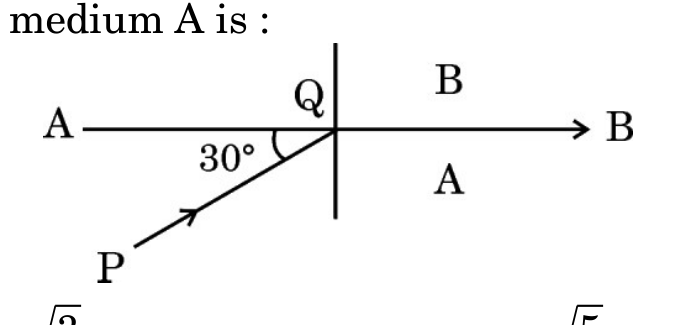 When a ray of light propagates from a denser medium to a rarer medium, it bends away from the normal. When the incident angle is increased, the refracted ray deviates more from the normal. For a particular angle of incidence in the denser medium, the refracted ray just grazes the interface of the two surfaces. This angle of incidence is called the critical angle for the pair of media involved.
(i) For a ray incident at the critical angle, the angle of reflection is :
(A) $0^{\circ}$
(B) $< 90^{\circ}$
(C) $>90^{\circ}$
(D) $90^{\circ}$
(ii) A ray of light of wavelength $600 \mathrm{~nm}$ is incident in water $\left(n=\frac{4}{3}\right)$ on the water-air interface at an angle less than the critical angle. The wavelength associated with the refracted ray is :
(A) $400 \mathrm{~nm}$
(B) $450 \mathrm{~nm}$
(C) $600 \mathrm{~nm}$
(D) $800 \mathrm{~nm}$
(iii) (a) The interface AB between the two media A and B is shown in the figure. In the denser medium A, the incident ray PQ makes an angle of $30^{\circ}$ with the horizontal. The refracted ray is parallel to the interface. The refractive index of medium B w.r.t. medium A is :
(A) $\frac{\sqrt{3}}{2}$
(B) $\frac{\sqrt{5}}{2}$
(C) $\frac{4}{\sqrt{3}}$
(D) $\frac{2}{\sqrt{3}}$
OR
(b) Two media A and B are separated by a plane boundary. The speed of light in medium A and B is $2 \times 10^8 \mathrm{~ms}^{-1}$ and $2.5 \times 10^8 \mathrm{~ms}^{-1}$ respectively. The critical angle for a ray of light going from medium A to medium B is :
(A) $\sin ^{-1} \frac{1}{2}$
(B) $\sin ^{-1} \frac{4}{5}$
(C) $\sin ^{-1} \frac{3}{5}$
(D) $\sin ^{-1} \frac{2}{5}$
(iv) The figure shows the path of a light ray through a triangular prism. In this phenomenon, the angle $\theta$ is given by :
(A) $\sin ^{-1} \sqrt{n^2-1}$
(B) $\sin ^{-1}\left(n^2-1\right)$
(C) $\sin ^{-1}\left[\frac{1}{\sqrt{n^2-1}}\right]$
(D) $\sin ^{-1}\left[\frac{1}{\left(n^2-1\right)}\right]$CBSE 12th Physics 2024 Set 55/2/14 marks · Notebook›101Assertion (A) : Plane and convex mirrors cannot produce real images under any circumstance.
Reason (R) : A virtual image cannot serve as an object to produce a real image.CBSE 12th Physics 2024 Set 55/1/1MCQ›102(a) Monochromatic light of frequency $5.0 \times 10^{14} \mathrm{~Hz}$ passes from air into a medium of refractive index $1.5$. Find the wavelength of the light (i) reflected, and (ii) refracted at the interface of the two media.
OR
(b) A plano-convex lens of focal length $16 \mathrm{~cm}$ is made of a material of refractive index $1.4$. Calculate the radius of the curved surface of the lens.CBSE 12th Physics 2024 Set 55/1/12 marks · Notebook›103An object is placed $30 \mathrm{~cm}$ in front of a concave mirror of radius of curvature $40 \mathrm{~cm}$. Find the (i) position of the image formed and (ii) magnification of the image.CBSE 12th Physics 2024 Set 55/1/12 marks · Notebook›104
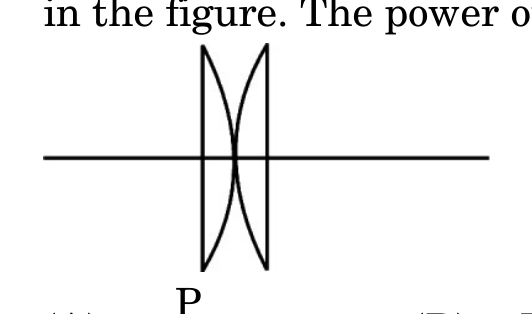 A lens is a transparent medium bounded by two surfaces, with one or both surfaces being spherical. The focal length of a lens is determined by the radii of curvature of its two surfaces and the refractive index of its medium with respect to that of the surrounding medium. The power of a lens is reciprocal of its focal length. If a number of lenses are kept in contact, the power of the combination is the algebraic sum of the powers of the individual lenses.
(i) A double-convex lens, with each face having same radius of curvature $R$, is made of glass of refractive index $n$. Its power is :
(A) $\frac{2(n-1)}{R}$
(B) $\frac{(2 n-1)}{R}$
(C) $\frac{(n-1)}{2 R}$
(D) $\frac{(2 n-1)}{2 R}$
(ii) A double-convex lens of power $P$, with each face having same radius of curvature, is cut into two equal parts perpendicular to its principal axis. The power of one part of the lens will be :
(A) $2 P$
(B) $P$
(C) $4 P$
(D) $\frac{P}{2}$
(iii) The above two parts are kept in contact with each other as shown in the figure. The power of the combination will be :
(A) $\frac{P}{2}$
(B) $P$
(C) $2 P$
(D) $\frac{P}{4}$
(iv) (a) A double-convex lens of power $P$, with each face having same radius of curvature, is cut along its principal axis. The two parts are arranged as shown in the figure. The power of the combination will be :
(A) Zero
(B) $P$
(C) $2 P$
(D) $\frac{P}{2}$
OR
(b) Two convex lenses of focal lengths $60 \mathrm{~cm}$ and $20 \mathrm{~cm}$ are held coaxially in contact with each other. The power of the combination is :
(A) $6.6 \mathrm{~D}$
(B) $15 \mathrm{~D}$
(C) $\frac{1}{15} \mathrm{~D}$
(D) $\frac{1}{80} \mathrm{~D}$CBSE 12th Physics 2024 Set 55/1/14 marks · Notebook›105
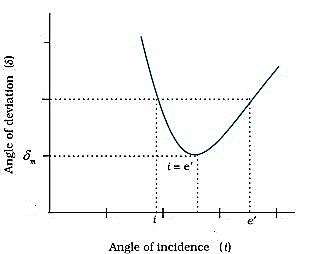 (a) (i) A ray of light passes through a triangular prism. Show graphically, how the angle of deviation varies with the angle of incidence ? Hence define the angle of minimum deviation.
(ii) A ray of light is incident normally on a refracting face of a prism of prism angle $A$ and suffers a deviation of angle $\delta$. Prove that the refractive index $n$ of the material of the prism is given by $n=\frac{\sin (A+\delta)}{\sin A}$.
(iii) The refractive index of the material of a prism is $\sqrt{2}$. If the refracting angle of the prism is $60^{\circ}$, find the
(1) Angle of minimum deviation, and
(2) Angle of incidence.
OR
(b) (i) State Huygens’ principle. A plane wave is incident at an angle $i$ on a reflecting surface. Construct the corresponding reflected wavefront. Using this diagram, prove that the angle of reflection is equal to the angle of incidence.
(ii) What are the coherent sources of light ? Can two independent sodium lamps act like coherent sources ? Explain.
(iii) A beam of light consisting of a known wavelength $520 \mathrm{~nm}$ and an unknown wavelength $\lambda$, used in Young’s double slit experiment produces two interference patterns such that the fourth bright fringe of unknown wavelength coincides with the fifth bright fringe of known wavelength. Find the value of $\lambda$.CBSE 12th Physics 2024 Set 55/1/15 marks · Notebook›106Assertion (A) : A convex lens, when immersed in a liquid, disappears.
Reason (R) : The refractive indices of material of the lens and the liquid are equal.CBSE 12th Physics 2024 Set 55/3/1MCQ›107The magnifying power of an astronomical telescope is 24. In normal adjustment, distance between its two lenses is $150 \mathrm{~cm}$. Find the focal length of the objective lens.CBSE 12th Physics 2024 Set 55/3/12 marks · Notebook›108Explain the following :
(a) For a simple microscope, the angular size of the object equals the angular size of the image. Yet it offers magnification.
(b) Both plane and convex mirrors produce virtual images of objects. Can they produce real images under some circumstances ?CBSE 12th Physics 2024 Set 55/3/12 marks · Notebook›109
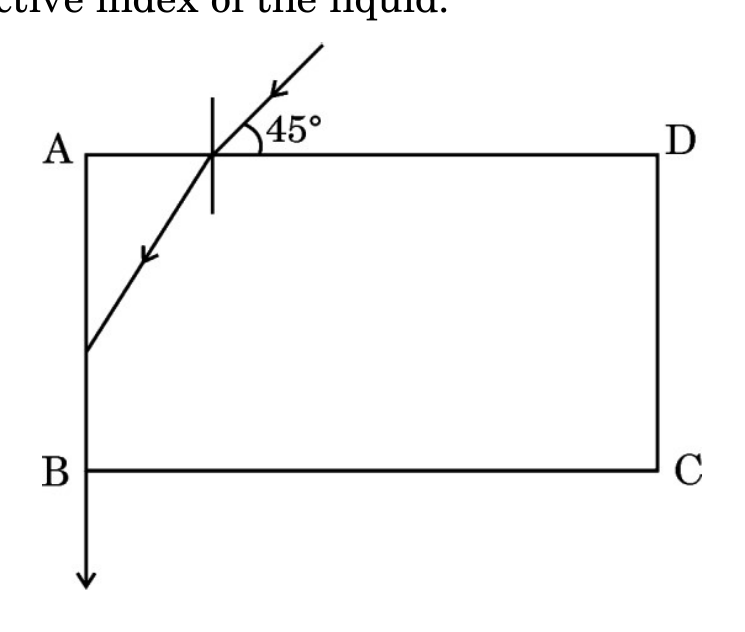 (a) (i) Trace the path of a ray of light showing refraction through a triangular prism and hence obtain an expression for angle of deviation $(\delta)$ in terms of A, i and e, where symbols have their usual meanings. Draw a graph showing the variation of angle of deviation with the angle of incidence.
(ii) In the figure, a ray of light is incident on a transparent liquid contained in a thin glass box at an angle of $45^{\circ}$ with its one face. The emergent ray passes along the face AB. Find the refractive index of the liquid.
OR
(b) (i) The displacement of two light waves, each of amplitude ‘$a$’ and frequency $\omega$, emanating from two coherent sources of light, are given by $y_1=a \cos \omega t$ and $y_2=a \cos (\omega t+\phi)$. $\phi$ is the phase difference between the two waves. These light waves superpose at a point. Obtain the expression for the resultant intensity at that point.
(ii) In Young’s double slit experiment, find the ratio of intensities at two points on a screen when waves emanating from two slits reaching these points have path differences (i) $\frac{\lambda}{6}$ and (ii) $\frac{\lambda}{12}$.CBSE 12th Physics 2024 Set 55/3/15 marks · Notebook›110The radius of curvature of a convex mirror is $30 \mathrm{~cm}$. It forms an image of an object which is half the size of the object. Find the separation between the object and the image.CBSE 12th Physics 2024 Set 55/5/22 marks · Notebook›111A point object is placed in air at a distance of $4 R$ on the principal axis of a convex spherical surface of radius of curvature $R$ separating two mediums, air and glass. As the object is moved towards the surface, the image formed is :CBSE 12th Physics 2024 Compartment Set 55/S/1MCQ›112Assertion (A) : Although the surfaces of a goggle lens are curved, it does not have any power.
Reason (R) : In case of goggles, both the curved surfaces are curved on the same side and have equal radii of curvature.CBSE 12th Physics 2024 Compartment Set 55/S/1MCQ›113A point light source rests on the bottom of a bucket filled with a liquid of refractive index $\mu=1.25$ up to height of $10 \mathrm{~cm}$. Calculate :
(a) the critical angle for liquid-air interface
(b) radius of circular light patch formed on the surface by light emerging from the source.CBSE 12th Physics 2024 Compartment Set 55/S/12 marks · Notebook›114(a) (i) What are the two main considerations for designing the objective and eyepiece lenses of an astronomical telescope ? Obtain the expression for magnifying power of the telescope when the final image is formed at infinity.
(ii) A ray of light is incident at an angle of $45^{\circ}$ at one face of an equilateral triangular prism and passes symmetrically through the prism. Calculate :
(1) the angle of deviation produced by the prism
(2) the refractive index of the material of the prism
OR
(b) (i) Describe a simple activity to observe diffraction pattern due to a single slit.
(ii) The figure below shows an equiconvex lens (of refractive index 1.50) in contact with a liquid layer on top of a plane mirror. A small needle with its tip on the principal axis is moved along the axis until its inverted image is found at the position of the needle. The distance of the needle from the lens is measured to be $45.0 \mathrm{~cm}$. When the liquid is removed and the experiment is repeated, the new distance is $30.0 \mathrm{~cm}$. Find the refractive index of the liquid.CBSE 12th Physics 2024 Compartment Set 55/S/15 marks · Notebook›115A point object is kept $60 \mathrm{~cm}$ in front of a spherical convex surface ($n=1.5$, radius of curvature $40 \mathrm{~cm}$). The image formed isCBSE 12th Physics 2024 Set 55/5/3MCQ›116A thin converging lens of focal length $10 \mathrm{~cm}$ is placed coaxially in contact with a thin diverging lens of focal length $15 \mathrm{~cm}$. How will the combination behave ? Justify your answer.CBSE 12th Physics 2024 Set 55/5/32 marks · Notebook›
 Define critical angle for a given pair of media and total internal reflection. Obtain the relation between the critical angle and refractive index of the medium.CBSE 12th Physics Outside Delhi Set 1 - 20233 marks · Notebook›122The minimum distance between an object and its real image formed by a convex lens of focal length $f$ is :CBSE 12th Physics 2023 Set 55/1/2MCQ›123A double-convex lens of power $4 \mathrm{D}$ is manufactured from a glass of refractive index $1.5$. What is the radius of curvature of each face of this lens if both faces have the same radius of curvature ?CBSE 12th Physics 2023 Set 55/1/22 marks · Notebook›124Which of the following pairs of media has the least value of critical angle ?CBSE 12th Physics 2023 Set 55/1/3MCQ›125The radii of curvature of the faces of a double-convex lens are $20 \mathrm{~cm}$ and $30 \mathrm{~cm}$. Its power is $\frac{25}{6} \mathrm{D}$. What is the refractive index of the glass of the lens ?CBSE 12th Physics 2023 Set 55/1/32 marks · Notebook›126A ray of light of wavelength $600 \mathrm{~nm}$ propagates from air into a medium. If its wavelength in the medium becomes $400 \mathrm{~nm}$, the refractive index of the medium isCBSE 12th Physics 2023 Set 55/2/2MCQ›127A point object in air is placed symmetrically at a distance of $60 \mathrm{~cm}$ in front of a concave spherical surface of refractive index 1.5. If the radius of curvature of the surface is $20 \mathrm{~cm}$, find the position of the image formed.CBSE 12th Physics 2023 Set 55/2/22 marks · Notebook›128A ray of light is incident on a glass prism of refractive index $\mu$ and refracting angle $A$. If it just suffers total internal reflection at the other face, obtain a relation between the angle of incidence, angle of prism and critical angle.CBSE 12th Physics 2023 Set 55/2/23 marks · Notebook›129A ray of light travels a distance of $12.0 \mathrm{~m}$ in a transparent sheet in $60 \mathrm{~ns}$. The refractive index of the sheet isCBSE 12th Physics 2023 Set 55/2/3MCQ›130The power of a thin lens is $+5 \mathrm{D}$. When it is immersed in a liquid, it behaves like a concave lens of focal length $100 \mathrm{~cm}$. Calculate the refractive index of the liquid. Given refractive index of glass $=1.5$.CBSE 12th Physics 2023 Set 55/2/32 marks · Notebook›131
 A ray of light is refracted by a glass prism. Obtain an expression for the refractive index of the glass in terms of the angle of prism $A$ and the angle of minimum deviation $\delta_m$.CBSE 12th Physics 2023 Set 55/2/33 marks · Notebook›132A small object lies at the bottom of a vessel filled with water (refractive index $4 / 3$) up to a height H. When viewed from a point above the surface of water, the object appears raised by n percent of H. The value of n is :CBSE 12th Physics 2023 Compartment Set 55/C/1MCQ›133A plane wave is incident on a concave mirror of radius of curvature R. The reflected wave is a spherical wave of radius :CBSE 12th Physics 2023 Compartment Set 55/C/1MCQ›134(a) (i) Draw a labelled ray diagram of an astronomical telescope to show the image formation of a distant object by it in normal adjustment. What are the main considerations required in selecting the objective and eyepiece lenses so that the telescope has large magnifying power and high resolution ?
(ii) A biconvex lens of focal length $20 \mathrm{~cm}$ is immersed in water, whose refractive index is $\frac{4}{3}$. Find the change, if any, in the nature and the focal length of the lens. Refractive index of the material of convex lens is $\frac{3}{2}$.
OR
(b) (i) Draw a ray diagram showing refraction of light through a prism of angle A and obtain the relation between $\mu$, A and the angle of minimum deviation $\delta_{\mathrm{m}}$.
(ii) An equiconvex lens of radius of curvature R and made of glass of refractive index $\mu$ is cut into two identical plano-convex lenses. Find the focal length of the plano-convex lenses.CBSE 12th Physics 2023 Compartment Set 55/C/15 marks · Notebook›135A prism is a solid transparent medium bounded by three rectangular faces with a triangular base and a top. A ray of light incident at angle i on one face of a prism suffers two refractions on passing through a prism. Hence it deviates through a certain angle $\delta$ from its original path. The angle of deviation becomes minimum $\left(\delta=\delta_{\mathrm{m}}\right)$ for a certain value of angle i. In such a condition, the refracted ray inside the prism becomes parallel to its base. An expression for refractive index $\mu$ of the material of the prism can be obtained in terms of angle A and angle $\delta_{\mathrm{m}}$.
(a) Show in a figure the variation of angle $\delta$ with angle of incidence i.
(b) Show that for a prism of small angle A, the refractive index $\mu$ of its material can be written as $\mu=1+\frac{\delta_{\mathrm{m}}}{A}$.
(c) A ray of light passes through an equilateral prism such that both the angle of incidence and the angle of emergence are equal to the angle of prism A. Find the refractive index of the material of the prism, in terms of A.
OR
(c) A ray of light passes through a prism of angle $75^{\circ}$, as shown in the figure. The refractive index of the material of the prism, with respect to its surrounding is $\sqrt{2}$. Find the angle of incidence i.CBSE 12th Physics 2023 Compartment Set 55/C/14 marks · Notebook›136A bright point source is placed at the bottom of a tank containing a transparent liquid (refractive index $\mu$) to a height H. Let r be the radius of the circular area of the liquid surface through which light can emerge out. Find the ratio $(\mathrm{r} / \mathrm{H})$.CBSE 12th Physics 2023 Compartment Set 55/C/22 marks · Notebook›137(a) Draw a ray diagram for formation of a real and diminished image of an object kept in front of a concave mirror. Hence derive the mirror equation.
(b) A concave mirror of focal length $10 \mathrm{~cm}$ produces a real image which is 3 times the size of the object. Find the distance of the object from the mirror.
OR
(a) Two converging lenses of focal lengths $\mathrm{f}_1$ and $\mathrm{f}_2$ are placed coaxially in contact. Derive the expression for the focal length of the combination using the ray diagram for the formation of the image of an object by the combination.
(b) The figure shows the variation of image distance v with object distance u for a lens.
(i) What is the nature of the lens ?
(ii) Using the graph, find the focal length of the lens.CBSE 12th Physics 2023 Compartment Set 55/C/25 marks · Notebook›138(a) (i) Draw a ray diagram to show the formation of image by a concave mirror when the object is placed between f and 2f. Using this diagram, derive the mirror equation.
(ii) An object is kept 30 cm in front of a convex mirror of focal length 12 cm. Find the nature and position of the image formed.
OR
(b) (i) Draw a ray diagram showing the image formation by a compound microscope. Hence obtain the expression for total magnification when the image is formed at least distance of distinct vision.
(ii) A compound microscope consists of an objective lens of focal length $2.0 \mathrm{~cm}$ and an eyepiece of focal length $6.0 \mathrm{~cm}$. If they are separated by a distance of $24 \mathrm{~cm}$, find the total magnification when the image is formed at infinity.CBSE 12th Physics 2023 Compartment Set 55/C/35 marks · Notebook›139For a concave mirror of focal length ‘$f$’, the minimum distance between the object and its real image is :CBSE 12th Physics 2023 Set 55/1/1MCQ›140
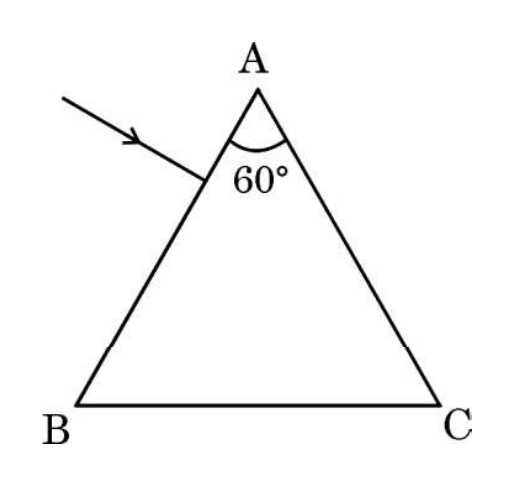 Strontium titanate is a rare oxide — a natural mineral found in Siberia. It is used as a substitute for diamond because its refractive index and critical angle are $2.41$ and $24.5^{\circ}$, respectively, which are approximately equal to the refractive index and critical angle of diamond. It has all the properties of diamond. Even an expert jeweller is unable to differentiate between diamond and strontium titanate. A ray of light is incident normally on one face of an equilateral triangular prism ABC made of strontium titanate.
Answer the following questions based on the above :
(a) Trace the path of the ray showing its passage through the prism.
(b) Find the velocity of light through the prism.
(c) Briefly explain two applications of total internal reflection.
OR
(c) Define total internal reflection of light. Give two conditions for it.CBSE 12th Physics 2023 Set 55/1/14 marks · Notebook›141The refractive indices of two media A and B are 2 and $\sqrt{2}$ respectively. What is the critical angle for their interface ?CBSE 12th Physics 2023 Set 55/3/12 marks · Notebook›142(a) (i) Draw a ray diagram showing the formation of a real image of an object placed at a distance ‘u’ in front of a concave mirror of radius of curvature ‘R’. Hence, obtain the relation for the image distance ‘v’ in terms of u and R.
(ii) A $1.8 \mathrm{~m}$ tall person stands in front of a convex lens of focal length $1 \mathrm{~m}$, at a distance of $5 \mathrm{~m}$. Find the position and height of the image formed.
OR
(b) (i) Draw a ray diagram showing refraction of a ray of light through a triangular glass prism. Hence, obtain the relation for the refractive index $(\mu)$ in terms of angle of prism $(A)$ and angle of minimum deviation $\left(\delta_m\right)$.
(ii) The radii of curvature of the two surfaces of a concave lens are $20 \mathrm{~cm}$ each. Find the refractive index of the material of the lens if its power is $-5.0 \mathrm{~D}$.CBSE 12th Physics 2023 Set 55/3/15 marks · Notebook›143A plane wavefront is incident on a concave mirror of radius of curvature $R$. The radius of the refracted wavefront will be :CBSE 12th Physics 2023 Set 55/4/11 marks · Notebook›144(a) (i) Draw a ray diagram to show how the final image is formed at infinity in an astronomical refracting telescope. Obtain an expression for its magnifying power.
(ii) Two thin lenses $L_1$ and $L_2, L_1$ being a convex lens of focal length $24 \mathrm{~cm}$ and $L_2$ a concave lens of focal length $18 \mathrm{~cm}$ are placed coaxially at a separation of $45 \mathrm{~cm}$. A $1 \mathrm{~cm}$ tall object is placed in front of the lens $L_1$ at a distance of $36 \mathrm{~cm}$. Find the location and height of the image formed by the combination.
OR
(b) (i) Explain the working principle of an optical fibre with the help of a diagram. Mention one use of a light pipe.
(ii) A ray of light is incident at an angle of $60^{\circ}$ on one face of a prism with the prism angle $A=60^{\circ}$. The ray passes symmetrically through the prism. Find the angle of minimum deviation $\left(\delta_m\right)$ and refractive index of the material of the prism. If the prism is immersed in water, how will $\delta_m$ be affected ? Justify your answer.CBSE 12th Physics 2023 Set 55/4/15 marks · Notebook›145The lens maker’s formula is useful to design lenses of desired focal lengths using surfaces of suitable radii of curvature. The focal length also depends on the refractive index of the material of the lens and the surrounding medium. The refractive index depends on the wavelength of the light used. The power of a lens is related to its focal length.
Answer the following questions based on the above :
(a) How will the power of a lens be affected with an increase of wavelength of light ?
(b) The radius of curvature of two surfaces of a convex lens is $R$ each. For what value of $\mu$ of its material will its focal length become equal to $R$ ?
(c) The focal length of a concave lens of $\mu=1.5$ is $20 \mathrm{~cm}$ in air. It is completely immersed in water of $\mu=\frac{4}{3}$. Calculate its focal length in water.
OR
(c) An object is placed in front of a lens which forms its erect image of magnification 3. The power of the lens is $5 \mathrm{D}$. Calculate the distance of the object and the image from the lens.CBSE 12th Physics 2023 Set 55/4/14 marks · Notebook›
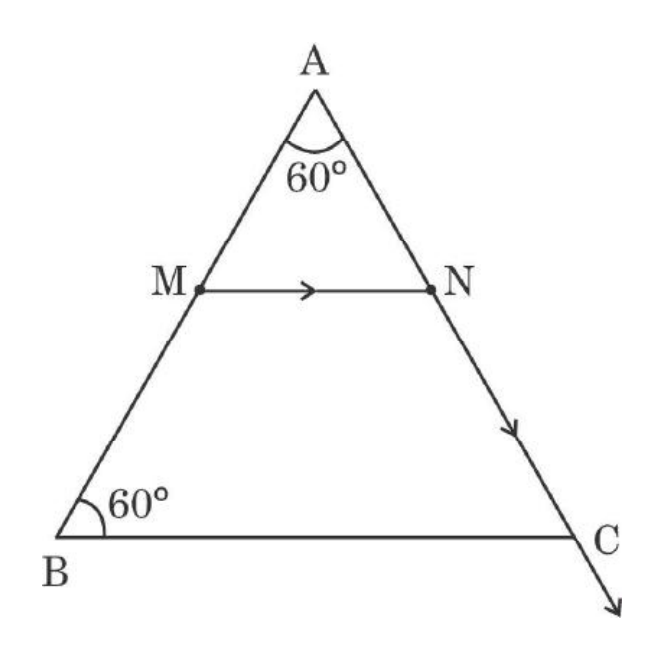 A ray is incident on a prism of material of refractive index $\sqrt{2}$ at point M such that it grazes along NC after emerging from the prism, as shown in the figure.
Find :
(a) the critical angle for the prism.
(b) the angle of refraction at face AB.CBSE 12th Physics 2022 Term 2 Set 55/2/33 marks · Notebook›148(a) Is the speed of light in glass independent of the colour of light ? Give reason.
(b) A small bulb is placed at the bottom of a tank containing water to a depth of $70 \mathrm{~cm}$. Find the area of the surface of water through which light from the bulb can emerge out. Given refractive index of water is $\frac{4}{3}$.CBSE 12th Physics 2022 Term 2 Set 55/2/23 marks · Notebook›149The refractive index of an equilateral triangular prism kept in air is $\sqrt{2}$. Calculate :
(a) the angle of minimum deviation.
(b) the critical angle for the prism.CBSE 12th Physics 2022 Term 2 Set 55/2/23 marks · Notebook›150A point source in air is kept $24 \mathrm{~cm}$ in front of a concave spherical glass surface $\left({ }_{\mathrm{a}} \mu_{\mathrm{g}}=1.5\right)$ and radius of curvature $60 \mathrm{~cm}$. Find the nature of the image formed and its distance from the point source.CBSE 12th Physics 2022 Term 2 Set 55/1/13 marks · Notebook›151Explain with the help of a suitable diagram, the phenomenon on which an optical fibre works. Mention any two uses of optical fibres.CBSE 12th Physics 2022 Term 2 Set 55/1/13 marks · Notebook›152A diver looking up through water $\left(\mu=\frac{4}{3}\right)$ sees the outside world contained in a circular area on the surface of water. If the diver's eyes are $\sqrt{7} \mathrm{~m}$ below the surface of water, then calculate the area of the circle.CBSE 12th Physics 2022 Term 2 Set 55/4/33 marks · Notebook›153
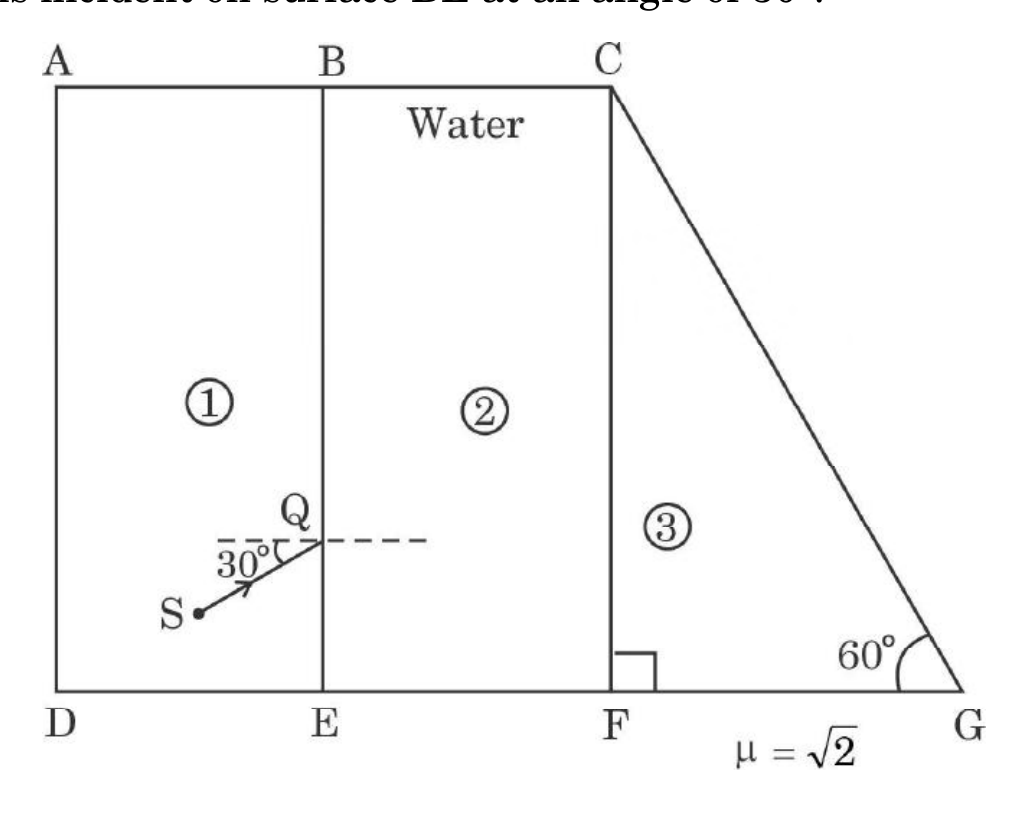 The figure shows a water column BCFE surrounded by two media (1) and (3) of the same refractive index $\sqrt{2}$. A ray of light from a point source S is incident on surface BE at an angle of $30^{\circ}$.
(a) Trace the path of ray through media (2) and (3) as it emerges out of face CG.
(b) Find the angle of emergence at face CG.CBSE 12th Physics 2022 Term 2 Set 55/4/23 marks · Notebook›154(a) (i) Draw a labelled ray diagram showing the formation of the image at infinity by an astronomical telescope.
(ii) A telescope consists of an objective of focal length $150 \mathrm{~cm}$ and an eyepiece of focal length $6.0 \mathrm{~cm}$. If the final image is formed at infinity, then calculate :
(I) the length of the tube in this adjustment, and
(II) the magnification produced.
OR
(b) (i) Draw a labelled ray diagram showing the formation of the image at least distance of distinct vision by a compound microscope.
(ii) A small object is placed at a distance of $3.0 \mathrm{~cm}$ from a magnifier of focal length $4.0 \mathrm{~cm}$. Find :
(I) the position of the image formed, and
(II) the linear magnification produced.CBSE 12th Physics 2022 Term 2 Set 55/4/13 marks · Notebook›155
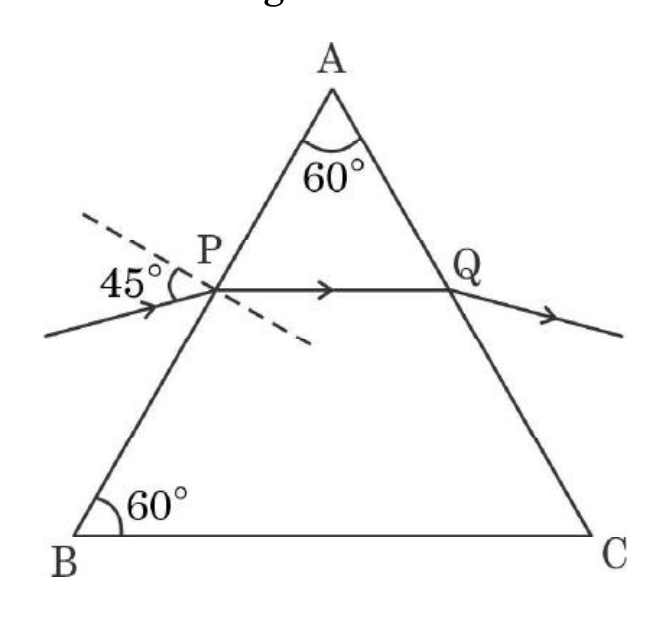 A ray of light is incident on a prism at an angle of $45^{\circ}$ and passes symmetrically as shown in the figure. Calculate :
(a) the angle of minimum deviation,
(b) the refractive index of the material of the prism, and
(c) the angle of refraction at the point P.CBSE 12th Physics 2022 Term 2 Set 55/4/13 marks · Notebook›156Two transparent media of refractive indices $\mathrm{n}_1$ and $\mathrm{n}_2$ are separated by a spherical transparent surface. The rays of light incident on the surface get refracted into the medium on the other side. The laws of refraction are valid at each point of the spherical surface. A lens is a transparent optical medium bounded by two surfaces, at least one of which should be spherical. The focal length of a lens is determined by the radii of curvature $\left(\mathrm{R}_1\right.$ and $\left.\mathrm{R}_2\right)$ of its two surfaces and the refractive index $(\mathrm{n})$ of the medium of the lens with respect to the surrounding medium. Depending on $\mathrm{R}_1$ and $\mathrm{R}_2$, a lens behaves as a diverging or a converging lens. The ability of a lens to diverge or converge a beam of light incident on it defines its power.
(a) An object is placed at the point B as shown in the figure. The object distance (u) and the image distance (v) are related as
(i) $\frac{1}{\mathrm{v}}-\frac{1}{\mathrm{u}}=\left(\frac{\mathrm{n}_2-\mathrm{n}_1}{\mathrm{n}_1}\right) \frac{1}{\mathrm{R}}$
(ii) $\frac{1}{\mathrm{v}}-\frac{1}{\mathrm{u}}=\left(\frac{\mathrm{n}_1-\mathrm{n}_2}{\mathrm{n}_2}\right) \frac{1}{\mathrm{R}}$
(iii) $\frac{\mathrm{n}_2}{\mathrm{v}}-\frac{\mathrm{n}_1}{\mathrm{u}}=\frac{\left(\mathrm{n}_2-\mathrm{n}_1\right)}{\mathrm{R}}$
(iv) $\frac{\mathrm{n}_1}{\mathrm{v}}-\frac{\mathrm{n}_2}{\mathrm{u}}=\frac{\left(\mathrm{n}_1-\mathrm{n}_2\right)}{\mathrm{R}}$
(b) A point object is placed in air at a distance ‘R’ in front of a convex spherical refracting surface of radius of curvature R. If the medium on the other side of the surface is glass, then the image is :
(i) real and formed in glass.
(ii) real and formed in air.
(iii) virtual and formed in glass.
(iv) virtual and formed in air.
(c) An object is kept at 2F in front of an equiconvex lens. The image formed is :
(i) real and of the size of the object.
(ii) virtual and of the size of the object.
(iii) real and enlarged.
(iv) virtual and diminished.
(d) A thin converging lens of focal length $10 \mathrm{~cm}$ and a thin diverging lens of focal length $20 \mathrm{~cm}$ are placed coaxially in contact. The power of the combination is :
(i) $-5 \mathrm{~D}$
(ii) $+5 \mathrm{~D}$
(iii) $+15 \mathrm{~D}$
(iv) $-15 \mathrm{~D}$
(e) An equiconcave lens of focal length ‘f’ is cut into two identical parts along the dotted line as shown in the figure. The focal length of each part will be :
(i) $\frac{\mathrm{f}}{4}$
(ii) $\frac{\mathrm{f}}{2}$
(iii) $\mathrm{f}$
(iv) $2 \mathrm{f}$CBSE 12th Physics 2022 Term 2 Set 55/4/15 marks · Notebook›157
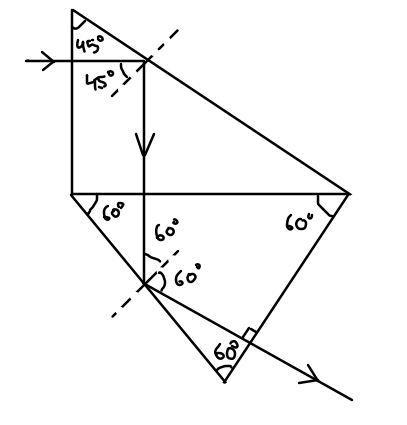 (a) Write two necessary conditions for total internal reflection.
(b) Two prisms ABC and DBC are arranged as shown in figure.
The critical angles for the two prisms with respect to air are $41.1^{\circ}$ and $45^{\circ}$ respectively. Trace the path of the ray through the combination.
OR
(a) An object is placed in front of a converging lens. Obtain the conditions under which the magnification produced by the lens is (i) negative and (ii) positive.
(b) A point object is placed at O in front of a glass sphere as shown in figure.
Show the formation of image by the sphere.CBSE 12th Physics 2022 Term 2 Set 55/3/13 marks · Notebook›158A compound microscope consists of two converging lenses. One of them, of smaller aperture and smaller focal length is called objective and the other of slightly larger aperture and slightly larger focal length is called eye-piece. Both the lenses are fitted in a tube with an arrangement to vary the distance between them. A tiny object is placed in front of the objective at a distance slightly greater than its focal length. The objective produces the image of the object which acts as an object for the eye-piece. The eye piece, in turn produces the final magnified image.
I. In a compound microscope the images formed by the objective and the eye-piece are respectively
(A) virtual, real
(B) real, virtual
(C) virtual, virtual
(D) real, real
II. The magnification due to a compound microscope does not depend upon
(A) the aperture of the objective and the eye-piece
(B) the focal length of the objective and the eye-piece
(C) the length of the tube
(D) the colour of the light used
III. Which of the following is not correct in the context of a compound microscope ?
(A) Both the lenses are of short focal lengths.
(B) The magnifying power increases by decreasing the focal lengths of the two lenses.
(C) The distance between the two lenses is more than (fo + fe).
(D) The microscope can be used as a telescope by interchanging the two lenses.
IV. A compound microscope consists of an objective of 10X and an eye-piece of 20X. The magnification due to the microscope would be
(A) 2
(B) 10
(C) 30
(D) 200
V. The focal lengths of objective and eye-piece of a compound microscope are $1.2 \mathrm{~cm}$ and $3.0 \mathrm{~cm}$ respectively. The object is placed at a distance of $1.25 \mathrm{~cm}$ from the objective. If the final image is formed at infinity, the magnifying power of the microscope would be
(A) 100
(B) 150
(C) 200
(D) 250CBSE 12th Physics 2022 Term 2 Set 55/3/15 marks · Notebook›159With the help of a ray diagram, show how a compound microscope forms a magnified image of a tiny object, at least distance of distinct vision. Hence derive an expression for the magnification produced by it.CBSE 12th Physics 2022 Term 2 Set 55/5/33 marks · Notebook›160(a) (i) Define SI unit of power of a lens.
(ii) A plano convex lens is made of glass of refractive index $1.5$. The radius of curvature of the convex surface is $25 \mathrm{~cm}$.
(ii.i) Calculate the focal length of the lens.
(ii.ii) If an object is placed $50 \mathrm{~cm}$ in front of the lens, find the nature and position of the image formed.
OR
(b) A slit of width $0.6 \mathrm{~mm}$ is illuminated by a beam of light consisting of two wavelengths $600 \mathrm{~nm}$ and $480 \mathrm{~nm}$. The diffraction pattern is observed on a screen $1.0 \mathrm{~m}$ from the slit. Find :
(i) The distance of the second bright fringe from the central maximum pertaining to light of $600 \mathrm{~nm}$.
(ii) The least distance from the central maximum at which bright fringes due to both the wavelengths coincide.CBSE 12th Physics 2022 Term 2 Set 55/5/13 marks · Notebook›161A ray of light passes through a prism of refractive index $\sqrt{2}$ as shown in the figure. Find :
(i) The angle of incidence $\left(\angle \mathrm{r}_2\right)$ at face AC.
(ii) The angle of minimum deviation for this prism.CBSE 12th Physics 2022 Term 2 Set 55/5/13 marks · Notebook›162A ray of light travels from a denser to a rarer medium. After refraction, it bends away from the normal. When we keep increasing the angle of incidence, the angle of refraction also increases till the refracted ray grazes along the interface of two media. The angle of incidence for which it happens is called critical angle. If the angle of incidence is increased further the ray will not emerge and it will be reflected back in the denser medium. This phenomenon is called total internal reflection of light.
(i) A ray of light travels from a medium into water at an angle of incidence of $18^{\circ}$. The refractive index of the medium is more than that of water and the critical angle for the interface between the two media is $20^{\circ}$. Which one of the following figures best represents the correct path of the ray of light ?
(ii) A point source of light is placed at the bottom of a tank filled with water, of refractive index $\mu$, to a depth d. The area of the surface of water through which light from the source can emerge, is :
(a) $\frac{\pi \mathrm{d}^2}{2\left(\mu^2-1\right)}$
(b) $\frac{\pi \mathrm{d}^2}{\left(\mu^2-1\right)}$
(c) $\frac{\pi \mathrm{d}^2}{\sqrt{2} \sqrt{\mu^2-1}}$
(d) $\frac{2 \pi \mathrm{d}^2}{\left(\mu^2-1\right)}$
(iii) For which of the following media, with respect to air, the value of critical angle is maximum ?
(a) Crown glass
(b) Flint glass
(c) Water
(d) Diamond
(iv) The critical angle for a pair of two media A and B of refractive indices $2.0$ and $1.0$ respectively is :
(a) $0^{\circ}$
(b) $30^{\circ}$
(c) $45^{\circ}$
(d) $60^{\circ}$
(v) The critical angle of pair of a medium and air is $30^{\circ}$. The speed of light in the medium is :
(a) $1 \times 10^8 \mathrm{~m} \mathrm{~s}^{-1}$
(b) $1.5 \times 10^8 \mathrm{~m} \mathrm{~s}^{-1}$
(c) $2.2 \times 10^8 \mathrm{~m} \mathrm{~s}^{-1}$
(d) $2.8 \times 10^8 \mathrm{~m} \mathrm{~s}^{-1}$CBSE 12th Physics 2022 Term 2 Set 55/5/15 marks · Notebook›163Find the two possible positions of an object kept in front of a lens of $+5.0 \mathrm{D}$, so that the image formed in both cases is four times magnified.CBSE 12th Physics 2022 Term 2 Set 55/1/23 marks · Notebook›164For a glass prism of refractive index $\sqrt{3}$, the value of angle of minimum deviation $\delta$ is equal to the angle of prism A. Find the angle of prism A. How will the angle $\delta$ be affected if the prism were immersed in water ?CBSE 12th Physics 2022 Term 2 Set 55/1/33 marks · Notebook›165(a) State the conditions for total internal reflection to take place.
(b) A tank is filled with a transparent liquid to height ‘H’. A coin suspended by a thread in the liquid is gradually lowered till it touches the bottom. The apparent depth is determined corresponding to different positions of the coin.
(i) Plot a graph showing variation of the apparent depth with the real depth of the coin.
(ii) What is the physical significance of the slope of the graph ?CBSE 12th Physics 2022 Term 2 Set 55/2/13 marks · Notebook›166(a) Draw a labelled ray diagram showing the formation of an image by an astronomical refracting telescope in normal adjustment. Hence, obtain the expression for its magnifying power.
OR
(b) A plane wavefront of light of wavelength ‘$\lambda$’ is incident normally on a narrow slit of width ‘a’ and a diffraction pattern is observed on a screen at a distance ‘D’ from the slit.
(i) Depict the intensity distribution in the pattern observed.
(ii) Obtain the expression for the first maximum from the central maximum.CBSE 12th Physics 2022 Term 2 Set 55/2/13 marks · Notebook›167A converging lens made of glass $(\mu=1.5)$ has its spherical faces of radii of curvature $10 \mathrm{~cm}$ and $20 \mathrm{~cm}$. Find its focal length
(a) in air, and
(b) when it is immersed in a liquid of refractive index 1.25.CBSE 12th Physics 2022 Term 2 Set 55/2/13 marks · Notebook›168(a) Draw a ray diagram to show the formation of an image at the least distance of distinct vision, by a compound microscope. Hence, obtain an expression for its angular magnification.
OR
(b) Consider a convex spherical surface of radius of curvature R, separating two media of refractive indices $\mathrm{n}_1$ and $\mathrm{n}_2\left(>\mathrm{n}_1\right)$. A point object is placed at a distance u in front of the surface in medium of refractive index $\mathrm{n}_1$. Its real image is formed at a distance v. Obtain a relation between u and v in terms of $\mathrm{n}_1, \mathrm{n}_2$ and R.CBSE 12th Physics 2022 Compartment Set 55/6/13 marks · Notebook›169A lens is a portion of a transparent medium bounded by two surfaces and one of these surfaces is essentially spherical. It is used to converge or diverge the light incident on it. Power of a lens is the measure of its ability to converge or diverge the light incident on it. Power of a lens depends on the refractive index of the material of lens with respect to the surrounding medium and the radii of curvature of its two surfaces.
(a) The power of a convex lens
(i) increases when the lens is dipped in water.
(ii) increases when the wavelength of incident light decreases.
(iii) decreases when another convex lens is placed in contact with it.
(iv) increases when the lens is cut into two identical plano-convex lenses.
(b) The focal length of a concave lens is $40 \mathrm{~cm}$. The power of the lens is :
(i) $0.025 \mathrm{~D}$
(ii) $2.5 \mathrm{~D}$
(iii) $-0.025 \mathrm{~D}$
(iv) $-2.5 \mathrm{~D}$
(c) The focal length of a concave lens $\left(\mu_{\mathrm{g}}=1.5\right)$ in air is $20 \mathrm{~cm}$. What should be the refractive index of the surrounding medium so that the lens behaves as a converging lens of focal length $60 \mathrm{~cm}$ ?
(i) $1.4$
(ii) $1.8$
(iii) $1.7$
(iv) $1.2$
(d) Beams of red light, blue light, yellow light and violet light are incident on a convex lens, one-by-one. Which one of them converges nearest to the lens ?
(i) Blue light
(ii) Violet light
(iii) Red light
(iv) Yellow light
(e) A beam of light coming parallel to the principal axis of a convex lens $\mathrm{L}_1$ of focal length $15 \mathrm{~cm}$ is incident on it. Another convex lens $\mathrm{L}_2$ of focal length $25 \mathrm{~cm}$ is placed coaxially at a distance d from $\mathrm{L}_1$. For the final image to be formed at infinity, the value of d should be :
(i) $10 \mathrm{~cm}$
(ii) $15 \mathrm{~cm}$
(iii) $25 \mathrm{~cm}$
(iv) $40 \mathrm{~cm}$CBSE 12th Physics 2022 Compartment Set 55/6/15 marks · Notebook›