
ExamQuark
Getting things ready
Your next step is almost ready.
Your progress
0
Correct
0
Wrong
0%
Accuracy
0 s
Time spent
—
Percentile
Questions by year
 (a) What are coherent sources ? Why they are necessary for observing stable interference pattern ? Draw a graph showing the variation of intensity of light with the position on the screen in Young’s double-slit experiment.
(b) Find the intensity of light at a point on the screen when two interfering waves of the same intensity $\left(I_0\right)$ have a path difference of (i) $\frac{\lambda}{4}$ and (ii) $\frac{\lambda}{3}$.
OR
(a) Draw a labelled ray diagram of a refracting telescope when it forms image of a distant object at infinity. Derive expression for its magnifying power.
(b) (i) In a telescope the objective has much larger aperture than the eye piece. Why ?
(ii) Write two advantages of reflecting telescope over refracting telescope.CBSE 12th Physics 2026 Set 55/2/15 marks · Notebook›7A ray of monochromatic light travelling in air is incident on a glass slab and is partly reflected and partly refracted. Both the reflected and refracted lights will have :CBSE 12th Physics 2026 Set 55/3/3MCQ›8In Young's double slit experiment, the central maximum is bright in the interference pattern obtained on a screen. What will happen when :
(a) light waves emitted out of slits $S_1$ and $S_2$ have an initial phase difference of $\pi$ radian ?
(b) one of the slits is closed ?
Justify your answers.CBSE 12th Physics 2026 Set 55/3/32 marks · Notebook›9(a) State Huygens principle. How did Huygens justify the absence of the backwave on a spherical wavefront ?
OR
(b) In a single-slit diffraction experiment, light of wavelength $\lambda$ illuminates the slit of width ‘$a$’. The diffraction pattern is observed on a screen kept at a distance $D$ from the slits.
(i) Depict variation of intensity in the fringe pattern with the angular position of the fringes.
(ii) How is the linear width of central maximum affected when separation between the slit and the screen is decreased ?CBSE 12th Physics 2026 Set 55/4/12 marks · Notebook›10The phenomenon of interference is shown byCBSE 12th Physics 2026 Set 55/1/3MCQ›11Assertion (A) : In Young’s double-slit experiment, the fringe width for dark and bright fringes is the same.
Reason (R) : Fringe width is given by $\beta=\frac{\lambda D}{d}$, where symbols have their usual meanings.CBSE 12th Physics 2026 Set 55/5/1MCQ›12
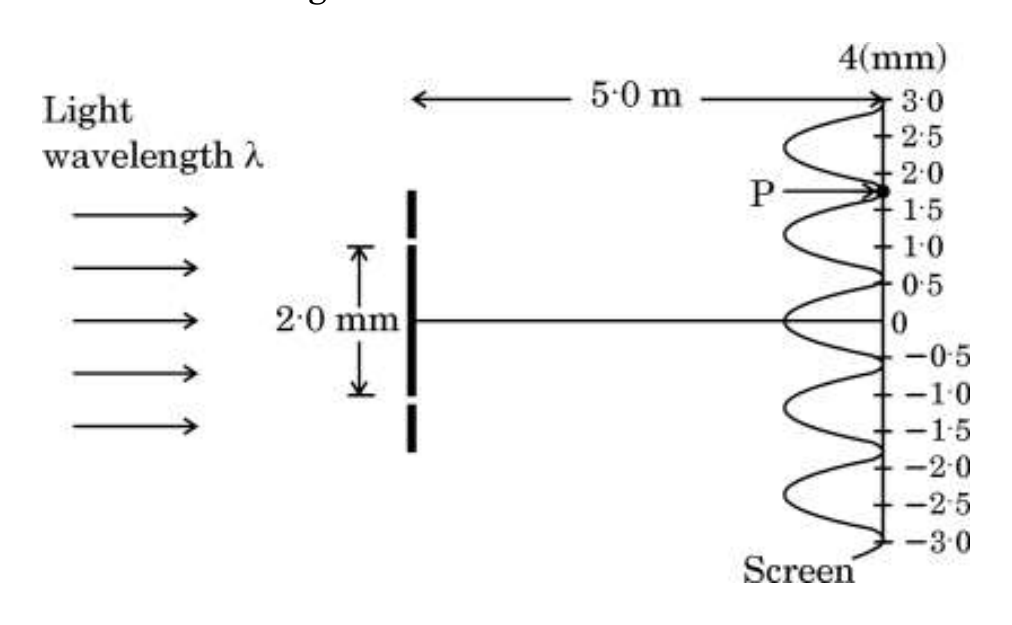 In a Young’s double-slit experiment, the two slits behave as coherent sources. When coherent light waves superpose over each other they create an interference pattern of successive bright and dark regions due to constructive and destructive interference.
Two slits $2 \mathrm{~mm}$ apart are illuminated by a source of monochromatic light and the interference pattern is observed on a screen $5.0 \mathrm{~m}$ away from the slits as shown in the figure.
(i) What property of light does this interference experiment demonstrate ?
(A) Wave nature of light
(B) Particle nature of light
(C) Transverse nature of light
(D) Both wave nature and transverse nature of light
(ii) (a) The wavelength of light used in this experiment is :
(A) $720 \mathrm{~nm}$
(B) $590 \mathrm{~nm}$
(C) $480 \mathrm{~nm}$
(D) $364 \mathrm{~nm}$
OR
(b) The fringe width in the interference pattern formed on the screen is :
(A) $1.2 \mathrm{~mm}$
(B) $0.2 \mathrm{~mm}$
(C) $4.2 \mathrm{~mm}$
(D) $6.8 \mathrm{~mm}$
(iii) The path difference between the two waves meeting at point P, where there is a minimum in the interference pattern is :
(A) $8.1 \times 10^{-7} \mathrm{~m}$
(B) $7.2 \times 10^{-7} \mathrm{~m}$
(C) $6.5 \times 10^{-7} \mathrm{~m}$
(D) $6.0 \times 10^{-7} \mathrm{~m}$
(iv) When the experiment is performed in a liquid of refractive index greater than 1, then fringe pattern will :
(A) disappear
(B) become blurred
(C) be widened
(D) be compressedCBSE 12th Physics 2026 Set 55/5/14 marks · Notebook›13
 (a) (i) A parallel beam of monochromatic light falls normally on a single slit of width ‘a’ and a diffraction pattern is observed on a screen placed at distance D from the slits. Explain :
(I) the formation of maxima and minima in the diffraction pattern, and
(II) why the maxima go on becoming weaker and weaker with its increasing number (n).
(ii) Write any two points of difference between interference pattern due to double-slit and diffraction pattern due to single-slit.
OR
(b) (i) With the help of a ray diagram, describe the construction and working of a compound microscope.
(ii) (I) The real image of an object placed between f and 2f from a convex lens can be seen on a screen placed at the image location. If the screen is removed, is the image still there ? Explain.
(II) Plane and convex mirrors produce virtual images of objects. Can they produce real images under some circumstances ? Explain.CBSE 12th Physics 2026 Set 55/5/15 marks · Notebook›14In a Young’s double-slit experiment, two waves each of intensity I superpose each other and produce an interference pattern. Prove that the resultant intensities at maxima and minima are 4 I and zero respectively.CBSE 12th Physics 2026 Set 55/5/22 marks · Notebook›15In an interference pattern, 10 fringes are obtained over a certain distance from its central maximum with light of wavelength $480 \mathrm{~nm}$. The number of fringes obtained over the same distance with light of wavelength $600 \mathrm{~nm}$ with be :CBSE 12th Physics 2026 Compartment Set 55/7/2MCQ›16The shape of the interference fringes in Young’s double-slit experiment, when the distance between the slit and the screen is very large as compared to the slit-separation, is nearlyCBSE 12th Physics 2026 Set 55/1/1MCQ›17Four independent waves are expressed as
(i) $y_1=A_1 \sin \omega t$
(ii) $y_2=A_2 \sin 2 \omega t$
(iii) $y_3=A_3 \cos \omega t$
(iv) $y_4=A_4 \sin (\omega t+\pi / 3)$
The interference between two of these waves is possible inCBSE 12th Physics 2026 Set 55/1/1MCQ›18(a) A beam of light consisting of two wavelengths $400 \mathrm{~nm}$ and $600 \mathrm{~nm}$ is used to illuminate a single slit of width $1 \mathrm{~mm}$. Find the least distance of the point from the central maximum where the dark fringes due to both wavelengths coincide on the screen placed $1.5 \mathrm{~m}$ from the slit.
OR
(b) In a Young’s double-slit experimental set-up with slit separation $0.6 \mathrm{~mm}$ a beam of light consisting of two wavelengths $440 \mathrm{~nm}$ and $660 \mathrm{~nm}$ is used to obtain interference pattern on a screen kept $1.5 \mathrm{~m}$ in front of the slits. Find the least distance of the point from the central maximum where the bright fringes due to both the wavelengths coincide.CBSE 12th Physics 2026 Set 55/1/12 marks · Notebook›19When the distance between the slit and screen is doubled, the angular separation between two fringes in single-slit diffraction experiment will :CBSE 12th Physics 2026 Compartment Set 55/7/3MCQ›
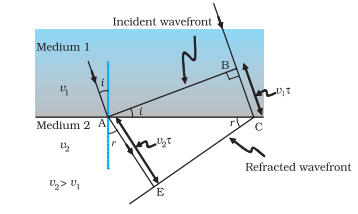 Show the refraction of light wave at a plane interface using Huygens’ principle and prove Snell’s law.CBSE 12th Physics 2025 Set 55/2/22 marks · Notebook›43In a Young's double-slit experiment, the intensity at the central maximum in the interference pattern on the screen is $I_0$. Find the intensity at a point on the screen where the path difference between the interfering waves is $\frac{\lambda}{6}$.CBSE 12th Physics 2025 Set 55/7/32 marks · Notebook›44Write two differences in the patterns of double-slit interference experiment and single-slit diffraction experiment.
Light waves from two pinholes illuminated by two sodium lamps do not produce interference patterns. Explain why.CBSE 12th Physics 2025 Set 55/7/12 marks · Notebook›
 (a) (i) A plane light wave propagating from a rarer into a denser medium, is incident at an angle $i$ on the surface separating two media. Using Huygen's principle, draw the refracted wave and hence verify Snell's law of refraction.
(ii) In a Young's double slit experiment, the slits are separated by 0.30 mm and the screen is kept 1.5 m away. The wavelength of light used is 600 nm . Calculate the distance between the central bright fringe and the $4^{\text {th }}$ dark fringe.
OR
(b) (i) Discuss briefly diffraction of light from a single slit and draw the shape of the diffraction pattern.
(ii) An object is placed between the pole and the focus of a concave mirror. Using mirror formula, prove mathematically that it produces a virtual and an enlarged image.CBSE 12th Physics Delhi Set 1 - 20245 marks · Notebook›48Assertion (A) : In interference and diffraction of light, light energy reduces in one region producing a dark fringe. It increases in another region and produces a bright fringe.
Reason (R) : This happens because energy is not conserved in the phenomena of interference and diffraction.CBSE 12th Physics 2024 Set 55/4/1MCQ›49(a) Two waves, each of amplitude ‘$a$’ and frequency ‘$\omega$’ emanating from two coherent sources of light superpose at a point. If the phase difference between the two waves is $\phi$, obtain an expression for the resultant intensity at that point.
OR
(b) What is the effect on the interference pattern in Young’s double-slit experiment when (i) the source slit is moved closer to the plane of the slits, and (ii) the separation between the two slits is increased ? Justify your answers.CBSE 12th Physics 2024 Set 55/2/12 marks · Notebook›50(a) (i) Give any two differences between the interference pattern obtained in Young’s double-slit experiment and a diffraction pattern due to a single slit.
(ii) Draw an intensity distribution graph in case of a double-slit interference pattern.
(iii) In Young’s double-slit experiment using monochromatic light of wavelength $\lambda$, the intensity of light at a point on the screen, where path difference is $\lambda$, is $K$ units. Find the intensity of light at a point on the screen where the path difference is $\frac{\lambda}{6}$.
OR
(b) (i) Draw a labelled ray diagram of a compound microscope showing image formation at least distance of distinct vision. Derive an expression for its magnifying power.
(ii) A telescope consists of two lenses of focal length $100 \mathrm{~cm}$ and $5 \mathrm{~cm}$. Find the magnifying power when the final image is formed at infinity.CBSE 12th Physics 2024 Set 55/2/15 marks · Notebook›51Diffraction and interference are closely related phenomena that occur together. Diffraction is the phenomenon of bending of light around the edges of the obstacle, while interference is the combination of waves that results in a new wave pattern. In order to get interference, there must be at least two waves that are diffracting. So while diffraction can occur without interference, interference cannot occur without diffraction.
Two slits of width $2 \mu \mathrm{m}$ each in an opaque material are separated by a distance of $6 \mu \mathrm{m}$. Monochromatic light of wavelength $450 \mathrm{~nm}$ is incident normally on the slits. One finds a combined interference and diffraction pattern on the screen.
(i) The number of peaks of the interference fringes formed within the central peak of the envelope of the diffraction pattern will be :
(A) 2
(B) 3
(C) 4
(D) 6
(ii) The number of peaks of the interference formed if the slit width is doubled while keeping the distance between the slits same will be :
(A) 1
(B) 2
(C) 3
(D) 4
(iii) (a) If instead of $450 \mathrm{~nm}$ light, another light of wavelength $680 \mathrm{~nm}$ is used, number of peaks of the interference formed in the central peak of the envelope of the diffraction pattern will be :
(A) 2
(B) 4
(C) 6
(D) 9
OR
(b) Consider the diffraction of light by a single slit described in this case study. The first minimum falls at an angle $\theta$ equal to :
(A) $\sin ^{-1}(0.12)$
(B) $\sin ^{-1}(0.225)$
(C) $\sin ^{-1}(0.32)$
(D) $\sin ^{-1}(0.45)$
(iv) The number of bright fringes formed due to interference on $1 \mathrm{~m}$ of screen placed at $\frac{4}{3} \mathrm{~m}$ away from the slits is :
(A) 2
(B) 3
(C) 6
(D) 10CBSE 12th Physics 2024 Set 55/3/14 marks · Notebook›52What is a sustained or stable interference pattern ? What are the conditions for obtaining such an interference pattern ?CBSE 12th Physics 2024 Set 55/3/32 marks · Notebook›53Write two points of difference between interference and diffraction of light.CBSE 12th Physics 2024 Set 55/3/22 marks · Notebook›54In a Young’s double-slit experiment in air, the fringe width is found to be $0.44 \mathrm{~mm}$. If the entire setup is immersed in water $\left(n=\frac{4}{3}\right)$, the fringe width will beCBSE 12th Physics 2024 Set 55/5/2MCQ›55
 State Huygens principle. Using it draw a diagram showing the details of passage of a plane wave from a denser into a rarer medium.CBSE 12th Physics 2024 Compartment Set 55/S/12 marks · Notebook›56(a) A ray of light is incident on a surface separating air from a denser medium A of refractive index $\mu_1$. It is then made incident on the parallel surface of another medium B of refractive index $\mu_2$ at the same angle of incidence. If the angle of refraction in the two media are $30^{\circ}$ and $35^{\circ}$ respectively, then in which one of the two media (A or B) will light travel faster and why ?
(b) The intensity of the two interfering waves in Young's double slit experiment is $I_0$ each. Find the intensity at a point on the screen where path difference between the interfering waves is (i) $\frac{\lambda}{2}$, and (ii) $\frac{\lambda}{3}$.CBSE 12th Physics 2024 Compartment Set 55/S/13 marks · Notebook›
 (a) A plane wave-front propagating in a medium of refractive index '$$\mu_1$$' is incident on a plane surface making an angle of incidence (i). It enters into a medium of refractive index $$\mu_2\left(\mu_2>\mu_1\right)$$. Use Huygen's construction of secondary wavelets to trace the retracted wave-front. Hence, verify Snell's law of refraction.
OR
Using Huygen's construction, show how a plane wave is reflected from a surface. Hence, verify the law of reflection.CBSE 12th Physics Delhi Set 1 - 20233 marks · Notebook›60A beam of light travels from air into a medium. Its speed and wavelength in the medium are $$1.5 \times 10^8\mathrm{ms}^{-1}$$ and $$230 \mathrm{~nm}$$ respectively. The wavelength of light in air will beCBSE 12th Physics Outside Delhi Set 1 - 2023MCQ›61Assertion (A) : In Young's double slit experiment all fringes are of equal width.
Reason (R) : The fringe width depends upon wavelength of light $$(\lambda)$$ used, distance of screen from plane of slits (D) and slits separation (d).CBSE 12th Physics Outside Delhi Set 1 - 2023MCQ›62What happens to the interference pattern when two coherent sources are
(a) infinitely close, and
(b) far apart from each otherCBSE 12th Physics Outside Delhi Set 1 - 20232 marks · Notebook›63(a) (i) State Huygen's principle. With the help of a diagram, show how a plane wave is reflected from a surface. Hence, verify the law of reflection.
(ii) A concave mirror of focal length $$12 \mathrm{~cm}$$ forms a three times magnified virtual image of an object. Find the distance of the object from the mirror.
OR
(b) (i) Draw a labelled ray diagram showing the image formation by a refracting telescope. Define its magnifying power. Write two limitations of a refracting telescope over a reflecting telescope.
(ii) The focal lengths of the objective and the eyepiece of a compound microscope are $$1.0 \mathrm{~cm}$$ and $$2.5 \mathrm{~cm}$$ respectively. Find the tube length of the microscope for obtaining a magnification of 300.CBSE 12th Physics Outside Delhi Set 1 - 20235 marks · Notebook›64In a Young’s double slit experiment, the separation between the two slits is $d$ and distance of the screen from the slits is $1000 d$. If the first minima falls at a distance $d$ from the central maximum, obtain the relation between $d$ and $\lambda$.CBSE 12th Physics 2023 Set 55/2/22 marks · Notebook›65In Young's double-slit experiment, the intensity on the screen is $I_0$ at a point where path difference is $\lambda$. The intensity at the point where path difference is $\frac{\lambda}{4}$ is :CBSE 12th Physics 2023 Compartment Set 55/C/1MCQ›66(a) (i) In which case is diffraction effect more dominant — slit formed by 2 blades or slit formed by two fingers ?
(ii) Yellow light $(\lambda=6000 \mathrm{~\mathring{A}})$ illuminates a single slit of width $1 \times 10^{-4} \mathrm{~m}$. Calculate (i) the distance between two dark lines on either side of central maximum, in the diffraction pattern observed on a screen kept $1.5 \mathrm{~m}$ away from the slit, and (ii) the angular spread of the first minimum.
OR
(b) (i) What will be the colour of the central bright fringe in Young's double slit experiment if the monochromatic source is replaced by a source of white light ? Give reason for your answer.
(ii) In Young's double slit experiment, the slits are separated by $0.3 \mathrm{~mm}$ and the screen is placed $1.5 \mathrm{~m}$ away from the slits. The distance between the central bright fringe and the sixth bright fringe is found to be $1.8 \mathrm{~cm}$. Find the wavelength of light used in the experiment.CBSE 12th Physics 2023 Compartment Set 55/C/13 marks · Notebook›67Assertion (A) : The phase difference between any two points on a wavefront is zero.
Reason (R) : All points on a wavefront are at the same distance from the source and thus oscillate in the same phase.CBSE 12th Physics 2023 Set 55/1/1MCQ›68(a) Using Huygens’ principle, draw a ray diagram showing the propagation of a plane wave refracting at a plane surface separating two media. Also verify Snell’s law of refraction.
OR
(b) Why is a reflecting telescope preferred over a refracting telescope ? Justify your answer giving two reasons.CBSE 12th Physics 2023 Set 55/1/12 marks · Notebook›69Two coherent monochromatic light beams of intensities $I$ and $4 I$ superpose each other. Find the ratio of maximum and minimum intensities in the resulting beam.CBSE 12th Physics 2023 Set 55/1/12 marks · Notebook›70
 (a) (i) (1) Write two points of difference between an interference pattern and a diffraction pattern.
(2) Name any two factors on which the fringe width in a Young’s double-slit experiment depends.
(ii) In Young’s double-slit experiment, the two slits are separated by a distance equal to 100 times the wavelength of light that passes through the slits. Calculate :
(1) the angular separation in radians between the central maximum and the adjacent maximum.
(2) the distance between these two maxima on a screen $50 \mathrm{~cm}$ from the slits.
OR
(b) (i) A spherical surface of radius of curvature $R$ separates two media of refractive indices $n_1$ and $n_2$. A point object is placed in front of the surface at distance $u$ in medium of refractive index $n_1$ and its image is formed by the surface at distance $v$, in the medium of refractive index $n_2$. Derive a relation between $u$ and $v$.
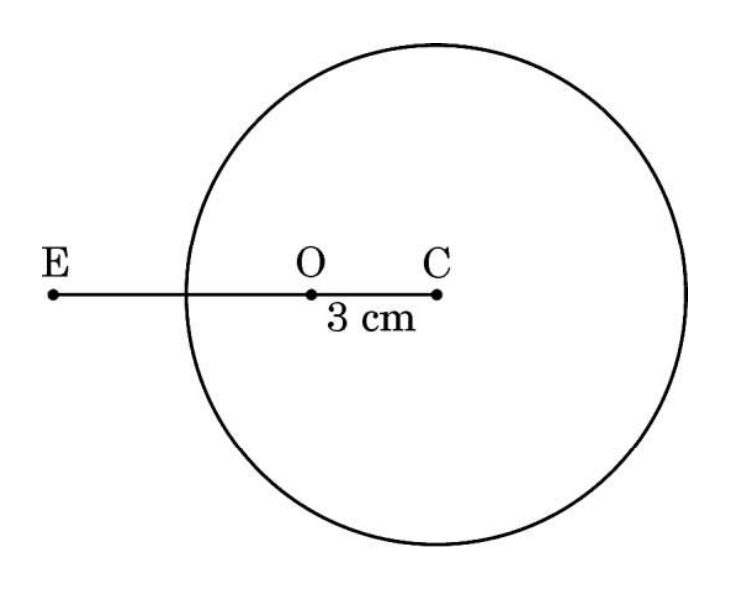
(ii) A solid glass sphere of radius $6.0 \mathrm{~cm}$ has a small air bubble trapped at a distance $3.0 \mathrm{~cm}$ from its centre C as shown in the figure. The refractive index of the material of the sphere is $1.5$. Find the apparent position of this bubble when seen through the surface of the sphere from an outside point E in air.CBSE 12th Physics 2023 Set 55/1/15 marks · Notebook›71In an interference experiment, third bright fringe is obtained at a point on the screen with a light of $700 \mathrm{~nm}$. What should be the wavelength of the light source in order to obtain the fifth bright fringe at the same point ?CBSE 12th Physics 2023 Set 55/5/3MCQ›72In the wave picture of light, the intensity $I$ of light is related to the amplitude $A$ of the wave as :CBSE 12th Physics 2023 Set 55/3/1MCQ›73In a single-slit diffraction experiment, the width of the slit is halved. The width of the central maximum, in the diffraction pattern, will become :CBSE 12th Physics 2023 Set 55/3/1MCQ›74(a) State Huygens’ principle. How did Huygens explain the absence of the backwave ?
OR
(b) Use Huygens’ principle to show reflection/refraction of a plane wave by (i) concave mirror, and (ii) a convex lens.CBSE 12th Physics 2023 Set 55/3/12 marks · Notebook›75Diffraction of light is bending of light around the corners of an object whose size is comparable with the wavelength of light. Diffraction actually defines the limits of ray optics. This limit for optical instruments is set by the wavelength of light. An experimental arrangement is set up to observe the diffraction pattern due to a single slit.
Answer the following questions based on the above :
(a) How will the width of central maximum be affected if the wavelength of light is increased ?
(b) Under what condition is the first minimum obtained ?
(c) Write two points of difference between interference and diffraction patterns.
OR
(c) Two students are separated by a $7 \mathrm{~m}$ partition wall in a room $10 \mathrm{~m}$ high. If both light and sound waves can bend around obstacles, how is it that the students are unable to see each other even though they can converse easily ?CBSE 12th Physics 2023 Set 55/3/14 marks · Notebook›76In a Young’s double-slit experiment, the fringe width is found to be $\beta$. If the entire apparatus is immersed in a liquid of refractive index $\mu$, the new fringe width will be :CBSE 12th Physics 2023 Set 55/4/1MCQ›77(a) (i) In diffraction due to a single slit, the phase difference between light waves reaching a point on the screen is $5 \pi$. Explain whether a bright or a dark fringe will be formed at the point.
(ii) What should the width $(a)$ of each slit be to obtain eight maxima of two double-slit patterns (slit separation $d$) within the central maximum of the single slit pattern ?
(iii) Draw the plot of intensity distribution in a diffraction pattern due to a single slit.
OR
(b) (i) In a Young’s double-slit experiment $S S_2-S S_1=\frac{\lambda}{4}$, where $S_1$ and $S_2$ are the two slits as shown in the figure. Find the path difference $\left(S_2 P-S_1 P\right)$ for constructive and destructive interference at P.
(ii) What is the effect on the interference fringes in a Young’s double-slit experiment, if the monochromatic source S is replaced by a source of white light ?CBSE 12th Physics 2023 Set 55/4/13 marks · Notebook›